The Truth About Muhammad
By Jamie Glazov
http://www.FrontPageMag.com
November 2, 2006
Frontpage Interview’s guest today is Robert Spencer, a scholar of Islamic history, theology, and law and the director of Jihad Watch. He is the author of six books, seven monographs, and hundreds of articles about jihad and Islamic terrorism, including Islam Unveiled: Disturbing Questions About the World’s Fastest Growing Faith and the New York Times Bestseller The Politically Incorrect Guide to Islam (and the Crusades). He is the author of the new book, The Truth About Muhammad.
FP: Robert Spencer, it is a pleasure to have you back at Frontpage Interview.
Spencer: Thank you for inviting me.
FP: So tell us what inspired you to write The Truth About Muhammad. In your book, you discuss why you didn’t want to write it at first. How come?
Spencer: I was inspired to write this book by a phenomenon I have observed many times over the years: moderate Muslims would invoke Muhammad's example in arguing that Muslims should become more peaceful, and jihadists would invoke his example also, but to justify their acts of violence. I give some examples of this in the book's first chapter.
This is a very important question, for since Muslims traditionally have looked to Muhammad as the supreme example for human behavior (cf. Qur'an 33:21), what he was really like according to the sources Muslims themselves consider reliable will reveal a great deal about what non-Muslims can realistically expect in the long term from the Islamic world and the American Muslim community.
Meanwhile, the prevailing assumption among policymakers and the mainstream media is that Islam is fundamentally peaceful. Since a range of American policies are based on this assumption, I thought it useful to examine the origins of Islam and the character of its founder -- again, strictly according to the texts Muslims consider most reliable -- in order to determine how Muslims themselves who take such texts seriously regard their obligations as believers. This will illuminate a great deal about the readiness of Islamic nations and groups to make common cause and form lasting alliances with America and the West.
FP: Before we continue, it is crucial to emphasize that there are obviously many sincere, knowledgeable Muslims, such as Irshad Manji, Thomas Haidon, Kamal Nawash, Sheikh Palazzi, etc., who do not fall into the categories of some of the things we will be talking about. There are many moderate Muslim reformers who represent the best hope for the future of Islam; they are our allies and we have a huge stake in supporting them.
As you yourself have also pointed out, the problem we face in the Islamic world today is not necessarily Muslims per se, but what Islam teaches. Crystallizing the ingredients of Islam that may give rise to Islamic terrorism is the best weapon with which we can arm Muslim moderates and reformers who are fighting to democratize and modernize their religion.
Now having said that, I would like to move to an issue that has been of great interest to me. Your book is based on Islamic sources – sources, in other words, that many Muslims believe to be reliable and legitimate. So kindly explain the following phenomeon:
I have had an infinite amount of conversations with various Muslims in which many of the ingredients of Muhammad’s life are denied. For instance, numerous Muslims have told me, emphatically, that Muhammad was not a military man and never touched the hair on one person’s head. They emphasize that he only preached and practised peace. They look completely mystified and alarmed when I tell them about, for instance, the massacre of the Jewish tribe, Banu Qurayzah, and they tell me that this either never happened or that I am mistaken in one way or another. And they do this with tremendous anger.
Yet these are all facts. Facts, which you demonstrate, that are in the Qur’an and a hadith.
So what am I missing here? Do many Muslims themselves know nothing about their own Prophet? Or are they pretending they don’t know?
Spencer: Yes, I relied on Muhammad's earliest Muslim biographers, Ibn Ishaq and Ibn Sa'd, as well as the great muhaddithin Bukhari and Muslim. I also give numerous examples in the book of Muslims themselves referring to the accounts of Muhammad that I detail in the book -- showing that they themselves take for granted that these things happened.
In doing this, I have tried to perform a service for sincere Muslim reformers. After all, there can be no reform without a thorough and searching acknowledgment of what within Islam actually needs reforming. I have focused on a few of those elements of Islam in this book.
Nevertheless, I have many times encountered the phenomenon to which you refer. Just a few days ago I received an acrimonious email from a prominent moderate Muslim spokesman whose writings have been featured in FrontPage. He accused me of "shameless lies" for reporting that Muhammad married his daughter-in-law. Of course, this incident is referred to obliquely in the Qur'an (33:37), as well as in the hadith collection of Bukhari, the writings of the historian Tabari, the Qur'an commentary Tafsir al-Jalalayn, and other Islamic sources.
When I noted this, the spokesman called me an idiotic liar and heaped scorn on my invoking Tabari, whom he claimed was unreliable. He didn't say anything about Bukhari or Tafsir al-Jalalayn. Nor did he address the fact that apologists such as Karen Armstrong and Muhammad Husayn Haykal, as well as Maxime Rodinson and the Muslim convert Martin Lings and others also, use Tabari in their books about Muhammad. Haykal takes for granted that the daughter-in-law incident took place, and comes up with various apologetic explanations for it.
Meanwhile, this Muslim moderate has informed me that he is working on a piece attacking me and my work, which I expect to be as hostile, confused and disingenuous as his emails. But I mention this curious incident now because it is indicative of a tendency: the denial, the indignation, and the charges of ignorance and ill will have become the dispiritingly common ways in which all too many Muslim spokesmen respond to those who merely point out various aspects of Islamic tradition that make them uncomfortable.
Instead of working in constructive ways for reform, they prefer to demonize and vilify those who bring such material to light -- as if I really did make up the incident in which Muhammad married his daughter-in-law and somehow, through my black Zionist arts, made millions of Muslims believe it.
FP: So why is it that the reaction to your book from the Islamic world is primarily filled with insults at best and death threats at worst? Where is the tradition to actually counter with scholarship and argumentation for an honest and meticulous diagnosis of Muhammad’s life? Why do so many Muslims not embrace a close scrutiny of their Prophet’s life to get to the truth of who he actually was?
Even more curious is how many Muslims insist that their religion is about peace and yet, upon others’ disagreement, they become violent. What just happened with the Pope is a perfect example. Muslims get outraged that an implication has been made that their religion is one of violence, but then they react to this supposed defamation of their religion, and of their Prophet, by threatening and perpetrating violence.
What is the logic here?
I have myself received several death threats over the years from certain Muslims. Paradoxically, these death threats were preceded, in almost every case, with the perpetrator of the threat trying to insist to me that Islam is a religion of peace. This is how it would go: I get an email from a Muslim reprimanding me for some kind of comment or argument I made about Islam having a tenet of violence. The writer insists to me that Islam is a religion of peace. I respond by asking about and referring to the verses in the Qur’an that promote violence (i.e. 9:5). Then, within two or three exchanges, I start getting threatening emails – from the same individual who started out telling me that Islam is a religion of peace.
It is somewhat of a bizarre and tragic comedy, no?
Spencer: Yes it is, Jamie. In fact, the same bizarre and tragicomedy recently played out for me. I recently received several death threats from a Muslim who claimed that somehow I had insulted Islam by writing this biography of Muhammad. In one of them, he insisted that Islam was a religion of peace:
“I am coming to America to hunt down spencer. Very soon he will be delivered!"I will be violent against anyone who hurts muslim feelings about Prophet."It is a religion of peace for everyone until some duckhead sprews out his damn saliva on a senstive topic as this. Spencer will be delivered."He will be killed for sure. Tell you FBI and CIA. You dont know muslims. They will rip apart US you know why? because America has insulted their religion.”
I have come to expect this kind of furious reaction even from Muslims who don't threaten my life, but I have to say that it has been somewhat disappointing. When I first began to do this work publicly and published my first book, Islam Unveiled, I assumed that some thoughtful Muslim would deal with the questions I raised in it in the spirit in which they were offered, and map out a path by which the violent elements of Islamic teaching could be mitigated. Today I am no longer so naive.
FP: So let’s explore a bit of the psychology of many Muslim believers and their attitude toward Mohammed and supposed blasphemy etc. I am a bit puzzled by certain aspects of it.
For instance, I am a person of the Christian faith. I must say that if someone in my presence started making fun of Jesus or ridiculed him in some way – and started desecrating a Bible in front of me, I might be a bit taken aback or maybe slightly bruised in one way or another, but overall I wouldn’t really be too interested. Yes, it would be a shame that the Bible was desecrated. But in the end I didn’t do it. The desecrator did. Yes, I would most likely try to protect the Bible, and I would also say what I consider to be the truth about Jesus. But overall, whatever the turnout, I wouldn’t be severely traumatized and enraged, let alone out for blood, after such an episode.
All in all, in this portrait I paint, it is that person’s business what he is doing and thinking. If anything, I would probably just think he is a loser. And this person will deal with what he has done, said and thought in his own journey and in his own hour of judgment when it comes. His soul is not my soul. His business is his business and my business is my own. I wouldn’t lose too much sleep over it, aside from maybe if I cared for him and was concerned for him.
I obviously do not speak for all Christians in my disposition toward these things, but overall there appears to be a substantial amount of tolerance and comfort in the Christian world in relation to non-Christian thought and anti-Christian ridicule – and also a certain awareness of private business. In Christianity there are boundaries between what people think, in the sense that there are notions of individuality, privacy and personal conscience, which appear to be almost non-existent in the Muslim religion and culture. This is in terms of the picture that many Muslims themselves present to us (i.e. the demonstrations and threats over the cartoons, the Pope’s statements, etc.)
Overall, I guess my point is that if someone engages in blasphemy in regards to my own religion, my mindset is that, if there is some kind of price to be paid for it, he will pay it. Why I am supposed to fly into a furious rage and start threatening or trying to kill someone and/or screaming with rage at some kind of demonstration is completely beyond me.
Can you enlighten me on the psychology here?
Spencer: Jamie, you're articulating one of the fundamental differences between the Christian and Islamic traditions. In Christianity, vengeance belongs to God only: "Vengeance is mine, says the Lord; I will repay" (Romans 12:19). But in Islam, the faithful are commanded to take revenge, for Allah will repay the offenders by means of the Muslim warriors: "Will ye not fight people who violated their oaths, plotted to expel the Messenger, and took the aggressive by being the first (to assault) you? Fight them, and Allah will punish them by your hands, cover them with shame" (Qur'an 9:13-14). So in the first place, it is much more acceptable within an Islamic context than within a Christian one to avenge a wrong, and in Islam blaspheming or insulting the Prophet is a very serious wrongdoing.
Muhammad himself also sets an example for Muslims in this. He ordered the assassinations of several people who had dared to mock him and his prophetic pretensions - notably, two poets, Abu 'Afak and 'Asma bint Marwan. Abu 'Afak was reputed to be over one hundred years old, and had dared to criticize in verse Muhammad's killing of another of his opponents. Muhammad asked his men, "Who will deal with this rascal for me?" He found a ready volunteer in a young Muslim named Salim bin 'Umayr, who dispatched the old poet as he lay sleeping. 'Asma bint Marwan, a poetess, was incensed when she heard of the murder of Abu 'Afak. She wrote verses denigrating the men of Medina for obeying "a stranger who is none of yours," and asked, "Is there no man of pride who would attack him by surprise and cut off the hopes of those who expect aught from him?"
When Muhammad heard of this, he looked to strike first, asking for a volunteer to kill her: "Who will rid me of Marwan's daughter?" A Muslim named 'Umayr bin 'Adiy al-Khatmi took the job, and killed her along with her unborn child that very night. But after he had done the deed, 'Umayr began to worry that perhaps he had committed a grave sin. Muhammad reassured him:
"You have helped God and His apostle, O 'Umayr!" But would he incur punishment?"
Two goats," replied the Prophet of Islam, "won't butt their heads about her."
The men of 'Asma bint Marwan's tribe, the Banu Khatma, "saw the power of Islam" in her killing - so says Muhammad's first biographer, Ibn Ishaq. They duly acknowledged Muhammad as the Prophet of Allah (Ibn Ishaq, 675-676).
Muslims who claim that the killing of 'Asma bint Marwan was justified by her attempting to rally the men of Medina against Muhammad cannot make the same claim about the killing of Abu 'Afak. In any case, in these incidents, Muhammad, the "excellent example of conduct" (Qur'an 33:21), sets a precedent for his followers which we see working out in our own day with the international riots and killings over the Danish cartoons of Muhammad and the Pope's remarks: perceived insults are to be punished with death. No quarter given.
FP: Ok, fair enough, this is the ideological foundation perhaps, the teaching and example on the issue of punishment for dissent or criticism or whatever. But I am also prying more into the psychology.
There appears to be a general rage, and a general incapacity to hear other voices, in this mindset we are talking about. Aside from what the radicalized Muslim believes is the right thing to do, he is often himself seething with anger and ready to inflict violence at every moment’s turn.
Is this lust for violence and incapacity to hear other voices other than one’s own, perhaps connected to the non-existence of freedom and joy within the culture that much of Islam has engendered? So much is forbidden, and so many of the cultures are so devoid of entertainment and fun, that the only freedom becomes to punish others with violence?
Spencer: I don't think there's any doubt that there are significant forces in the Islamic world that are doing all they can to stoke rage and then channel it for their purposes. Some notorious recent examples include the fact that three more inflammatory cartoons of Muhammad were added to the ones that actually appeared in the Danish newspaper Jyllands Posten in a dossier that was circulated in the Islamic world by Muslim leaders. Evidently they thought that the genuine cartoons weren't sufficient to induce the rage they wanted. Likewise the airing of a TV show depicting the Passover blood libel - Jews murdering a Christian child in order to use his blood in making Passover matzo - in Syria and Jordan does nothing but fan the flames of Islamic rage. And there is a veritable blizzard of such examples.
But aside from Islamic rage being stoked by leaders who plan to exploit it for a particular agenda (which primarily involves jihad recruitment), there is a deeper principle involved here. The Ayatollah Khomeini articulated it most vividly when he said:
"Allah did not create man so that he could have fun. The aim of creation was for mankind to be put to the test through hardship and prayer. An Islamic regime must be serious in every field. There are no jokes in Islam. There is no humor in Islam. There is no fun in Islam. There can be no fun and joy in whatever is serious."
In this he recalls something Lenin once said - that he enjoyed music but couldn't listen to it, as it made him want to embrace everyone and thus ran counter to the revolutionary spirit. Khomeini interpreted the Muslim prophet Muhammad's prohibition of music in much the same way: as a drug that diverted people away from their true purpose. "Music," he thundered, "corrupts the minds of our youth. There is no difference between music and opium. Both create lethargy in different ways. If you want your country to be independent, then ban music. Music is treason to our nation and to our youth."
I think the insight was sound: that music and other arts and forms of relaxation (Lenin gave up chess too, for much the same reason that he gave up music) soften the strength of the rage that is necessary for any revolutionary movement. And the Islamic jihad is just that - a revolutionary movement. Sayyid Abul A'la Maududi, a leading 20th century Pakistani Islamic thinker and activist, author of several influential books including Jihad in Islam and the massive Towards Understanding the Qur'an, and founder of the Jamaat-e-Islami (Islamic Party), which is still an influential political party in Pakistan, stated this clearly:
"The truth is that Islam is not the name of a 'Religion,' nor is 'Muslim' the title of a 'Nation.' In reality Islam is a revolutionary ideology and programme which seeks to alter the social order of the whole world and rebuild it in conformity with its own tenets and ideals. 'Muslim' is the title of that International Revolutionary Party organized by Islam to carry into effect its revolutionary programme. And 'Jihad' refers to that revolutionary struggle and utmost exertion which the Islamic Party brings into play to achieve this objective."
Such a revolutionary struggle, of course, advances through violence. And that violence is provoked by rage. Rage thus becomes a cornerstone of a society that holds that revolutionary advance as one of its core principles.
FP: Some profound wisdom here, thank you sir. Again, I am trying to delve into the psychology of the mindset that rejects the notion that someone else’s thoughts are none of your business and that these thoughts are also disconnected from your own reality and happiness. I am interested in the phenomenon of why an individual would put such a high stake into what someone else is thinking, believing and saying. But you have helped to put this into context for us, thank you.
In any case, let’s move on.
I would like to touch on the Satanic Verses. This is a bit mystifying. According to Islamic teachings and sources themselves, the devil once spoke through Muhammad’s mouth. This is a bit odd, no? What exactly was this about and what exactly do Muslims think about this?
Spencer: The Islamic sources tell us that Muhammad's failure to convince his own tribesmen, the Quraysh, that he was a prophet grieved him. According to his earliest biographer, Ibn Ishaq, “the apostle was anxious for the welfare of his people, wishing to attract them as far as he could.” However, ultimately it was the leaders of the Quraysh who came to him with an offer to make him their king, with one condition: “desist from reviling our gods and do not speak evilly of them.” And they made an alternate offer: If you will not do so, we offer you one means which will be to your advantage and to ours.”
“What is it?”asked the Prophet of Islam.
“You will worship our gods, al-Lat and al-Uzza, for a year, and we shall worship your god for a year.”
Muhammad responded: “Let me see what revelation comes to me from my Lord.” And initially, the answer the Prophet of Islam received was sharply negative: “Say: O disbelievers! I worship not that which ye worship; nor worship ye that which I worship. And I shall not worship that which ye worship, nor will ye worship that which I worship. Unto you your religion, and unto me my religion” (Qur’an 109:1-6).
But still Muhammad longed for a way out of the impasse. He said: “I wish Allah had not revealed to me anything distasteful to them.” And finally he hit on a solution. A new revelation came to him, part of which is today found in sura 53 of the Qur’an. Ibn Ishaq states that when Muhammad declared that the goddesses of the Quraysh were “the exalted Gharaniq whose intercession is approved.”
The Gharaniq were high-flying cranes. Muhammad meant that they were near Allah’s throne, and that it was legitimate for Muslims to pray to al-Lat, al-Uzza, and Manat, the three goddesses favored by the pagan Quraysh, as intercessors before Allah. The Quraysh were elated, and prostrated themselves with Muhammad. Word traveled quickly: “the Quraysh have accepted Islam.” Since peace seemed to be at hand, some of the Muslims who had earlier fled to Abyssinia for their safety began to return. But one principal player in the drama was not at all pleased: the angel Gabriel, the one whose appearing to Muhammad had given birth to Islam. He came to Muhammad and said: “What have you done, Muhammad? You have read to these people something I did not bring you from God and you have said what He did not say to you.”
Muhammad began to realize just how severely he had compromised his entire enterprise. “I have fabricated things against God and have imputed to Him words which He has not spoken.” He “was bitterly grieved and was greatly in fear” of Allah for having allowed his message to be adulterated by Satan. The Qur'an asserts that this happens to all prophets: “Never did We send a messenger or a prophet before thee, but, when he framed a desire, Satan threw some (vanity) into his desire: but Allah will cancel anything (vain) that Satan throws in, and Allah will confirm (and establish) His Signs: for Allah is full of Knowledge and Wisdom” (22:52). Indeed, it was all a test of the unbelievers: “That He may make the suggestions thrown in by Satan, but a trial for those in whose hearts is a disease and who are hardened of heart: verily the wrong-doers are in a schism far (from the Truth)” (22:53).
Allah sent down a new revelation to replace Satan’s words about al-Lat, al-’Uzza, and Manat; the corrected verses are found in sura 53 of the Qur’an.
Muhammad had returned to his original uncompromising monotheism; but unsurprisingly, his about-face only enflamed tensions with the Quraysh all the more. Ibn Ishaq recalls that the polytheists began to use this episode against him: "When the annulment of what Satan had put upon the prophet’s tongue came from God, Quraysh said: ‘Muhammad has repented of what he said about the position of your gods with Allah, altered it and brought something else.’ Now those two words which Satan had put upon the apostle’s tongue were in the mouth of every polytheist and they became more violently hostile to the Muslims and the apostle’s followers."
The Satanic verses incident, of course, has caused Muslims acute embarrassment for centuries. Indeed, it casts a shadow over the veracity of Muhammad’s entire claim to be a prophet. After all, if Satan could put words into Muhammad’s and make him think they were revelations from Allah once, he could again. Thus Islamic scholars, apologists, and historians have attacked it with particular ferocity and claimed it was a fabrication by Islam’s enemies.
Nevertheless, there remains the question of how and why such a story would have been fabricated and accepted as authentic by such pious Muslims in the eighth- and ninth-century: the historians Ibn Ishaq, Ibn Sa’d and Tabari, as well as by the later Qur’anic commentator Zamakhshari (1074-1143), who is unlikely to have recounted it if he had not thought it based on reliable sources, and others. Here, as in many other areas, the witness of the early Islamic sources is compelling. While events may be explained in other ways, those who would wish away the Satanic verses cannot get around the fact that these elements of Muhammad’s life were not the inventions of his enemies, but were passed along by men who believed he was indeed the prophet of Allah.
FP: As I mentioned earlier, we have many friends and allies in the Islamic world. There are many courageous Muslims, like Hassan Shahid and Tarek Fatah, who have tried to bring out the humane side of their religion and have been threatened because of their valiant efforts. What can non-Muslims do most effectively to help true Muslim moderates and reformers such as these to weaken the hold that fanatics have on Islam?
Spencer: Jamie, I consider this book, The Truth About Muhammad, to be an attempt to help sincere Muslim reformers fight the jihadist hardliners. After all, no reform can be accomplished without there first being an acknowledgment that some things need reforming. Muslim reformers today are confronted daily by jihadists who invoke Muhammad's example to justify what they are doing. As I show in the book, several years ago Zarqawi pointed to beheadings ordered by Muhammad to justify the beheadings he was carrying out in Iraq. Nor was this by any means an isolated example. A British Muslim called for a new massacre of the Jews, in imitation of Muhammad's massacre of the Jewish Qurayzah tribe, when Israeli troops entered Lebanon earlier this year. And there are many other similar examples quoted in the book.
In the face of this, what are Muslim reformers to do? They can deny that the Hadith ever says that Muhammad really did these things -- a tactic to which many pseudo-reformers have resorted in order to capitalize upon the ignorance of Western non-Muslims. Or they can acknowledge that he did do these things, and re-evaluate his status as the supreme example for human behavior for Muslims, formulating new ways to live out his example in a non-literal fashion in the 21st century. I believe that the latter is the only path to formulating a way for Muslims to live in peace with non-Muslims as equals on an indefinite basis, with no imperative to impose Sharia at any point in the future. But no steps can be taken toward this at all unless the aspects of his example that are being used to justify violence are confronted forthrightly.
FP: Thank you for joining us today Mr. Spencer:
Spencer: Thank you. At a time when most conservative and liberal media outlets cower in fear before jihadist intimidation and refuse even to discuss these important issues, FP's courage, and the ability it offers to be candid and politically incorrect, are immensely refreshing.
Click Here to support Frontpagemag.com.
Jamie Glazov is Frontpage Magazine's managing editor. He holds a Ph.D. in History with a specialty in Soviet Studies. He edited and wrote the introduction to David Horowitz’s new book Left Illusions. He is also the co-editor (with David Horowitz) of the new book The Hate America Left and the author of Canadian Policy Toward Khrushchev’s Soviet Union (McGill-Queens University Press, 2002) and 15 Tips on How to be a Good Leftist. To see his previous symposiums, interviews and articles Click Here. Email him at jglazov@rogers.com.
Thursday, November 02, 2006


Ann Coulter: Jihad is Fun! Vote Democrat!
http://www.anncoulter.com
November 1, 2006
John Kerry is the "botched joke" of American politics. For those of you keeping score at home, John Kerry has now called members of the U.S. military (a) stupid, (b) crazy, (c) murderers, (d) rapists, (e) terrorizers of Iraqi women and children. I wonder what he'll call them tomorrow. Whatever Karl Rove is paying John Kerry to say stupid things, it's worth every penny.
Now, back to the midterm elections ... Analysts place the average midterm loss for the party in the White House at around 15 to 44 seats, depending on which elections are counted — only elected presidents, midterm elections since the Civil War, midterm elections since World War II, comparable-sized congresses, first and second midterm elections and so on. The average first midterm election loss for every elected president since 1914 is 27 House seats and three Senate seats. The average sixth-year midterm election, like this year, is much worse for the president's party, which typically loses 34 seats in the House and six seats in the Senate. This makes the average loss in two midterm elections for the party in the White House: 30 House seats and four or five Senate seats in each midterm election.
In his first midterm election, George W. Bush picked up six House seats and two Senate seats — making him, according to The New York Times, "the first Republican president to gain House seats in an off-year election" and only the third president of either party to pick up House seats in a midterm election since the Civil War.
This means that for Democrats simply to match the historical average gain for the party out of the White House during the first and second midterm, they would have to pick up 67 seats in the House and 11 seats in the Senate. They're about 30 Mark Foleys short of having that happen. It at least seems clear that Democrat gains this year are going to fall far short of the historical average. No poll has the Democrats winning even half of their rightful midterm gains.
Despite the precedent of big wins in midterm elections for the party out of power — especially in a sixth-year midterm election — something is depressing the Democrats' popularity with Americans this year. I suspect it's the perception that many of them are Democrats. But instead of recognizing that the Democratic Party is a dying party, falling far short of its due historical gains, any gain by the Democrats will be hailed as a crowning mandate for the party that wants to lose the Iraq war, shut down Guantanamo and stop spying on Islamic terrorists on U.S. soil.
Even a dying party has death throes. If Democrats win a slight majority in the House or Senate, Americans will get shrill, insane leadership of the nation in time of war. Democrats can't not be crazy. They will instantly set to work enacting a national gay marriage law, impeachment hearings, slavery reparations and a series of new federal felonies for abortion clinic protesters.
The only way to get Democrats to focus on terrorists would be to convince them that the terrorists are interfering with a woman's right to choose or that commercial jetliners exploding in midair are a threat to America's wetlands.
The probable new House speaker, Nancy Pelosi, is in a catfight with Rep. Jane Harman for not being insane enough. Pelosi has indicated she will deny Harman the chairmanship of the Intelligence Committee, instead giving it to Rep. Alcee Hastings, whom Pelosi voted to impeach from his federal judgeship in 1988 for conspiring to extract a $150,000 bribe from convicted criminals in return for lowering their sentences. An O.J. jury had acquitted Hastings on the bribery charge in a criminal proceeding, though his alleged co-conspirator, attorney William Borders, was convicted. But the evidence of Hastings' bribery plot was so overwhelming that a Democratic House voted to impeach Hastings 413-3 on 17 separate counts — including falsifying evidence to win his acquittal in the criminal case, and a majority Democratic Senate voted to convict Hastings on the very first count by 69-26, enough to remove him from office.
Rep. John Conyers Jr. — another finalist for the coveted "craziest Democrat in congress" title — led the charge for Hastings' impeachment, saying the judge had "betrayed his office." In addition to having a history of soliciting bribes from criminals before his court, Hastings wants to shut down Guantanamo, and he adamantly opposes the U.S. government listening to phone calls from al-Qaida phones to anyone in America (especially federal judges negotiating bribery deals by telephone).
As millions of lunatic Muslims plot to murder Americans, some Americans — we call them "Soccer Moms" — will cast a vote to save Michael J. Fox this year. In the process, they will put all Americans at risk by voting for a frivolous, dying party.
November 1, 2006
John Kerry is the "botched joke" of American politics. For those of you keeping score at home, John Kerry has now called members of the U.S. military (a) stupid, (b) crazy, (c) murderers, (d) rapists, (e) terrorizers of Iraqi women and children. I wonder what he'll call them tomorrow. Whatever Karl Rove is paying John Kerry to say stupid things, it's worth every penny.
Now, back to the midterm elections ... Analysts place the average midterm loss for the party in the White House at around 15 to 44 seats, depending on which elections are counted — only elected presidents, midterm elections since the Civil War, midterm elections since World War II, comparable-sized congresses, first and second midterm elections and so on. The average first midterm election loss for every elected president since 1914 is 27 House seats and three Senate seats. The average sixth-year midterm election, like this year, is much worse for the president's party, which typically loses 34 seats in the House and six seats in the Senate. This makes the average loss in two midterm elections for the party in the White House: 30 House seats and four or five Senate seats in each midterm election.
In his first midterm election, George W. Bush picked up six House seats and two Senate seats — making him, according to The New York Times, "the first Republican president to gain House seats in an off-year election" and only the third president of either party to pick up House seats in a midterm election since the Civil War.
This means that for Democrats simply to match the historical average gain for the party out of the White House during the first and second midterm, they would have to pick up 67 seats in the House and 11 seats in the Senate. They're about 30 Mark Foleys short of having that happen. It at least seems clear that Democrat gains this year are going to fall far short of the historical average. No poll has the Democrats winning even half of their rightful midterm gains.
Despite the precedent of big wins in midterm elections for the party out of power — especially in a sixth-year midterm election — something is depressing the Democrats' popularity with Americans this year. I suspect it's the perception that many of them are Democrats. But instead of recognizing that the Democratic Party is a dying party, falling far short of its due historical gains, any gain by the Democrats will be hailed as a crowning mandate for the party that wants to lose the Iraq war, shut down Guantanamo and stop spying on Islamic terrorists on U.S. soil.
Even a dying party has death throes. If Democrats win a slight majority in the House or Senate, Americans will get shrill, insane leadership of the nation in time of war. Democrats can't not be crazy. They will instantly set to work enacting a national gay marriage law, impeachment hearings, slavery reparations and a series of new federal felonies for abortion clinic protesters.
The only way to get Democrats to focus on terrorists would be to convince them that the terrorists are interfering with a woman's right to choose or that commercial jetliners exploding in midair are a threat to America's wetlands.
The probable new House speaker, Nancy Pelosi, is in a catfight with Rep. Jane Harman for not being insane enough. Pelosi has indicated she will deny Harman the chairmanship of the Intelligence Committee, instead giving it to Rep. Alcee Hastings, whom Pelosi voted to impeach from his federal judgeship in 1988 for conspiring to extract a $150,000 bribe from convicted criminals in return for lowering their sentences. An O.J. jury had acquitted Hastings on the bribery charge in a criminal proceeding, though his alleged co-conspirator, attorney William Borders, was convicted. But the evidence of Hastings' bribery plot was so overwhelming that a Democratic House voted to impeach Hastings 413-3 on 17 separate counts — including falsifying evidence to win his acquittal in the criminal case, and a majority Democratic Senate voted to convict Hastings on the very first count by 69-26, enough to remove him from office.
Rep. John Conyers Jr. — another finalist for the coveted "craziest Democrat in congress" title — led the charge for Hastings' impeachment, saying the judge had "betrayed his office." In addition to having a history of soliciting bribes from criminals before his court, Hastings wants to shut down Guantanamo, and he adamantly opposes the U.S. government listening to phone calls from al-Qaida phones to anyone in America (especially federal judges negotiating bribery deals by telephone).
As millions of lunatic Muslims plot to murder Americans, some Americans — we call them "Soccer Moms" — will cast a vote to save Michael J. Fox this year. In the process, they will put all Americans at risk by voting for a frivolous, dying party.
Wednesday, November 01, 2006
Jonah Goldberg: Kerry, Kerry, Quite Contrary
The Salt Lake Tribune
Article Last Updated:10/31/2006 08:42:35 PM MST
Well, Sen. John Kerry certainly did his best to offer an October surprise for Republicans at the last minute.
On Monday, Kerry was in California, stumping for Democratic gubernatorial candidate Phil Angelides. At an event at Pasadena City College intended to highlight Democratic education policies, Kerry told students, "You know, education, if you make the most of it, if you study hard and do your homework, and you make an effort to be smart, you can do well." But, he added, "If you don't, you get stuck in Iraq."
The Internet lit up like a pinball machine. Sen. John McCain called on Kerry to apologize. Shortly thereafter the grand whirligig of the GOP message machine started churning, with denunciatory press releases from the usual suspects. White House Press Secretary Tony Snow asked the press to ask Democratic U.S. Senate candidate Jim Webb of Virginia - a veteran and the father of a soldier in Iraq - if he agreed with Kerry's comments.
In response, Kerry issued a splenetic statement: "I'm not going to be lectured by a stuffed-suit White House mouthpiece standing behind a podium. ... It disgusts me that these Republican hacks, who have never worn the uniform of our country, lie and distort so blatantly and carelessly about those who have. ... Bottom line, these Republicans want to debate straw men because they're afraid to debate real men."
This raises an interesting question:
Can a typed diatribe still be spittle-flecked?
Later, Kerry did find a podium in Seattle and more or less read the same statement for the cameras.
Presumably, Kerry doesn't believe that McCain is either a stuffed-suit Republican hack or a cowardly service-slacking liar. Nor should it matter. Either what Kerry said was wrong or it wasn't. Neither his service nor his critics' lack thereof changes the meaning of what Kerry said.
But what did he say? Kerry insists he was making a joke about President Bush, not a joke about students who aren't smart enough to do better than the military. While there's virtually nothing in the text or video of his remarks to lend support for this, save for a wan smile he offered to the mute audience, it's possible that was his intent. After all, Kerry is an awful politician, a human toothache with the charisma of a 19th-century Oxford Latin tutor. One can't rule out the possibility that he simply botched a joke.
If it was a joke, it was a pretty bad one, even for him. First, Bush got better grades than Kerry at Yale. More relevant, if launching the Iraq war is a sign of stupidity and a failure to do one's homework, Kerry should avoid calling attention to the fact that he voted to approve it and defended that vote throughout his 2004 presidential campaign.
But whether or not it was a joke, it certainly sounded like Kerry was talking about the troops, because that's the way Kerry talks about everything. Kerry's a bit like one of those cavemen from the Geico commercials, only he's a throwback to a slightly more recent era: Vietnam. All of his ideas were formed from his experience as an anti-Vietnam crusader. He may have run as a born-again war hero in 2004, but his political career was founded on his activism against a war he repeatedly labeled a crime.
That's why few gave Kerry the benefit of the doubt. The idea that the military is the last refuge for the lumpen-proletariat is a Vietnam-era chestnut that continues to pop up in liberal talking points. It wasn't very accurate during Vietnam, and it's even less so now. A timely study of the demographics of enlistees in our all-volunteer military found that the share of recruits from the poorest American neighborhoods has declined steadily since 1999 and throughout the war. Moreover, "U.S. military enlistees are better educated, wealthier, and more rural on average than their civilian peers."
Kerry thinks it's unfair for Republicans to seize on his comments, and to an extent he's right. He obviously didn't intend to insult America's servicemen and women. But Kerry fails to understand that he -- like so many fossils of his generation in the Democratic Party -- sounds like he's frozen in the past. The Democratic position on Iraq is that it's Vietnam all over again, and the only time Kerry ever seems sure of himself is when he's reprising his anti-Vietnam schtick.
Sure, Republicans are seizing on his comments with the same opportunistic zeal Democrats displayed when they recently tried to paint the GOP as soft on sexual predation on congressional pages. But Kerry -- like much of his party -- seems determined to lend plausibility to such criticisms.
You can write to Jonah Goldberg by e-mail at JonahsColumn@aol.com.
Article Last Updated:10/31/2006 08:42:35 PM MST
Well, Sen. John Kerry certainly did his best to offer an October surprise for Republicans at the last minute.
On Monday, Kerry was in California, stumping for Democratic gubernatorial candidate Phil Angelides. At an event at Pasadena City College intended to highlight Democratic education policies, Kerry told students, "You know, education, if you make the most of it, if you study hard and do your homework, and you make an effort to be smart, you can do well." But, he added, "If you don't, you get stuck in Iraq."
The Internet lit up like a pinball machine. Sen. John McCain called on Kerry to apologize. Shortly thereafter the grand whirligig of the GOP message machine started churning, with denunciatory press releases from the usual suspects. White House Press Secretary Tony Snow asked the press to ask Democratic U.S. Senate candidate Jim Webb of Virginia - a veteran and the father of a soldier in Iraq - if he agreed with Kerry's comments.
In response, Kerry issued a splenetic statement: "I'm not going to be lectured by a stuffed-suit White House mouthpiece standing behind a podium. ... It disgusts me that these Republican hacks, who have never worn the uniform of our country, lie and distort so blatantly and carelessly about those who have. ... Bottom line, these Republicans want to debate straw men because they're afraid to debate real men."
This raises an interesting question:
Can a typed diatribe still be spittle-flecked?
Later, Kerry did find a podium in Seattle and more or less read the same statement for the cameras.
Presumably, Kerry doesn't believe that McCain is either a stuffed-suit Republican hack or a cowardly service-slacking liar. Nor should it matter. Either what Kerry said was wrong or it wasn't. Neither his service nor his critics' lack thereof changes the meaning of what Kerry said.
But what did he say? Kerry insists he was making a joke about President Bush, not a joke about students who aren't smart enough to do better than the military. While there's virtually nothing in the text or video of his remarks to lend support for this, save for a wan smile he offered to the mute audience, it's possible that was his intent. After all, Kerry is an awful politician, a human toothache with the charisma of a 19th-century Oxford Latin tutor. One can't rule out the possibility that he simply botched a joke.
If it was a joke, it was a pretty bad one, even for him. First, Bush got better grades than Kerry at Yale. More relevant, if launching the Iraq war is a sign of stupidity and a failure to do one's homework, Kerry should avoid calling attention to the fact that he voted to approve it and defended that vote throughout his 2004 presidential campaign.
But whether or not it was a joke, it certainly sounded like Kerry was talking about the troops, because that's the way Kerry talks about everything. Kerry's a bit like one of those cavemen from the Geico commercials, only he's a throwback to a slightly more recent era: Vietnam. All of his ideas were formed from his experience as an anti-Vietnam crusader. He may have run as a born-again war hero in 2004, but his political career was founded on his activism against a war he repeatedly labeled a crime.
That's why few gave Kerry the benefit of the doubt. The idea that the military is the last refuge for the lumpen-proletariat is a Vietnam-era chestnut that continues to pop up in liberal talking points. It wasn't very accurate during Vietnam, and it's even less so now. A timely study of the demographics of enlistees in our all-volunteer military found that the share of recruits from the poorest American neighborhoods has declined steadily since 1999 and throughout the war. Moreover, "U.S. military enlistees are better educated, wealthier, and more rural on average than their civilian peers."
Kerry thinks it's unfair for Republicans to seize on his comments, and to an extent he's right. He obviously didn't intend to insult America's servicemen and women. But Kerry fails to understand that he -- like so many fossils of his generation in the Democratic Party -- sounds like he's frozen in the past. The Democratic position on Iraq is that it's Vietnam all over again, and the only time Kerry ever seems sure of himself is when he's reprising his anti-Vietnam schtick.
Sure, Republicans are seizing on his comments with the same opportunistic zeal Democrats displayed when they recently tried to paint the GOP as soft on sexual predation on congressional pages. But Kerry -- like much of his party -- seems determined to lend plausibility to such criticisms.
You can write to Jonah Goldberg by e-mail at JonahsColumn@aol.com.
Book Review: 'America Alone' by Mark Steyn
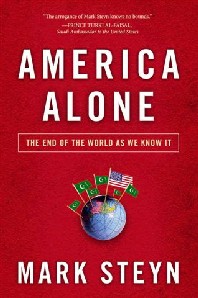
By Lt. Col. Gordon Cucullu
http://www.FrontPageMag.com
November 1, 2006
America Alone: The End of the World as We Know It
by Mark Steyn
Regnery Publishing
256 pp
ISBN: 0895269786
In America Alone, Mark Steyn presents us with a doomsday scenario backed by impeccable science and research, and he does it in such a clever manner that we are actually amused as we read of the impending demise of Europe-as-we-knew-it, Japan, and Canada.
Why are they failing? Procreation, or more pointedly, the lack thereof. Populations in Russia, Italy, and the Low Countries may have already passed the point of no return. Canada is on the borderline. America, on the other hand, appears to have a sustainable reproductive level, a fact that ought to make some Canucks wish that General Hull had won in 1812 after all.
One of the most interesting sidebars of America Alone is that the front jacket blurb – the spot that most authors and publishers reserve for their prized quotation – is a comment from Saudi Ambassador to the US Prince Turki al-Faisal. The Prince is succinct in his praise, saying that “The arrogance of Mark Steyn knows no bounds.” How many of us would have the guts to stick a quotation like that on our covers?
But the Saudi prince’s quotation is germane to the thesis of the book. Along with what he terms a voluntary demographic decline akin to “cultural suicide,” Steyn juxtaposes the decline of European numbers beside the fecund Islamic population. The result is a precipitous axis of European decline already overtaken by an exploding Muslim population, generally termed “Asian or African immigrants” by the willfully blind Euromedia.
Thanks to virulent Whabbist imams in the new mosques, the immigrants are uniformly anti-Europe, anti-assimilation, and very pro-Islamofascist. For the latter, Steyn notes, we need to thank His Highness, the Saudi prince and the rest of the House of Saud “royal” family. After all, it is their excess petrodollars that provide the comp and benefits package for the imams along with training in what – absent those dollars – would have remained a rather quaint if violent Whabbist Islamic cult lost somewhere out in the desert.
Where America Alone resonates particularly is in the realization of the stark inevitability of the inexorable tide of radical Islam eroding at the basis of the Greco-Roman Judeo-Christian culture that has sustained Western philosophy and culture for more than two millennia.
We dismiss the potency of the Whabbist Islamic philosophy at our peril. They don’t want to live beside us, nor do they particularly lust for our material or scientific wealth. In fact, they reject these cultural niceties as entirely dispensable contrasted to the overwhelming goal of establishing a sharia state upon the rest of the world. Democracy? Don’t need it when you have a caliphate headed by a political-religious leader who knows what’s best for you better than you do. Steyn summarizes it nicely: “Pre-modern Islam beats post-modern Christianity” for its political potency.
Steyn spends time on another suicidal cult, post-modern multiculturalism, with all of its wacky permutations and self-flagellations. By refusing to be judgmental and by according all cultures equal value, he argues, we diminish ourselves. But by setting out deliberately to denigrate our own culture the result is that the other cultures become superior. Such is the case in Europe and much of left-elitist America where it is insufficient merely to “respect” Islam but seems necessary to elevate it as superior to what it is eager to replace. How do the Muslims react to such culture-deprecating humility? By moving in ever more rapaciously, with contempt for the “weak horse” ideology of the “multiculti.”
Steyn also spends time discussing what Robert Kaplan terms the “re-primitivization” of human beings by Islamofascism. He shows how absolute irrational behavior can characterize people who comfortably possess the trappings of a modern civilization – cell phones, airline travel, the Internet – and yet do not sign up for its underpinning values. Steyn cites a case in Sudan where a man generated hysteria by claiming to have lost his penis while shaking hands with a foreigner. “Here’s the telling detail,” he notes, “the vanishing-penis hysteria was spread by cell phones and text messaging.”
More awful than the faintly amusing disappearing-penis phenomenon is the fact that what the press calls “British-born of Asian descent” meaning Pakistanis or other Muslims, UK citizens who love football and fish-and-chips, and boast about downloading the latest beheadings of infidels broadcast by al Jazeera or on Islamist websites to watch over and over again on their cell phones and to share with friends. In this bloodlust, they are encouraged by the radical imams (Saudi trained, of course) that preach from the many mosques that are now so filled to bursting that a new mega-mosque is planned to be erected beside the 2012 Olympic facilities. Many Londoners proudly point to this as yet another sign of their open-minded multiculturalism.
So what’s to do? Steyn offers three solutions (alert: giving away the ending here!). They boil down to 1) capitulate to Islam, 2) destroy Islam, or 3) reform Islam. He rejects the first two, and lists several recommendations for Islamic reform. In this, I think that he may exhibit uncharacteristic optimism, but absent an apocalypse – which is also highly desirable by some Iranian characters – it may be our only approach to problem solving. For this Steyn is to be commended, for most commentators are unable even to admit the problem much less offer solutions.
Mark Steyn has written a most amazing, entertaining, informative, and necessary book. Even before I finished it, I bought copies and sent them to my kids. He will be attacked as arrogant (done, see cover), bigoted, shallow, and tendentious. Steyn’s America Alone is none of these. This is a must-read work that will be germane for decades, or until the last native European turns off the light (or has it turned off for him by a knife-wielding Muslim shrieking Allahu Akbar!).
America Alone is an essential part of every thinking person’s library and must be purchased immediately. On the outside chance that your friends may be snoozing, it is wise to give copies to as many people as you know. It is a wonderful read and an essential component in recognizing the deadly challenges we face as this new century begins to unwind.
Click Here to support Frontpagemag.com.
Lt. Col. Gordon Cucullu has been an Army Green Beret lieutenant colonel, as well as a writer, popular speaker, business executive and farmer. His most recent book is Separated at Birth, about North and South Korea.
Tuesday, October 31, 2006
Don Feder: Oh, Those Mischievous Muslims!
Don Feder
GrassTopsUSA.com
October 31, 2006
I should seriously write a book called, The Idiots Guide To Not Thinking Seriously About Islam.
It’s hard to find a subject where mushy thinking is more in vogue – where political correctness conquers reality more thoroughly. People actually are afraid to think seriously on the subject, because the logical conclusions are too frightening for many to contemplate.
And so, there’s no place where comfortable clichés are more readily deployed.
Probably the most glaring illustration of inanity here were recent comments by his Holiness, the Dalai Lama.
On leaving a meeting with Pope Benedict XVI, the leader of Tibetan Buddhists told reporters that we can’t hold all Muslims responsible for the misdeeds of a few.
The Lama: "Nowadays, I often express that due to a few mischievous Muslims’ acts we should not consider all Muslims as something bad. That is very unfair."
Expanding on this dazzling analysis, the Dalai Lama continued: "A few mischievous people you can find from all religions – among Muslims and Christians and Jews and Buddhists. To generalize is not correct."
O.K., now I know this will get me scratched from the invite list for Richard Gere’s New Year’s Eve party, but I just gotta ask: When was the last time a bald guy in a saffron robe threatened to kill someone he believed had insulted the Buddha?
While we’re at it, when was the last time a gang of Talmudic scholars tried to blow up anything? Did the Vatican put out a fatwah on "DaVinci Code" author Dan Brown? The last holy war committed in the name of Christianity was over 800 years ago. If Hindus behead hostages, I’ve somehow managed to miss it.
"A few mischievous Muslims" makes kidnapping, torture, beheadings, bomb plots, mass murder and death threats sound like schoolboy pranks. It’s September 11, 2001, and some high-spirited Muslim merrymakers just crashed two planes into the World Trade Center, slaughtering 3,000 innocents. What a lark!
Here are some recent examples of Muslim high-jinks:
* In Iraq, Father Paulis Iskander, a Syrian-Orthodox priest, was kidnapped by a few Muslim pranksters. After good-naturedly torturing him, they beheaded the priest. This was in retaliation for Pope Benedict XVI’s quote of a 14th century Byzantine emperor. Jihadists apparently missed the Catholic-Orthodox schism (1054 AD) -- or maybe all Crusaders look the same to them.
* There are 1 million Assyrian Christians in Iraq – but not for long. They’ve been targeted by every side in the civil war. On September 24th, two bombs exploded in St. Mary’s Cathedral in Baghdad. Earlier, a church was bombed in Basra.
* Muslims celebrated their holy month of Ramadan by racking up an impressive body count -- more than 1,600 dead in 280 separate terror attacks in 17 countries. As I recall, for my bar mitzvah, I didn’t kill anyone. But I did hurt someone’s feelings on Passover, once.
* In a recent column, former New York Mayor Ed Koch reports on a meeting he had with Pope John Paul II in the early 1990s. Forthright fellow that he is, Koch asked the Pope why the Vatican didn’t recognize Israel (it did a few years later), Koch says John Paul II replied: "It will happen someday, but it can’t happen now. I have a responsibility to the Catholics who live in Koranic lands and who would be in danger if we recognized Israel." This wasn’t paranoia. John Paul knew exactly what happens when Muslims get testy.
* In Germany, the government is starting to crack down on an estimated 5,000 Islamist websites that are "spreading hatred" and "hawking terror." I see, those few mischievous Muslims must all be web-site designers and computer geeks.
* Then again, perhaps they’re all involved in mass communications. The American-Muslim TV network, broadcasting in six states to a potential audience of two million, says its mission is "to improve the image of Muslims in the United States." Recent programming included the broadcast of an anti-Semitic/anti-Christian sermon, with the supplication: "May God destroy them."
* In Atlanta, Ethiopian immigrant Khalid Adem is on trial for circumcising his then-two-year-old daughter. Female genital mutilation is all the rage among African Muslims.
* Islamic funsters tend to be particularly hard on the ladies. There are as many as 300,000 runaway girls in happenin’ Iran, some as young as 9. It’s estimated that 86% of the runaways were rejected by their families after they were raped. In Prophet-land, rape is shameful – for the victim.
* Islam’s rhetorical war against the hated Zionist entity continues. In Karachi, Pakistan, a few mischievous Muslims – well, 6,000 to be exact – marched through the streets shouting "Death to Israel! Death America." That’s how Muslim merrymakers celebrate Al-Qods Day (or Jerusalem Day).
* His Naziness Mahmoud Ahmadinejad (president of 68 million waggish Iranians) continues to assure us that Israel will be "wiped from the map," the Holocaust is a "myth," and any nation that sides with the Jewish state will face the "boiling wrath" of adherents to the religion of peace.
* On October 24, the Taliban announced it was planning attacks on civilian targets in Europe, in revenge for the invasion of Afghanistan that resulted in toppling its regime. A Taliban commander observed on Sky News television: "It’s acceptable to kill ordinary people in Europe because these are the people who have voted in the government…. We will kill them and laugh over them." Like the Dalai Lama said, these guys have a sense of humor.
* As noted earlier, there is no freedom of conscience in Islam (or freedom of anything else). In Ethiopia, in July, a mischievous Muslim mob attacked a group of Christians in the city of Henno. The victims included two prominent Christians who had converted from Islam. The Muslim scamps used knives, stones and metal bars to reinforce the point that – like the Syndicate – there’s only one way out of this organization.
* The Afghans who kidnapped Italian journalist Gabriele Torsello have offered to exchange him for Abdul Rahman, a Christian convert forced to flee the country. His own family wants Rahman dead. Bring back Rahman so we may instruct him in the finer points of Sharia, the abductors of Torsello plead.
* In Britain, there are veiled threats over the suggestion by Tony Blair and others, that some Muslim chicks stop dressing like they just stepped off a camel caravan (full face veil).
Perhaps the Brits are thinking that if their homegrown Sons and Daughters of Allah were more assimilated, they wouldn’t be subjected to high-spirited pranks like the 2005 London transit bombings (52 commuters dead) or the foiled August plot to blow up 10 U.S.-bound jetliners (with a potential death toll exceeding 9/11)
* Across the Channel, Robert Redeker (a French high-school philosophy teacher) is a marked man, since the publication of his September 19 piece in Le Figaro, wherein he called the Koran "a book of extraordinary violence" (Hello, Dalai!) and observed that Mohammed was "a pitiless warlord, pillager , massacrer of Jews and polygamist" – in other words, a 7th century Arabian rascal. E-mail death threats started pouring in the day the article ran. One naughty website published a map showing the exact location of his home, along with photos of Redeker and his workplace. (An e-mail amusingly informed the teacher: "You will never feel secure on this earth. One billion, three hundred million Muslims are ready to kill you.")
* All it took was one guy named Mohammed to murder Dutch filmmaker Theo van Gogh in 2004, for making a movie about the treatment of women in the wacky world of Islam. Van Gogh was shot, stabbed and had his throat slashed. A note by the killer, pinned to his body, read, "I did what I did purely out of my beliefs."
* A spokesman for a French police union says Muslim youths are waging a "civil war" against the gendarmes. The Gallic intifada that started last November never really stopped. At one point last year, disaffected "youth," as the French press discretely calls them, were torching 1,300 cars a night, to cries of "Allahu Akbar." Rioting spread to 300 French cities and spilled over into Belgium and Germany. Now, whenever French cops go to housing projects they are assaulted with everything from stones to guns to Molotov cocktails. Nearly 2,500 officers have been injured this year.
* To return to the Dalai Lama’s daft observation, while it is undoubtedly true that most Muslims don’t want to jihad us – there are enough who do. In a 2005 survey by The Daily Telegraph, one quarter of British Muslims said they had at least some sympathy with their coreligionists who murdered 52 random Brits in the July commuter bombings. One-quarter of a million is more than "a few."
Add to this number the minions of al-Qaeda, Hamas, Fatah, Hezbollah, the Muslim Brotherhood, the Jihad-this, and Army of God-that, the mobs in Tehran, Karachi and Dar es Saalam etc., the ayatollahs, imams, sheiks, mullahs, their blind followers and rabid supporters – not to mention the Saudis funding radical mosques and madrassahs from Queens to Calcutta and beyond. It all adds up to a whole lot of Muslim mischief-making.
And let’s not forget the millions (tens of millions? hundreds of millions?) of Muslims who aren’t actually killing anyone, or condoning the killing of anyone (except Jews, of course), who nevertheless think it would be swell if the whole world lived under Islamic law – with honor-killings and genital-mutilation for all.
Now, here’s the really scary part: As Mark Steyn points out in his book America Alone: The End of The World As We Know It, between 1970 and 2000, while the share of the world’s population represented by industrialized nations fell from just under 30% to just over 20%, the mischievous nations (whose principal manufactured products are jihad and general theological nuttiness) went from 15% to around 20%.
What nations have the highest fertility rates? So sorry you asked. (and you will be too when you see the answer) -- Niger (7.46 children per woman), Mali (7.42), Somalia (6.76), Afghanistan (6.69) and Yemen (6.58). Says Steyn: "Notice what they have in common? Starts with an I, ends with a slam."
For comparison, the fertility rate in the U.S. is 2.11, about replacement level. That’s high next to Canada (1.5), Germany (1.3), Russia and Italy (1.2) and Spain (1.1). Of the 10 nations with the lowest birthrates, 9 are in Europe.
It gets worse. Consider the percentage of population currently under 15 years of age – a harbinger of future demographic growth – Spain and Germany (14%), the U.K. (18%), the U.S. (21%), Saudi Arabia (39%), Pakistan (40%) and Yemen (47%).
We’re told that Muslims are 10% of the population of France. But of "Frenchmen" under 20, 30% are mischievous. In the U.K. there are more Moslems in mosque each week than Christians attending Church of England services.
Forget suicide bombs; they’re detonating population bombs.
Should we "consider all Muslims as something bad"? Of course not. Should we consider Islam as something bad? That’s an entirely different question – one which politicians, Lamas and the mainstream media studiously avoid – when they’re not babbling about the "religion of peace."
And if Islam itself is "something bad" – if a faith embraced by 1.3 billion people contains within it the seeds of the evil we see all around us (requiring only the right conditions to germinate) – what does that say for the future of a world where Islam is the fastest growing religion?
Some of us live on comfortable estates in India, writing books about inner-peace and harmony, while contemplating the sound of one hand clapping. Others of us live in the real world.
This column originally appeared on GrassTopsUSA.com.
Click Here to support Frontpagemag.com.
Don Feder is a former Boston Herald writer who is now a political/communications consultant. He also maintains his own website, DonFeder.com.
GrassTopsUSA.com
October 31, 2006
I should seriously write a book called, The Idiots Guide To Not Thinking Seriously About Islam.
It’s hard to find a subject where mushy thinking is more in vogue – where political correctness conquers reality more thoroughly. People actually are afraid to think seriously on the subject, because the logical conclusions are too frightening for many to contemplate.
And so, there’s no place where comfortable clichés are more readily deployed.
Probably the most glaring illustration of inanity here were recent comments by his Holiness, the Dalai Lama.
On leaving a meeting with Pope Benedict XVI, the leader of Tibetan Buddhists told reporters that we can’t hold all Muslims responsible for the misdeeds of a few.
The Lama: "Nowadays, I often express that due to a few mischievous Muslims’ acts we should not consider all Muslims as something bad. That is very unfair."
Expanding on this dazzling analysis, the Dalai Lama continued: "A few mischievous people you can find from all religions – among Muslims and Christians and Jews and Buddhists. To generalize is not correct."
O.K., now I know this will get me scratched from the invite list for Richard Gere’s New Year’s Eve party, but I just gotta ask: When was the last time a bald guy in a saffron robe threatened to kill someone he believed had insulted the Buddha?
While we’re at it, when was the last time a gang of Talmudic scholars tried to blow up anything? Did the Vatican put out a fatwah on "DaVinci Code" author Dan Brown? The last holy war committed in the name of Christianity was over 800 years ago. If Hindus behead hostages, I’ve somehow managed to miss it.
"A few mischievous Muslims" makes kidnapping, torture, beheadings, bomb plots, mass murder and death threats sound like schoolboy pranks. It’s September 11, 2001, and some high-spirited Muslim merrymakers just crashed two planes into the World Trade Center, slaughtering 3,000 innocents. What a lark!
Here are some recent examples of Muslim high-jinks:
* In Iraq, Father Paulis Iskander, a Syrian-Orthodox priest, was kidnapped by a few Muslim pranksters. After good-naturedly torturing him, they beheaded the priest. This was in retaliation for Pope Benedict XVI’s quote of a 14th century Byzantine emperor. Jihadists apparently missed the Catholic-Orthodox schism (1054 AD) -- or maybe all Crusaders look the same to them.
* There are 1 million Assyrian Christians in Iraq – but not for long. They’ve been targeted by every side in the civil war. On September 24th, two bombs exploded in St. Mary’s Cathedral in Baghdad. Earlier, a church was bombed in Basra.
* Muslims celebrated their holy month of Ramadan by racking up an impressive body count -- more than 1,600 dead in 280 separate terror attacks in 17 countries. As I recall, for my bar mitzvah, I didn’t kill anyone. But I did hurt someone’s feelings on Passover, once.
* In a recent column, former New York Mayor Ed Koch reports on a meeting he had with Pope John Paul II in the early 1990s. Forthright fellow that he is, Koch asked the Pope why the Vatican didn’t recognize Israel (it did a few years later), Koch says John Paul II replied: "It will happen someday, but it can’t happen now. I have a responsibility to the Catholics who live in Koranic lands and who would be in danger if we recognized Israel." This wasn’t paranoia. John Paul knew exactly what happens when Muslims get testy.
* In Germany, the government is starting to crack down on an estimated 5,000 Islamist websites that are "spreading hatred" and "hawking terror." I see, those few mischievous Muslims must all be web-site designers and computer geeks.
* Then again, perhaps they’re all involved in mass communications. The American-Muslim TV network, broadcasting in six states to a potential audience of two million, says its mission is "to improve the image of Muslims in the United States." Recent programming included the broadcast of an anti-Semitic/anti-Christian sermon, with the supplication: "May God destroy them."
* In Atlanta, Ethiopian immigrant Khalid Adem is on trial for circumcising his then-two-year-old daughter. Female genital mutilation is all the rage among African Muslims.
* Islamic funsters tend to be particularly hard on the ladies. There are as many as 300,000 runaway girls in happenin’ Iran, some as young as 9. It’s estimated that 86% of the runaways were rejected by their families after they were raped. In Prophet-land, rape is shameful – for the victim.
* Islam’s rhetorical war against the hated Zionist entity continues. In Karachi, Pakistan, a few mischievous Muslims – well, 6,000 to be exact – marched through the streets shouting "Death to Israel! Death America." That’s how Muslim merrymakers celebrate Al-Qods Day (or Jerusalem Day).
* His Naziness Mahmoud Ahmadinejad (president of 68 million waggish Iranians) continues to assure us that Israel will be "wiped from the map," the Holocaust is a "myth," and any nation that sides with the Jewish state will face the "boiling wrath" of adherents to the religion of peace.
* On October 24, the Taliban announced it was planning attacks on civilian targets in Europe, in revenge for the invasion of Afghanistan that resulted in toppling its regime. A Taliban commander observed on Sky News television: "It’s acceptable to kill ordinary people in Europe because these are the people who have voted in the government…. We will kill them and laugh over them." Like the Dalai Lama said, these guys have a sense of humor.
* As noted earlier, there is no freedom of conscience in Islam (or freedom of anything else). In Ethiopia, in July, a mischievous Muslim mob attacked a group of Christians in the city of Henno. The victims included two prominent Christians who had converted from Islam. The Muslim scamps used knives, stones and metal bars to reinforce the point that – like the Syndicate – there’s only one way out of this organization.
* The Afghans who kidnapped Italian journalist Gabriele Torsello have offered to exchange him for Abdul Rahman, a Christian convert forced to flee the country. His own family wants Rahman dead. Bring back Rahman so we may instruct him in the finer points of Sharia, the abductors of Torsello plead.
* In Britain, there are veiled threats over the suggestion by Tony Blair and others, that some Muslim chicks stop dressing like they just stepped off a camel caravan (full face veil).
Perhaps the Brits are thinking that if their homegrown Sons and Daughters of Allah were more assimilated, they wouldn’t be subjected to high-spirited pranks like the 2005 London transit bombings (52 commuters dead) or the foiled August plot to blow up 10 U.S.-bound jetliners (with a potential death toll exceeding 9/11)
* Across the Channel, Robert Redeker (a French high-school philosophy teacher) is a marked man, since the publication of his September 19 piece in Le Figaro, wherein he called the Koran "a book of extraordinary violence" (Hello, Dalai!) and observed that Mohammed was "a pitiless warlord, pillager , massacrer of Jews and polygamist" – in other words, a 7th century Arabian rascal. E-mail death threats started pouring in the day the article ran. One naughty website published a map showing the exact location of his home, along with photos of Redeker and his workplace. (An e-mail amusingly informed the teacher: "You will never feel secure on this earth. One billion, three hundred million Muslims are ready to kill you.")
* All it took was one guy named Mohammed to murder Dutch filmmaker Theo van Gogh in 2004, for making a movie about the treatment of women in the wacky world of Islam. Van Gogh was shot, stabbed and had his throat slashed. A note by the killer, pinned to his body, read, "I did what I did purely out of my beliefs."
* A spokesman for a French police union says Muslim youths are waging a "civil war" against the gendarmes. The Gallic intifada that started last November never really stopped. At one point last year, disaffected "youth," as the French press discretely calls them, were torching 1,300 cars a night, to cries of "Allahu Akbar." Rioting spread to 300 French cities and spilled over into Belgium and Germany. Now, whenever French cops go to housing projects they are assaulted with everything from stones to guns to Molotov cocktails. Nearly 2,500 officers have been injured this year.
* To return to the Dalai Lama’s daft observation, while it is undoubtedly true that most Muslims don’t want to jihad us – there are enough who do. In a 2005 survey by The Daily Telegraph, one quarter of British Muslims said they had at least some sympathy with their coreligionists who murdered 52 random Brits in the July commuter bombings. One-quarter of a million is more than "a few."
Add to this number the minions of al-Qaeda, Hamas, Fatah, Hezbollah, the Muslim Brotherhood, the Jihad-this, and Army of God-that, the mobs in Tehran, Karachi and Dar es Saalam etc., the ayatollahs, imams, sheiks, mullahs, their blind followers and rabid supporters – not to mention the Saudis funding radical mosques and madrassahs from Queens to Calcutta and beyond. It all adds up to a whole lot of Muslim mischief-making.
And let’s not forget the millions (tens of millions? hundreds of millions?) of Muslims who aren’t actually killing anyone, or condoning the killing of anyone (except Jews, of course), who nevertheless think it would be swell if the whole world lived under Islamic law – with honor-killings and genital-mutilation for all.
Now, here’s the really scary part: As Mark Steyn points out in his book America Alone: The End of The World As We Know It, between 1970 and 2000, while the share of the world’s population represented by industrialized nations fell from just under 30% to just over 20%, the mischievous nations (whose principal manufactured products are jihad and general theological nuttiness) went from 15% to around 20%.
What nations have the highest fertility rates? So sorry you asked. (and you will be too when you see the answer) -- Niger (7.46 children per woman), Mali (7.42), Somalia (6.76), Afghanistan (6.69) and Yemen (6.58). Says Steyn: "Notice what they have in common? Starts with an I, ends with a slam."
For comparison, the fertility rate in the U.S. is 2.11, about replacement level. That’s high next to Canada (1.5), Germany (1.3), Russia and Italy (1.2) and Spain (1.1). Of the 10 nations with the lowest birthrates, 9 are in Europe.
It gets worse. Consider the percentage of population currently under 15 years of age – a harbinger of future demographic growth – Spain and Germany (14%), the U.K. (18%), the U.S. (21%), Saudi Arabia (39%), Pakistan (40%) and Yemen (47%).
We’re told that Muslims are 10% of the population of France. But of "Frenchmen" under 20, 30% are mischievous. In the U.K. there are more Moslems in mosque each week than Christians attending Church of England services.
Forget suicide bombs; they’re detonating population bombs.
Should we "consider all Muslims as something bad"? Of course not. Should we consider Islam as something bad? That’s an entirely different question – one which politicians, Lamas and the mainstream media studiously avoid – when they’re not babbling about the "religion of peace."
And if Islam itself is "something bad" – if a faith embraced by 1.3 billion people contains within it the seeds of the evil we see all around us (requiring only the right conditions to germinate) – what does that say for the future of a world where Islam is the fastest growing religion?
Some of us live on comfortable estates in India, writing books about inner-peace and harmony, while contemplating the sound of one hand clapping. Others of us live in the real world.
This column originally appeared on GrassTopsUSA.com.
Click Here to support Frontpagemag.com.
Don Feder is a former Boston Herald writer who is now a political/communications consultant. He also maintains his own website, DonFeder.com.
Monday, October 30, 2006
Bob Ryan: Red was just full of color
Icon interesting on, off the court
The Boston Globe
October 30, 2006
What most people don't realize is that Red Auerbach married the prettiest girl in town. Even in her 70s, Dorothy (Lewis) Auerbach was an elegant presence in the finest Sophia Loren sense, and one can only imagine what a head-turning traffic-stopper she must have been when young Arnie Auerbach slipped that ring on her finger oh so many years ago.
But should we be surprised? We already knew Red had an eye for talent. Well, yes, there was the problem with his original dismissal of Bob Cousy as merely an overrated favorite of the "local yokels," but in time Red proved he knew how to make better use of The Cooz's singular talents than anyone else ever could have imagined.
The Cousy episode was one of the very few professional misjudgments in the career of the most important non-playing person in the history of professional basketball. That's a non-negotiable premise. Red was coaching the Washington Capitols when the Basketball Association of America (BAA) began play there in 1946 (the BAA merged with the National Basketball League three years later to form the National Basketball Association) and he was still the Celtics' team president almost 60 years to the day from the BAA's first game. No one in NBA history ever has had more influence on the sport.
We also know that no sports person (which would include Connie Mack and George Halas) ever was associated longer with any team. Red Auerbach was the embodiment of the Boston Celtics for nearly 57 years.
The Red Auerbach folklore is extensive: The seven basic plays, plus options. The victory cigar. The Chinese food. The legendarily bad driving. The way he protected the owner du jour's money even better than he did his own. The love of Asian art and furniture. The letter opener collection. The image of him with the rolled-up program battling such referee foils as Sid Borgia and Mendy Rudolph. The love of tennis and racquetball. The chutzpah to draft the NBA's first black player, Chuck Cooper, in 1950; the further chutzpah to start five black players in the 1964-65 season; and even more chutzpah to name Bill Russell his successor when he retired from coaching in 1966.
And more: The fact that during the Bird Era he was not to be disturbed between 4 and 5 in his office because that's when he watched "Hawaii 5-0." The cab driver who may have persuaded him not to leave Boston for the Knicks. The pioneering '50s and '60s State Department trips that spread the basketball gospel to Europe, Asia, and Africa. The ceaseless and touching devotion to George Washington University, his alma mater. The Red Auerbach Basketball Camp at Camp Milbrook, the second week of which officially became the Celtics' Rookie camp, as well. The propagation of the Celtics as Family.
Stories tumble out of all the above, and even if you were to hear 10 tales for each Auerbach idiosyncrasy, foible, or association, you still wouldn't know the half of what he was like. But I'll tell you one thing he was, and that was larger than life.
I'm 24. I have just finished my first year of covering the Celtics and it is Draft Day, 1970. I walk into Red's office, where he would make his selections into a squawk box connected to the league headquarters in New York (it was not quite the extensive production it is today), and as soon as he sees me, he barks, "Ryan, I ought to cut your [very private part] off!"
My crime? I had written that his 1962 choice of John Havlicek, long assumed to have been the product of superior Auerbach prescience, actually had been the result of a strong recommendation from then-team promotion director (and fellow Hall of Famer) Bill Mokray.
Red liked to get to the point. Early in the 1974-75 season, he had to come out of coaching retirement to run the club when Tom Heinsohn had taken sick. Assistant coach John Killilea had just presented an elaborate scouting report on the Portland Trail Blazers, X-ing and O-ing on the blackboard all over the place, as dedicated coaches are wont to do. When Killilea was done, Auerbach addressed the team.
"All that was very nice," he acknowledged. "You want to win this game? Block out on the boards and play defense! Now get outta here!"
You could never underestimate Red's wry humor. He once said to me, "Who's the best sixth man in the history of the NBA?" I guessed, naturally, Havlicek. Red said, "No." I tried Billy Cunningham. Then I guessed Ernie Vandeweghe. Again, "No."
"The answer," Red said, "is Chinky Shapiro."
"Who?" I said. "Chinky Shapiro. He was the timer in Rochester." Red was full of surprises. I used to chat him up on occasion before home games at his midcourt seat at the Old Garden. During one of these sessions, a rather va-va-voomish young lady sauntered up the steps. It was hard not to take notice. Red's expression never changed, but he could see by the look on my face I was wondering if he had paid any attention. "What?" he said. "You think I didn't see that?"
I mean, he did scoop up Dorothy Lewis.
If Dorothy Lewis had been his best draft choice, Bill Russell was surely his second. Five, seven, nine, or 11 championships down the road, the move to make Bill Russell a Celtic in the 1956 draft may have looked like a rather obvious decision, but that was not at all the case. Russell was something new, and many NBA traditionalists didn't really know what to make of him. After all, Red and owner Walter Brown did have to scheme with both St. Louis and Rochester to get Russell's rights. How many times after losing games to the Celtics do you think they'd have liked a do-over?
But Red absolutely, positively knew that Russell was the answer to his prayers. Conversely, Red was the answer to Russell's. The latter has said many times that he never would have been the NBA player he turned out to be had he been playing for any other coach. Red knew who Russell was, both professionally and, more important, personally. He knew how to appeal to Russell's pride to get the necessary work done, and he knew when to back off. Treat Russell the same way he did everyone else? Red knew better.
He always knew. He did not deal with Cousy the way he did with Heinsohn, or with Heinsohn the way he did with Sam Jones, or with Sam the way he did with Satch Sanders, or with Satch the way he did with Frank Ramsey. His basketball mind was great, but his understanding of individual personalities was even better.
Consider some of the advice contained in his splendid and timeless 1952 book, "Basketball For The Player, The Coach and The Fan." Under the heading, ATTITUDE of PLAYER to HIS TEAMMATES, he tells us:
1) You must think of getting along with your teammates, because if you are not well liked, it is easy for them to "freeze you out."
2) Show a desire to block or screen for your teammates so that they will do the same for you.
3) Show your teammates that you will take the good shots. Don't appear too "hungry."
4) Don't hold the ball. Look for men cutting.
5) Dribble with a purpose. Don't just stand there hugging the ball or dribbling aimlessly while your teammates continually cut.
6) Help your teammates on defense. Switch whenever necessary.
7) Don't chide a teammate whose man happens to score. Often, it's the fault of your whole team.
8) Don't be too chummy with one or two players. Avoid obvious cliques.
9) Don't discuss the faults of any teammate with the other members of the team.
10) Don't give the impression that you are always hanging around the coach and discussing your teammates with him, unless, of course, you are the captain and the coach asks your opinion.
11) When scrimmaging, don't loaf or take it easy. This will keep the high respect of your teammates. Remember, "There are no friends on the other team, even in practice."
Red was enormously proud of that book, which had a long run and was translated into a score of languages. So here he is, speaking wisdom from the grave 54 years later. What coach on any team in the world would not be thrilled if his players were to absorb those lessons?
The person Red knew best, of course, was himself. He walked away from coaching at age 48, tired of being the coach (no assistants in those days), general manager, and traveling secretary all by himself. Before the 1965-66 season, he announced to the world that it would have one last shot at him. It took seven tough games against the Lakers, but he went out on top.
He then went on to a second career as the best team executive the NBA ever has known, before settling into the permanent role of playing Red Auerbach, in which he was his alternately irascible and charming self to the end.
There was a time more than a year ago, for example, when he was gravely ill, and it appeared he was on his way out. But he did awake, and a friend, Rob Ades, said to him, "Red, we thought we were going to lose you."
Red looked at him. "I'll decide," he rasped.
God, I miss him already.
Bob Ryan can be reached at ryan@globe.com.
The Boston Globe
October 30, 2006
What most people don't realize is that Red Auerbach married the prettiest girl in town. Even in her 70s, Dorothy (Lewis) Auerbach was an elegant presence in the finest Sophia Loren sense, and one can only imagine what a head-turning traffic-stopper she must have been when young Arnie Auerbach slipped that ring on her finger oh so many years ago.
But should we be surprised? We already knew Red had an eye for talent. Well, yes, there was the problem with his original dismissal of Bob Cousy as merely an overrated favorite of the "local yokels," but in time Red proved he knew how to make better use of The Cooz's singular talents than anyone else ever could have imagined.
The Cousy episode was one of the very few professional misjudgments in the career of the most important non-playing person in the history of professional basketball. That's a non-negotiable premise. Red was coaching the Washington Capitols when the Basketball Association of America (BAA) began play there in 1946 (the BAA merged with the National Basketball League three years later to form the National Basketball Association) and he was still the Celtics' team president almost 60 years to the day from the BAA's first game. No one in NBA history ever has had more influence on the sport.
We also know that no sports person (which would include Connie Mack and George Halas) ever was associated longer with any team. Red Auerbach was the embodiment of the Boston Celtics for nearly 57 years.
The Red Auerbach folklore is extensive: The seven basic plays, plus options. The victory cigar. The Chinese food. The legendarily bad driving. The way he protected the owner du jour's money even better than he did his own. The love of Asian art and furniture. The letter opener collection. The image of him with the rolled-up program battling such referee foils as Sid Borgia and Mendy Rudolph. The love of tennis and racquetball. The chutzpah to draft the NBA's first black player, Chuck Cooper, in 1950; the further chutzpah to start five black players in the 1964-65 season; and even more chutzpah to name Bill Russell his successor when he retired from coaching in 1966.
And more: The fact that during the Bird Era he was not to be disturbed between 4 and 5 in his office because that's when he watched "Hawaii 5-0." The cab driver who may have persuaded him not to leave Boston for the Knicks. The pioneering '50s and '60s State Department trips that spread the basketball gospel to Europe, Asia, and Africa. The ceaseless and touching devotion to George Washington University, his alma mater. The Red Auerbach Basketball Camp at Camp Milbrook, the second week of which officially became the Celtics' Rookie camp, as well. The propagation of the Celtics as Family.
Stories tumble out of all the above, and even if you were to hear 10 tales for each Auerbach idiosyncrasy, foible, or association, you still wouldn't know the half of what he was like. But I'll tell you one thing he was, and that was larger than life.
I'm 24. I have just finished my first year of covering the Celtics and it is Draft Day, 1970. I walk into Red's office, where he would make his selections into a squawk box connected to the league headquarters in New York (it was not quite the extensive production it is today), and as soon as he sees me, he barks, "Ryan, I ought to cut your [very private part] off!"
My crime? I had written that his 1962 choice of John Havlicek, long assumed to have been the product of superior Auerbach prescience, actually had been the result of a strong recommendation from then-team promotion director (and fellow Hall of Famer) Bill Mokray.
Red liked to get to the point. Early in the 1974-75 season, he had to come out of coaching retirement to run the club when Tom Heinsohn had taken sick. Assistant coach John Killilea had just presented an elaborate scouting report on the Portland Trail Blazers, X-ing and O-ing on the blackboard all over the place, as dedicated coaches are wont to do. When Killilea was done, Auerbach addressed the team.
"All that was very nice," he acknowledged. "You want to win this game? Block out on the boards and play defense! Now get outta here!"
You could never underestimate Red's wry humor. He once said to me, "Who's the best sixth man in the history of the NBA?" I guessed, naturally, Havlicek. Red said, "No." I tried Billy Cunningham. Then I guessed Ernie Vandeweghe. Again, "No."
"The answer," Red said, "is Chinky Shapiro."
"Who?" I said. "Chinky Shapiro. He was the timer in Rochester." Red was full of surprises. I used to chat him up on occasion before home games at his midcourt seat at the Old Garden. During one of these sessions, a rather va-va-voomish young lady sauntered up the steps. It was hard not to take notice. Red's expression never changed, but he could see by the look on my face I was wondering if he had paid any attention. "What?" he said. "You think I didn't see that?"
I mean, he did scoop up Dorothy Lewis.
If Dorothy Lewis had been his best draft choice, Bill Russell was surely his second. Five, seven, nine, or 11 championships down the road, the move to make Bill Russell a Celtic in the 1956 draft may have looked like a rather obvious decision, but that was not at all the case. Russell was something new, and many NBA traditionalists didn't really know what to make of him. After all, Red and owner Walter Brown did have to scheme with both St. Louis and Rochester to get Russell's rights. How many times after losing games to the Celtics do you think they'd have liked a do-over?
But Red absolutely, positively knew that Russell was the answer to his prayers. Conversely, Red was the answer to Russell's. The latter has said many times that he never would have been the NBA player he turned out to be had he been playing for any other coach. Red knew who Russell was, both professionally and, more important, personally. He knew how to appeal to Russell's pride to get the necessary work done, and he knew when to back off. Treat Russell the same way he did everyone else? Red knew better.
He always knew. He did not deal with Cousy the way he did with Heinsohn, or with Heinsohn the way he did with Sam Jones, or with Sam the way he did with Satch Sanders, or with Satch the way he did with Frank Ramsey. His basketball mind was great, but his understanding of individual personalities was even better.
Consider some of the advice contained in his splendid and timeless 1952 book, "Basketball For The Player, The Coach and The Fan." Under the heading, ATTITUDE of PLAYER to HIS TEAMMATES, he tells us:
1) You must think of getting along with your teammates, because if you are not well liked, it is easy for them to "freeze you out."
2) Show a desire to block or screen for your teammates so that they will do the same for you.
3) Show your teammates that you will take the good shots. Don't appear too "hungry."
4) Don't hold the ball. Look for men cutting.
5) Dribble with a purpose. Don't just stand there hugging the ball or dribbling aimlessly while your teammates continually cut.
6) Help your teammates on defense. Switch whenever necessary.
7) Don't chide a teammate whose man happens to score. Often, it's the fault of your whole team.
8) Don't be too chummy with one or two players. Avoid obvious cliques.
9) Don't discuss the faults of any teammate with the other members of the team.
10) Don't give the impression that you are always hanging around the coach and discussing your teammates with him, unless, of course, you are the captain and the coach asks your opinion.
11) When scrimmaging, don't loaf or take it easy. This will keep the high respect of your teammates. Remember, "There are no friends on the other team, even in practice."
Red was enormously proud of that book, which had a long run and was translated into a score of languages. So here he is, speaking wisdom from the grave 54 years later. What coach on any team in the world would not be thrilled if his players were to absorb those lessons?
The person Red knew best, of course, was himself. He walked away from coaching at age 48, tired of being the coach (no assistants in those days), general manager, and traveling secretary all by himself. Before the 1965-66 season, he announced to the world that it would have one last shot at him. It took seven tough games against the Lakers, but he went out on top.
He then went on to a second career as the best team executive the NBA ever has known, before settling into the permanent role of playing Red Auerbach, in which he was his alternately irascible and charming self to the end.
There was a time more than a year ago, for example, when he was gravely ill, and it appeared he was on his way out. But he did awake, and a friend, Rob Ades, said to him, "Red, we thought we were going to lose you."
Red looked at him. "I'll decide," he rasped.
God, I miss him already.
Bob Ryan can be reached at ryan@globe.com.
Book Review: 'The Truth About Muhammad'
By Brigitte Gabriel
http://www.FrontPageMag.com
October 30, 2006
The Truth About Muhammad
by Robert Spencer
Regnery Publishing
256 pp.
ISBN- 1596980281
“Freedom of inquiry and speech, the quest for truth, should not be cowed into silence by violent intimidation or the acceptance of half-truths and propaganda meant to appease freedom’s enemies. One thing is certain: if no one is willing to take such risks, freedom of speech will swiftly become a relic of history.”
These are the words of author Robert Spencer, who is risking his life to educate Westerners about the life of the founder of Islam. He has just come out with a new book, The Truth About Muhammad: Founder of the World's Most Intolerant Religion. In this biography, Spencer tells the story of the founder of Islam -- a story that many Muslims themselves apparently either do not know about or do not want non-Muslims to hear.
Yet it's strange that any Muslim would react with anger to Spencer's book, since he bases it strictly on Islamic sources, all written by pious and serious Muslims. No critic can rightly say that anything Spencer has said about Muhammad in this book is inaccurate. But the problem Muslims find with it is that Spencer doesn't treat Muhammad as if he were the highest moral standard.
Within the Islamic world, by contrast, Muhammad is considered untouchable. Spencer demonstrates that the Qur’an and Islamic tradition are clear that the Prophet is the supreme example of behavior for Muslims to follow. And today, no hint of criticism of any of his acts or teachings is tolerated.
This stifling of speech is now beginning to affect the West, within which non-Muslims are becoming increasingly frightened to say anything critical about Islam and its founder. Indeed, at even the mildest criticism, either by the Pope or in lightly satirical newspaper cartoons, Islamic nations erupt in a frenzy of blind anger. Furious Muslims take to the streets, burn churches and temples, kill innocent civilians, and threaten violence against the non-Muslim world.
Spencer warns that for the West to be intimidated into silence by this behavior is dangerous. He writes, “to place Muhammad and Islam beyond criticism and even beyond lampooning would be just as dangerous for a free society as the idea that the “Beloved Leader” of North Korea and dialectical materialism is above criticism. Indeed it would be death for a free society.”
Spencer accordingly presents the truth about Islam’s founder clearly. His story is backed up by solid scholarship and research. So the key question becomes: who is the man whom the Qur’an states is “an excellent model of conduct” (33:21)?
Spencer begins by introducing the historical Muhammad as well as the books and writings that make up the religion of Islam. This is crucial for all to understand, because it is not only the Qur’an that influences Muslim opinion, but also accompanying religious literature, including the hadith (traditions of Muhammad recorded by his followers) and the Sira (the biography of Muhammad).
Spencer goes on to explain how Muhammad became a prophet, and how he tried at first to spread his message by peaceful means -- including attempts to convince Jews and Christians that he was a prophet in the line of the Old Testament prophets and Jesus (whom he considered a prophet, not the Son of God). When his efforts failed to bring them, along with the pagan Arabs of his native tribe, into his new religion, he became a warlord -- killing, slaughtering and beheading in order to convert others or to force them to submit to him and to the religion given to him by Allah.
Spencer shows how the Prophet Muhammad, the perfect model for human behavior according to Islam and any professing Muslim, perfected the arts of assassination, deceit and taking booty. Chapters 7, 8 and 9 detail the warrior Muhammad’s battles with pagans, Jews and Christians. He told them that their lives and property would be safe only if they became Muslims. In many places, we can see clearly how he serves today as an example for Muslim behavior: at one point Spencer writes,
“Muhammad addressed them (the Jews) in terms that have become familiar usage for Islamic Jihadists when speaking of Jews today …. ‘You brothers of monkeys, has God disgraced you and brought His vengeance upon you?’ The Qur'an in three places (2:62-65; 5:59-60; and 7:166) says that Allah transformed the Sabbath-breaking Jews into pigs and monkeys.
Jihadists today routinely refer to Jews as "pigs and monkeys" -- not just a term of abuse, but an imitation of the holy prophet's example.
The author also sheds a light on the Treaty of Hudaybiyya, the ten-year truce (Hudna) Muhammad signed with the pagan Quraysh tribe. By breaking this treaty, Muhammad again set a precedent: Muslims can sign a treaty but can break it at anytime, when doing so is to their advantage. The purpose of Hudna is to allow weakened Muslim forces to gather strength to fight again later more effectively. This is an extremely important principle for the West to understand today, since it shows the difference between what we perceive as a cease-fire and what believing Muslims think it is.
Chapter 10 explores in a carefully balanced and restrained manner the personal life of Muhammad, allowing the reader to make his own informed decision based on the facts. Spencer presents frightening facts that call into serious question the wisdom behind the Islamic tradition that has dubbed Muhammad “al-insan al-kamil,” or the Perfect Man: his marriage to a child (which is widely imitated in the Islamic world today), his polygamy, his calls to subjugate Jews and Christians, and more.
Throughout the book, we learn how Muhammad treated women and how his words and actions have inspired generation after generation of Muslim men to look at women as nothing more than property. As Spencer notes,
“The Qur’an likens a woman to a field (tilth), to be used by a man as he wills: ‘Your women are a tilth for you (to cultivate) so go to your tilth as ye will’ ” (2:223).
That's bad enough, but there is much more. Spencer’s work details example after example of Muhammad’s teaching about women and how to treat them: beat them if they are disobedient, deny them the right to testify in cases involving sexual crimes, deny their inheritance rights, and deny their rights in numerous ways. And as the historical record has shown, his teachings have sentenced millions of women into a life of oppression, misery and depression.
Readers will learn a great deal from this book, as I did. Spencer also offers constructive suggestions and solutions if we ever want to win this war on Islamofascism. Some of them include:
* Stop insisting that Islam is a religion of peace.
* Initiate a full-scale Manhattan Project to find new energy sources.
* Make Western aid contingent upon renunciation of the Jihad ideology.
* Call upon American Muslim advocacy groups to work against the Jihad ideology.
* Revise immigration policies with the Jihad ideology in view.
This book is a must read for all to understand the roots of radical Islam. It arms non-Muslims and Muslims alike by illuminating what needs to be targeted in order to weaken Islamic extremism and the oxygen which they need to breathe.
Get it and be informed.
Click Here to support Frontpagemag.com.
Brigitte Gabriel is the author of Because They Hate: A Survivor of Islamic Terror Warns America and the founder of American Congress for Truth.org. She is an expert on the Middle East and lectures nationally and internationally on the subject
http://www.FrontPageMag.com
October 30, 2006
The Truth About Muhammad
by Robert Spencer
Regnery Publishing
256 pp.
ISBN- 1596980281
“Freedom of inquiry and speech, the quest for truth, should not be cowed into silence by violent intimidation or the acceptance of half-truths and propaganda meant to appease freedom’s enemies. One thing is certain: if no one is willing to take such risks, freedom of speech will swiftly become a relic of history.”
These are the words of author Robert Spencer, who is risking his life to educate Westerners about the life of the founder of Islam. He has just come out with a new book, The Truth About Muhammad: Founder of the World's Most Intolerant Religion. In this biography, Spencer tells the story of the founder of Islam -- a story that many Muslims themselves apparently either do not know about or do not want non-Muslims to hear.
Yet it's strange that any Muslim would react with anger to Spencer's book, since he bases it strictly on Islamic sources, all written by pious and serious Muslims. No critic can rightly say that anything Spencer has said about Muhammad in this book is inaccurate. But the problem Muslims find with it is that Spencer doesn't treat Muhammad as if he were the highest moral standard.
Within the Islamic world, by contrast, Muhammad is considered untouchable. Spencer demonstrates that the Qur’an and Islamic tradition are clear that the Prophet is the supreme example of behavior for Muslims to follow. And today, no hint of criticism of any of his acts or teachings is tolerated.
This stifling of speech is now beginning to affect the West, within which non-Muslims are becoming increasingly frightened to say anything critical about Islam and its founder. Indeed, at even the mildest criticism, either by the Pope or in lightly satirical newspaper cartoons, Islamic nations erupt in a frenzy of blind anger. Furious Muslims take to the streets, burn churches and temples, kill innocent civilians, and threaten violence against the non-Muslim world.
Spencer warns that for the West to be intimidated into silence by this behavior is dangerous. He writes, “to place Muhammad and Islam beyond criticism and even beyond lampooning would be just as dangerous for a free society as the idea that the “Beloved Leader” of North Korea and dialectical materialism is above criticism. Indeed it would be death for a free society.”
Spencer accordingly presents the truth about Islam’s founder clearly. His story is backed up by solid scholarship and research. So the key question becomes: who is the man whom the Qur’an states is “an excellent model of conduct” (33:21)?
Spencer begins by introducing the historical Muhammad as well as the books and writings that make up the religion of Islam. This is crucial for all to understand, because it is not only the Qur’an that influences Muslim opinion, but also accompanying religious literature, including the hadith (traditions of Muhammad recorded by his followers) and the Sira (the biography of Muhammad).
Spencer goes on to explain how Muhammad became a prophet, and how he tried at first to spread his message by peaceful means -- including attempts to convince Jews and Christians that he was a prophet in the line of the Old Testament prophets and Jesus (whom he considered a prophet, not the Son of God). When his efforts failed to bring them, along with the pagan Arabs of his native tribe, into his new religion, he became a warlord -- killing, slaughtering and beheading in order to convert others or to force them to submit to him and to the religion given to him by Allah.
Spencer shows how the Prophet Muhammad, the perfect model for human behavior according to Islam and any professing Muslim, perfected the arts of assassination, deceit and taking booty. Chapters 7, 8 and 9 detail the warrior Muhammad’s battles with pagans, Jews and Christians. He told them that their lives and property would be safe only if they became Muslims. In many places, we can see clearly how he serves today as an example for Muslim behavior: at one point Spencer writes,
“Muhammad addressed them (the Jews) in terms that have become familiar usage for Islamic Jihadists when speaking of Jews today …. ‘You brothers of monkeys, has God disgraced you and brought His vengeance upon you?’ The Qur'an in three places (2:62-65; 5:59-60; and 7:166) says that Allah transformed the Sabbath-breaking Jews into pigs and monkeys.
Jihadists today routinely refer to Jews as "pigs and monkeys" -- not just a term of abuse, but an imitation of the holy prophet's example.
The author also sheds a light on the Treaty of Hudaybiyya, the ten-year truce (Hudna) Muhammad signed with the pagan Quraysh tribe. By breaking this treaty, Muhammad again set a precedent: Muslims can sign a treaty but can break it at anytime, when doing so is to their advantage. The purpose of Hudna is to allow weakened Muslim forces to gather strength to fight again later more effectively. This is an extremely important principle for the West to understand today, since it shows the difference between what we perceive as a cease-fire and what believing Muslims think it is.
Chapter 10 explores in a carefully balanced and restrained manner the personal life of Muhammad, allowing the reader to make his own informed decision based on the facts. Spencer presents frightening facts that call into serious question the wisdom behind the Islamic tradition that has dubbed Muhammad “al-insan al-kamil,” or the Perfect Man: his marriage to a child (which is widely imitated in the Islamic world today), his polygamy, his calls to subjugate Jews and Christians, and more.
Throughout the book, we learn how Muhammad treated women and how his words and actions have inspired generation after generation of Muslim men to look at women as nothing more than property. As Spencer notes,
“The Qur’an likens a woman to a field (tilth), to be used by a man as he wills: ‘Your women are a tilth for you (to cultivate) so go to your tilth as ye will’ ” (2:223).
That's bad enough, but there is much more. Spencer’s work details example after example of Muhammad’s teaching about women and how to treat them: beat them if they are disobedient, deny them the right to testify in cases involving sexual crimes, deny their inheritance rights, and deny their rights in numerous ways. And as the historical record has shown, his teachings have sentenced millions of women into a life of oppression, misery and depression.
Readers will learn a great deal from this book, as I did. Spencer also offers constructive suggestions and solutions if we ever want to win this war on Islamofascism. Some of them include:
* Stop insisting that Islam is a religion of peace.
* Initiate a full-scale Manhattan Project to find new energy sources.
* Make Western aid contingent upon renunciation of the Jihad ideology.
* Call upon American Muslim advocacy groups to work against the Jihad ideology.
* Revise immigration policies with the Jihad ideology in view.
This book is a must read for all to understand the roots of radical Islam. It arms non-Muslims and Muslims alike by illuminating what needs to be targeted in order to weaken Islamic extremism and the oxygen which they need to breathe.
Get it and be informed.
Click Here to support Frontpagemag.com.
Brigitte Gabriel is the author of Because They Hate: A Survivor of Islamic Terror Warns America and the founder of American Congress for Truth.org. She is an expert on the Middle East and lectures nationally and internationally on the subject
Sunday, October 29, 2006
Dan Shaughnessy- Red Auerbach: An Appreciation
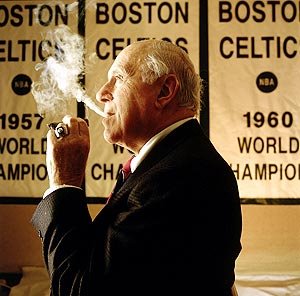
For decades, he lit up our lives
The Boston Globe
October 29, 2006
We were so lucky. We had Red Auerbach for nearly 57 NBA seasons. We had his genius, his rough, old-school charm, and his Brooklyn-learned street smarts. And we lost him yesterday. At the age of 89. Just four days before the start of another Celtics season.
Red was the Celtics. Sure, we had Bill Russell, Bob Cousy, John Havlicek, Larry Bird, and the rest. But Red was the Celtics. He delivered 16 championships to our town. We never could pay back all the pride and glory he brought to Boston.
We tried. We dedicated a statue to Red a full 21 years before he died. We wrote books about him. We created a scholarship in his honor. We made documentaries about him and held a $500 per plate "Red-fest" at the Bayside Exposition Center.
"Most guys have to die to get a tribute like that," Red said, with a chuckle.
We were hoping he never would die. As long as Red lived, there was still Celtic tradition, Celtic pride. We were looking forward to seeing him for one more opening night Wednesday at the Garden. It would have been his 57th opener with the Celts. It would have been his 61st opening night with the NBA, a magnificent career that spanned the entire history of the league. But he just missed. In the end, he never lived to see the first Celtic cheerleader. Probably the way he wanted it.
Where do we start now that Red is officially finished? Do we tell you that he made more great deals than any executive in the history of sports? Do we tell you that he was the best coach, then the best general manager? Do we tell you that he invented the end zone dance?
That's right, boys and girls. You may think that opponent-baiting started with NFL wide receivers preening in end zones, but it all goes back to the 1950s and a short fellow in a jacket and tie with a rolled-up game program in his hand -- lighting up a Hoyo de Monterrey -- as he sat at the end of the bench watching his Celtics bring home another win. Red's victory cigar was the original in-your-face taunt. Celtic rivals despised the gesture and even Red's players dreaded the ceremonial stogie: It just made the other team mad. It made them play harder.
Red didn't care. He was enjoying victory, already thinking about the next game.
Red was decades ahead of his time. The old saying was that Red was playing chess while the rest of the coaches and GMs were still playing checkers. He outsmarted all of them. When confronted, he punched first and asked questions later. He dared his rivals to beat him. And none ever could. Drove them crazy.
Being Jewish helped. It taught him discrimination at a young age. This knowledge was handy when Red came into a fledgling league that was initially all white, but one day would be more than 70 percent black. Red was the first NBA executive to draft a black player, the first coach to start five black players, and he hired the first black coach (Russell) in the history of American sports. Russell, we all know, was more sensitive to frauds than any athlete on the planet. Russell went through walls for Red. And no one else.
Red was sometimes crude and ever vengeful. Ask Cedric Maxwell. When Max took too long to recover from knee surgery in 1985, Red shipped him out of town (for Bill Walton), then had all positive Maxwell references deleted from an Auerbach book that was still in production. Downright Kremlinesque. It took two decades for Red to agree to let the Celtics retire Max's number.
He was well past 65 when he stormed across the parquet floor and challenged Moses Malone to a fight. A couple of years later, the death of Len Bias almost killed Red and sent the Celtics into a tailspin from which they still have not recovered.
What else can we tell you? Red was a sore loser and a gloating winner. Referees hated him. He got into beefs with the officials at old-timers' games. Seriously. And he always hated Madison Square Garden, dating to the 1930s, when he felt his George Washington team was snubbed by the NIT.
Red loved "Hawaii Five-O." He loved Chinese food and would order for the entire table. He was a historically bad driver, rarely getting into accidents, but leaving a trail of fenders and furious drivers in his exhaust. He collected letter openers from around the world and delighted in telling stories of deal-making with trinket merchants on other continents.
Red was constitutionally incapable of participating in small talk. He could be particularly ham-handed when dealing with women. In 1982, he barred Lesley Visser from the Celtic locker room just two years after attending her wedding in Boston.
In 1984, I brought my young wife and infant daughter to the NBA meetings in Salt Lake City. Red had given me a box of cigars when our daughter was born (probably a company violation to accept them, but hopefully the statute of limitations on graft has expired) and I was anxious to have him take a look at our 6-week-old baby. Red took one look at little Sarah, blew some smoke past my wife's head, and said, "Lady, you got a lot of balls bringing that baby all the way out here. Yes, sir, a lot of balls."
It took a while to explain to my wife that this was Red's highest form of praise.
For all that bluster, there was a sweetness about him and you saw it when he was in the presence of his late wife, Dorothy, and his two daughters. In all the years he worked for the Celtics, Red never bought a house in Boston. Dorothy liked her native Washington and dutiful Red went along with the plan. Case closed.
Modern laws be damned, the Celtics should hand out cigars at the Garden opening night. After the anthem, before the opening tap, turn out the lights and let everybody light up a Hoyo de Monterrey. It'll smell like victory.
Murray Chass: Series is Over; Let the Bidding Begin
MURRAY CHASS
The New York Times
Published: October 29, 2006
In the early days of free agency, one of its fiercest opponents was a veteran baseball executive named Jim Campbell. He was the general manager of the Detroit Tigers, and he refused to sign free agents. They weren’t part of the baseball he knew and loved. Campbell epitomized the old guard who inspired the players union to fight for free agency.
The 2006 Tigers did not win the World Series; no team that played as poorly as they did could win the World Series. But the Tigers have at least entered the modern baseball world. Three players they signed as free agents in the past three years served as their foundation: Iván Rodríguez, Magglio Ordóñez and Kenny Rogers. Jim Campbell is in agony, wherever he is.
“That’s a long time ago,” Dave Dombrowski, the Tigers’ chief executive and general manager, said Friday in the hour after the St. Louis Cardinals beat the Tigers, eating a chocolate sundae as he talked about Campbell. “The game has changed so much since then. I understand there was a whole different mind-set from some people, but it’s a tool that’s helped us win, and we’ve gotten some good players that way.”
Nearly 200 players are eligible to become free agents in the next two weeks, and 59 filed yesterday, the first day of the 15-day filing period. Among those filing were Barry Bonds, Orlando Hernández and Steve Trachsel. Only a player’s 2006 club may sign him during this 15-day period, but beginning Nov. 12, all clubs are permitted to sign any free agent.
Starting pitchers will be in demand because they always are. Everybody needs starting pitchers, including the biggest spenders, a k a the Yankees and the Red Sox.
Barry Zito is the brightest name on the pitching list, and his record this season — 16-10 for a 102-63 career mark — did nothing to tarnish his stature. Kerry Wood, Mark Buehrle, Randy Wolf and Jason Schmidt can also be free agents, with Wood raising the most questions among the elite group.
A 29-year-old right-hander, Wood has had an injury-plagued career, making a full complement of 32 starts only twice in eight seasons. He started only four games this year and 14 the last two years.
But if you want to ask questions, ask if Roger Clemens will play another season. He hasn’t said, but at 44 years old, he looks as if he can still pitch effectively. This season he had only a 7-6 record, but his 2.30 earned run average sure looked good after a 1.87 in 32 starts the year before.
Mike Mussina will most likely be a free agent because the Yankees aren’t expected to exercise his $17 million option, but they could negotiate a contract at a lower salary by adding a year to the deal.
The Yankees, who had pitching problems the past season, will be one of the teams most actively pursuing pitchers. The Mets will be right there with them, and the competition for Zito could serve as the off-season’s Subway Series.
The free-agent list will have hitters, too, including outfielders Alfonso Soriano, Jermaine Dye, Carlos Lee, Gary Matthews, Torii Hunter and Juan Pierre. Among the top infielders who are expected to file are third baseman Aramis Ramírez and second baseman Mark Loretta.
And don’t forget Bonds. Clubs that would consider signing him, including the Giants, have to decide how much his 22nd home run will be worth to them. They can sell only a certain number of seats for the few games in which he may break Henry Aaron’s record of 755.
The recently negotiated labor contract has changed some of the rules for free agency. A player’s former club will no longer face deadlines for signing him, meaning their talks can go beyond the previous deadlines of Dec. 7 (if a club didn’t offer salary arbitration) and Jan. 8 (if it did).
The clubs proposed eliminating the deadlines, and the union agreed.
Parsing Girardi
Joe Girardi’s experience as a rookie manager in Florida was weird enough. Now he has made it more so.
Girardi did more than anyone could have expected with a rookie-laden team and a $15 million payroll. But it was the makeup of the team’s roster that was at the crux of Girardi’s conflicting comments.
Last week Girardi, who was fired at the end of the season, told The New York Times, “I believe the landscape changed from what it was originally going to be and I was misled a bit.”
But 11 months ago, when the Marlins were trading their best and most expensive players — Carlos Delgado, Josh Beckett and Mike Lowell, for starters — Girardi told The Times: “I knew they were going to make trades. We talked about that when I first met with them. They said they had to do some things they felt would make their club better for a long time.” And he added: “I knew when I signed the contract that the team was different than what it would be when we took the field in February. I’m excited.”
That doesn’t sound as if he was misled at all.
Who’s in Charge?
A Major League Baseball all-star team goes to Japan this week for a five-game series, but the players can’t be blamed if they don’t know who their manager is.
Initially, it was supposed to be Ken Macha of Oakland. But on the day Macha was announced as the manager, the Athletics fired him. Terry Francona of Boston was the next manager named, but Francona withdrew when he developed a foot infection and was hospitalized.
Then Bruce Bochy of San Diego replaced Francona, but when he manages the team, he will be Bruce Bochy of San Francisco. The Giants named Bochy as their manager Friday.
Easy Come, Easy Go
Like student, like teacher.
Why would the Padres give the Giants permission to talk to Bruce Bochy even though he had a year left on his contract, he had been their manager for a dozen years and he had directed the team to division titles the last two seasons? The belief in baseball circles is that Sandy Alderson, the Padres’ chief executive, wanted to make a change.
Alderson once upon a time was general manager, then president of the Oakland Athletics. He was Billy Beane’s boss and mentor.
Four years ago, Beane, the Athletics’ general manager, gave the Mets permission to talk with Art Howe even though he had managed the Athletics to three consecutive playoff appearances. The belief at the time was that Beane wanted to get rid of Howe.
Asked to explain the Padres’ decision to let Bochy leave, General Manager Kevin Towers said he and Alderson believed that if a team sought permission to talk to one of their employees, the employee “should have the right to talk to them.”
Alderson, Towers said, gave him permission a year ago to talk to the Arizona Diamondbacks about their general manager’s job. “I almost left, but it didn’t work out,” Towers said.
Bochy had one year left on his Padres contract, and they were not prepared to extend it now, if ever. Bochy opted for the security of a three-year contract with the Giants.
A Rule Meant to Be Broken
With his help, teams have made a mockery of Commissioner Bud Selig’s ban on major announcements during the postseason, particularly the World Series. The Chicago Cubs (Lou Piniella) and the Giants (Bruce Bochy) didn’t violate Selig’s ban because they received his permission to announce their new managers.
But what’s the point of having a rule if every time someone wants to make an announcement, Selig says go ahead?
In the Giants’ case, they asked to be allowed to announce Bochy’s appointment because he is leaving for Japan tomorrow. Selig could have told them to wait until after the World Series to make the announcement, then have a news conference when Bochy returned. As it turned out, the Giants could have held their news conference yesterday or today, after the World Series was over and before Bochy left for Japan.
The New York Times
Published: October 29, 2006
In the early days of free agency, one of its fiercest opponents was a veteran baseball executive named Jim Campbell. He was the general manager of the Detroit Tigers, and he refused to sign free agents. They weren’t part of the baseball he knew and loved. Campbell epitomized the old guard who inspired the players union to fight for free agency.
The 2006 Tigers did not win the World Series; no team that played as poorly as they did could win the World Series. But the Tigers have at least entered the modern baseball world. Three players they signed as free agents in the past three years served as their foundation: Iván Rodríguez, Magglio Ordóñez and Kenny Rogers. Jim Campbell is in agony, wherever he is.
“That’s a long time ago,” Dave Dombrowski, the Tigers’ chief executive and general manager, said Friday in the hour after the St. Louis Cardinals beat the Tigers, eating a chocolate sundae as he talked about Campbell. “The game has changed so much since then. I understand there was a whole different mind-set from some people, but it’s a tool that’s helped us win, and we’ve gotten some good players that way.”
Nearly 200 players are eligible to become free agents in the next two weeks, and 59 filed yesterday, the first day of the 15-day filing period. Among those filing were Barry Bonds, Orlando Hernández and Steve Trachsel. Only a player’s 2006 club may sign him during this 15-day period, but beginning Nov. 12, all clubs are permitted to sign any free agent.
Starting pitchers will be in demand because they always are. Everybody needs starting pitchers, including the biggest spenders, a k a the Yankees and the Red Sox.
Barry Zito is the brightest name on the pitching list, and his record this season — 16-10 for a 102-63 career mark — did nothing to tarnish his stature. Kerry Wood, Mark Buehrle, Randy Wolf and Jason Schmidt can also be free agents, with Wood raising the most questions among the elite group.
A 29-year-old right-hander, Wood has had an injury-plagued career, making a full complement of 32 starts only twice in eight seasons. He started only four games this year and 14 the last two years.
But if you want to ask questions, ask if Roger Clemens will play another season. He hasn’t said, but at 44 years old, he looks as if he can still pitch effectively. This season he had only a 7-6 record, but his 2.30 earned run average sure looked good after a 1.87 in 32 starts the year before.
Mike Mussina will most likely be a free agent because the Yankees aren’t expected to exercise his $17 million option, but they could negotiate a contract at a lower salary by adding a year to the deal.
The Yankees, who had pitching problems the past season, will be one of the teams most actively pursuing pitchers. The Mets will be right there with them, and the competition for Zito could serve as the off-season’s Subway Series.
The free-agent list will have hitters, too, including outfielders Alfonso Soriano, Jermaine Dye, Carlos Lee, Gary Matthews, Torii Hunter and Juan Pierre. Among the top infielders who are expected to file are third baseman Aramis Ramírez and second baseman Mark Loretta.
And don’t forget Bonds. Clubs that would consider signing him, including the Giants, have to decide how much his 22nd home run will be worth to them. They can sell only a certain number of seats for the few games in which he may break Henry Aaron’s record of 755.
The recently negotiated labor contract has changed some of the rules for free agency. A player’s former club will no longer face deadlines for signing him, meaning their talks can go beyond the previous deadlines of Dec. 7 (if a club didn’t offer salary arbitration) and Jan. 8 (if it did).
The clubs proposed eliminating the deadlines, and the union agreed.
Parsing Girardi
Joe Girardi’s experience as a rookie manager in Florida was weird enough. Now he has made it more so.
Girardi did more than anyone could have expected with a rookie-laden team and a $15 million payroll. But it was the makeup of the team’s roster that was at the crux of Girardi’s conflicting comments.
Last week Girardi, who was fired at the end of the season, told The New York Times, “I believe the landscape changed from what it was originally going to be and I was misled a bit.”
But 11 months ago, when the Marlins were trading their best and most expensive players — Carlos Delgado, Josh Beckett and Mike Lowell, for starters — Girardi told The Times: “I knew they were going to make trades. We talked about that when I first met with them. They said they had to do some things they felt would make their club better for a long time.” And he added: “I knew when I signed the contract that the team was different than what it would be when we took the field in February. I’m excited.”
That doesn’t sound as if he was misled at all.
Who’s in Charge?
A Major League Baseball all-star team goes to Japan this week for a five-game series, but the players can’t be blamed if they don’t know who their manager is.
Initially, it was supposed to be Ken Macha of Oakland. But on the day Macha was announced as the manager, the Athletics fired him. Terry Francona of Boston was the next manager named, but Francona withdrew when he developed a foot infection and was hospitalized.
Then Bruce Bochy of San Diego replaced Francona, but when he manages the team, he will be Bruce Bochy of San Francisco. The Giants named Bochy as their manager Friday.
Easy Come, Easy Go
Like student, like teacher.
Why would the Padres give the Giants permission to talk to Bruce Bochy even though he had a year left on his contract, he had been their manager for a dozen years and he had directed the team to division titles the last two seasons? The belief in baseball circles is that Sandy Alderson, the Padres’ chief executive, wanted to make a change.
Alderson once upon a time was general manager, then president of the Oakland Athletics. He was Billy Beane’s boss and mentor.
Four years ago, Beane, the Athletics’ general manager, gave the Mets permission to talk with Art Howe even though he had managed the Athletics to three consecutive playoff appearances. The belief at the time was that Beane wanted to get rid of Howe.
Asked to explain the Padres’ decision to let Bochy leave, General Manager Kevin Towers said he and Alderson believed that if a team sought permission to talk to one of their employees, the employee “should have the right to talk to them.”
Alderson, Towers said, gave him permission a year ago to talk to the Arizona Diamondbacks about their general manager’s job. “I almost left, but it didn’t work out,” Towers said.
Bochy had one year left on his Padres contract, and they were not prepared to extend it now, if ever. Bochy opted for the security of a three-year contract with the Giants.
A Rule Meant to Be Broken
With his help, teams have made a mockery of Commissioner Bud Selig’s ban on major announcements during the postseason, particularly the World Series. The Chicago Cubs (Lou Piniella) and the Giants (Bruce Bochy) didn’t violate Selig’s ban because they received his permission to announce their new managers.
But what’s the point of having a rule if every time someone wants to make an announcement, Selig says go ahead?
In the Giants’ case, they asked to be allowed to announce Bochy’s appointment because he is leaving for Japan tomorrow. Selig could have told them to wait until after the World Series to make the announcement, then have a news conference when Bochy returned. As it turned out, the Giants could have held their news conference yesterday or today, after the World Series was over and before Bochy left for Japan.
Mark Steyn: Only choice on war is to win or lose it
October 29, 2006
Chicago Sun-Times
I was on C-SPAN the other morning, and a lady called in to complain that ''you are making my blood pressure rise.'' Usual reason. The host, Paul Orgel, had asked me what I thought of President Bush and I replied that, whatever my differences with him on this or that, I thought he was one of the most farsighted politicians in Washington. That's to say, he's looking down the line to a world in which a radicalized Islam has exported its pathologies to every corner on Earth, Iran and like-minded states have applied nuclear blackmail to any parties within range, and a dozen or more nutcake basket-case jurisdictions have joined Pyongyang and Tehran as a Nukes R Us one-stop shop for all your terrorist needs.
In 2020, no one's going to be worrying about which Congressional page Mark Foley is coming on to. Except Mark Foley, who'll be getting a bit long in the tooth by then. But if it really is, as Democrats say, ''all about the future of our children,'' then our children will want to know why our generation saw what was happening and didn't do anything about it. They will despise us as we despise the political class of the 1930s. And the fact that we passed a great prescription drug plan will be poor consolation when the entire planet is one almighty headache.
My caller at C-SPAN thought this Bush farsightedness shtick was ridiculous. And, though I did my best to lower her blood pressure, I can't honestly say I succeeded. But suppose the ''Anyone But Bush'' bumper-sticker set got their way; suppose he and Cheney and Rummy and all the minor supporting warmongers down to yours truly were suddenly vaporized in 20 seconds' time. What then?
Nothing, that's what. The jihad's still there. Kim Jong Il's still there. The Iranian nukes are still there. The slyer Islamist subversion from south-east Asia to the Balkans to northern England goes on, day after day after day. And one morning we'll switch on the TV and the smoke and flames will be on this side of the Atlantic, much to President Rodham's surprise. Bush hatred is silly and parochial and reductive: History is on the march and the anti-Bush crowd is holding the telescope the wrong way round.
"We're in this grand ideological struggle," said the president two days later. "I am in disbelief that people don't take these people seriously." He was sitting in the Oval Office with a handful of columnists including yours truly. At the risk of making that C-SPAN caller's head explode, it was a great honor. I wasn't the only foreigner in the room: There was a bust of Winston Churchill, along with those of Lincoln and Eisenhower. A war president, a war prime minister, a war general.
Bush was forceful and informed, and it seems to me he performs better in small groups of one-night-only White House correspondents than in the leaden electronic vaudeville with Helen Thomas, David Gregory and the other regulars. (You can judge for yourself: Michael Barone has posted the entire audio at U.S. News & World Report's Web site.) He dismissed the idea that going into Iraq had only served to "recruit" more terrorists to the cause. (General Pace told me last week that, if anything, the evidence is that Iraq has tied up a big chunk of senior jihadists who'd otherwise be blowing up Afghanistan and elsewhere.) The president's view is that before it was Iraq it was Israel; with these guys, it's always something. Sometimes it's East Timor -- which used to be the leftie cause du jour. And, riffing on the endless list of Islamist grievances, Bush concluded with an exasperated: "If it's not the Crusades, it's the cartoons." That'd make a great slogan: it encapsulates simultaneously the Islamists' inability to move on millennium-in millennium-out, plus their propensity for instant new "root causes," and their utter lack of proportion.
"We need to be on the offense all the time," said the president. I pointed out that, when the military are obviously on offense -- liberating Afghanistan, toppling Saddam -- the American people are behind them. But that it's hard to see where the offense is in what to most TV viewers has dwindled down to a thankless semi-colonial policing operation with no end in sight. How about a bit more offense? Syria's been subverting Iraq for three years. Why not return the favor?
"We are on the offense," he insisted, sounding sometimes as frustrated as us columnists that so much of the wider momentum had become (in Charles Krauthammer's words) "mired in diplomacy." Still, it was a different conversation than most Bush encounters with the media-political class. I happened to be plugging my book on a local radio show this week just as a Minnesota "conservative" (ish) Democrat joined the herd of stampeding donkeys explaining why they were now disowning their vote in favor of the Iraq war. What a sorry sight. It's not a question of whether you're "for" or "against" a war. Once you're in it, the choice is to win it or lose it. And, if you're arguing for what will look to most of the world like the latter option, you better understand what the consequences are. In this case, it would, in effect, end the American moment.
Does that bother people? Bush said something, en passant, that I brooded on all the way home. Asked about poll numbers, he said that 25 percent of the population are always against the war -- any war.
That sounds about right. And it's a bit disturbing. To be sure, if Canadian storm troopers were swarming across the 49th Parallel or Bahamian warships were firing off the coast of Florida, some of that 25 percent might change their mind, though it might be a bit late by then. But, as America's highly unlikely to be facing that kind of war in the foreseeable future, that 25 percent's objection to the only wars on offer is rather unnerving.
The invaluable Brussels Journal recently translated an interview with the writer Oscar van den Boogaard from the Belgian paper De Standaard. A Dutch gay "humanist" (which is pretty much the trifecta of Eurocool), van den Boogaard was reflecting on the accelerating Islamification of the Continent and concluding that the jig was up for the Europe he loved. "I am not a warrior, but who is?" he shrugged. "I have never learned to fight for my freedom. I was only good at enjoying it."
Too many of us are only good at enjoying freedom. That war-is-never-the-answer 25 percent are in essence saying that there's nothing about America worth fighting for, and that, ultimately, the continuation of their society is a bet on the kindness of strangers -- on the goodnaturedness of Kim Jong Il and the mullahs and al-Qaida and what the president called "al-Qaida lookalikes and al-Qaida wannabes" and whatever nuclear combination thereof comes down the pike. Some of us don't reckon that's a good bet, and think America's arms-are-for-hugging crowd need to get real. Van den Boogaard's arms are likely to be doing rather less of their preferred form of hugging in the European twilight.
©Mark Steyn 2006
Chicago Sun-Times
I was on C-SPAN the other morning, and a lady called in to complain that ''you are making my blood pressure rise.'' Usual reason. The host, Paul Orgel, had asked me what I thought of President Bush and I replied that, whatever my differences with him on this or that, I thought he was one of the most farsighted politicians in Washington. That's to say, he's looking down the line to a world in which a radicalized Islam has exported its pathologies to every corner on Earth, Iran and like-minded states have applied nuclear blackmail to any parties within range, and a dozen or more nutcake basket-case jurisdictions have joined Pyongyang and Tehran as a Nukes R Us one-stop shop for all your terrorist needs.
In 2020, no one's going to be worrying about which Congressional page Mark Foley is coming on to. Except Mark Foley, who'll be getting a bit long in the tooth by then. But if it really is, as Democrats say, ''all about the future of our children,'' then our children will want to know why our generation saw what was happening and didn't do anything about it. They will despise us as we despise the political class of the 1930s. And the fact that we passed a great prescription drug plan will be poor consolation when the entire planet is one almighty headache.
My caller at C-SPAN thought this Bush farsightedness shtick was ridiculous. And, though I did my best to lower her blood pressure, I can't honestly say I succeeded. But suppose the ''Anyone But Bush'' bumper-sticker set got their way; suppose he and Cheney and Rummy and all the minor supporting warmongers down to yours truly were suddenly vaporized in 20 seconds' time. What then?
Nothing, that's what. The jihad's still there. Kim Jong Il's still there. The Iranian nukes are still there. The slyer Islamist subversion from south-east Asia to the Balkans to northern England goes on, day after day after day. And one morning we'll switch on the TV and the smoke and flames will be on this side of the Atlantic, much to President Rodham's surprise. Bush hatred is silly and parochial and reductive: History is on the march and the anti-Bush crowd is holding the telescope the wrong way round.
"We're in this grand ideological struggle," said the president two days later. "I am in disbelief that people don't take these people seriously." He was sitting in the Oval Office with a handful of columnists including yours truly. At the risk of making that C-SPAN caller's head explode, it was a great honor. I wasn't the only foreigner in the room: There was a bust of Winston Churchill, along with those of Lincoln and Eisenhower. A war president, a war prime minister, a war general.
Bush was forceful and informed, and it seems to me he performs better in small groups of one-night-only White House correspondents than in the leaden electronic vaudeville with Helen Thomas, David Gregory and the other regulars. (You can judge for yourself: Michael Barone has posted the entire audio at U.S. News & World Report's Web site.) He dismissed the idea that going into Iraq had only served to "recruit" more terrorists to the cause. (General Pace told me last week that, if anything, the evidence is that Iraq has tied up a big chunk of senior jihadists who'd otherwise be blowing up Afghanistan and elsewhere.) The president's view is that before it was Iraq it was Israel; with these guys, it's always something. Sometimes it's East Timor -- which used to be the leftie cause du jour. And, riffing on the endless list of Islamist grievances, Bush concluded with an exasperated: "If it's not the Crusades, it's the cartoons." That'd make a great slogan: it encapsulates simultaneously the Islamists' inability to move on millennium-in millennium-out, plus their propensity for instant new "root causes," and their utter lack of proportion.
"We need to be on the offense all the time," said the president. I pointed out that, when the military are obviously on offense -- liberating Afghanistan, toppling Saddam -- the American people are behind them. But that it's hard to see where the offense is in what to most TV viewers has dwindled down to a thankless semi-colonial policing operation with no end in sight. How about a bit more offense? Syria's been subverting Iraq for three years. Why not return the favor?
"We are on the offense," he insisted, sounding sometimes as frustrated as us columnists that so much of the wider momentum had become (in Charles Krauthammer's words) "mired in diplomacy." Still, it was a different conversation than most Bush encounters with the media-political class. I happened to be plugging my book on a local radio show this week just as a Minnesota "conservative" (ish) Democrat joined the herd of stampeding donkeys explaining why they were now disowning their vote in favor of the Iraq war. What a sorry sight. It's not a question of whether you're "for" or "against" a war. Once you're in it, the choice is to win it or lose it. And, if you're arguing for what will look to most of the world like the latter option, you better understand what the consequences are. In this case, it would, in effect, end the American moment.
Does that bother people? Bush said something, en passant, that I brooded on all the way home. Asked about poll numbers, he said that 25 percent of the population are always against the war -- any war.
That sounds about right. And it's a bit disturbing. To be sure, if Canadian storm troopers were swarming across the 49th Parallel or Bahamian warships were firing off the coast of Florida, some of that 25 percent might change their mind, though it might be a bit late by then. But, as America's highly unlikely to be facing that kind of war in the foreseeable future, that 25 percent's objection to the only wars on offer is rather unnerving.
The invaluable Brussels Journal recently translated an interview with the writer Oscar van den Boogaard from the Belgian paper De Standaard. A Dutch gay "humanist" (which is pretty much the trifecta of Eurocool), van den Boogaard was reflecting on the accelerating Islamification of the Continent and concluding that the jig was up for the Europe he loved. "I am not a warrior, but who is?" he shrugged. "I have never learned to fight for my freedom. I was only good at enjoying it."
Too many of us are only good at enjoying freedom. That war-is-never-the-answer 25 percent are in essence saying that there's nothing about America worth fighting for, and that, ultimately, the continuation of their society is a bet on the kindness of strangers -- on the goodnaturedness of Kim Jong Il and the mullahs and al-Qaida and what the president called "al-Qaida lookalikes and al-Qaida wannabes" and whatever nuclear combination thereof comes down the pike. Some of us don't reckon that's a good bet, and think America's arms-are-for-hugging crowd need to get real. Van den Boogaard's arms are likely to be doing rather less of their preferred form of hugging in the European twilight.
©Mark Steyn 2006
Subscribe to:
Posts (Atom)