Thursday, October 18, 2018

One last thriller from the author of 'Day of the Jackal'


By Fred J. Eckert
October 17, 2018
Image result for frederick forsyth the fox
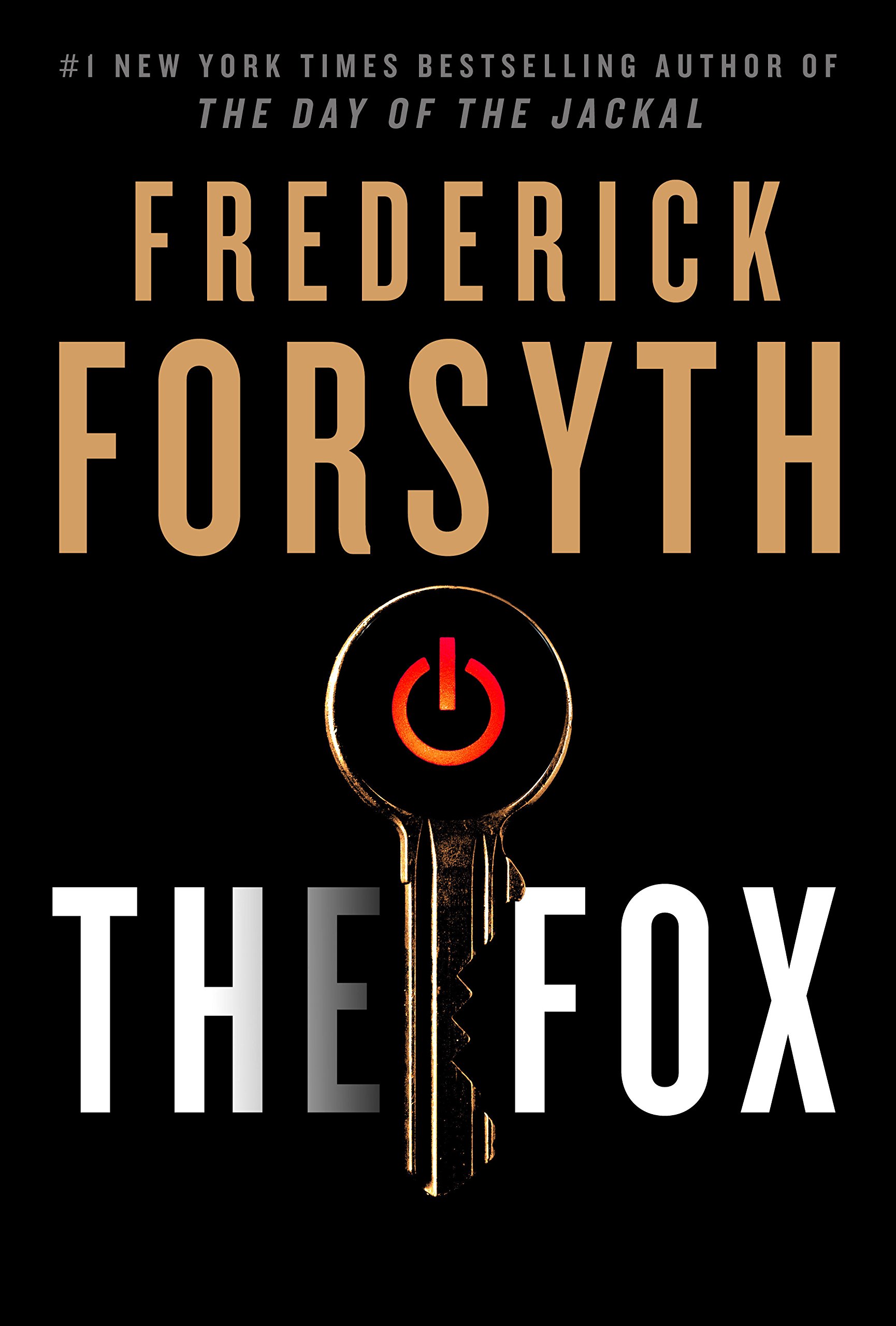
THE FOX
By Frederick Forsyth
G.P. Putnam’s Sons, $28, 304 pages
A momentous deadly war is underway against the West — intense, constant, ever-escalating, a war that makes our rapidly-changing era perhaps the most dangerous ever.
This is the warning that leaps out from the pages of Frederick Forsyth’s brilliant new thriller novel “The Fox.”
Mr. Forsyth’s latest tale, which he says will be his last, rivals his iconic first novel, “The Day of the Jackal,” that classic of the political and espionage thriller genre that 47 years ago first brought him world-wide acclaim and began his string of 17 novels that include some of the best thrillers of our time.
“The Fox” is a gripping yarn about a “war without shells, without bombs, but most of all without declaration”: cyberwar.
With every country’s security now dependent upon computers, computer systems and their archives known as databases, the great warriors in this new kind of war are ultra-skilled hackers. The lethal weapon they deploy is injecting sabotage-inflicting malicious software called malware or “Trojan Horses.” Such cyberspace sabotage could be as deadly as a nuclear strike.
Without perfect security against cyberattacks, a country might find its power grids, communications systems and everything else essential to supporting daily living suddenly disabled, triggering widespread panic.
On guard shielding potential cyberattack targets are firewalls. Standing between hackers and the most crucially important targets are firewalls so highly sophisticated and complex they are considered impenetrable.
Mr. Forsyth’s riveting tale tracks responses to the shocking discovery that all three centers most critical to U.S. national security — the Pentagon, the NSA and the CIA — have been hacked.
Whoever cracked the best-in-the-world firewalls safeguarding the most secret databases in the world must be the greatest hacker the world has ever seen — or, more aptly put, didn’t see, since no one noticed he had been there until well after he had moved on.
Oddly, although he could have done earth-shattering damage, he did none. Nor does he later when he hacks into a major financial institution from which he easily could have transferred to accounts of his own hundreds of millions of dollars.
To pinpoint the location from which he is operating, it takes some of the world’s best technological minds three months — more than enough time for such a super-genius perpetrator to wreak unimaginable havoc upon all countries and institutions he might wish to target.
To the great embarrassment of the British government which has teamed up with the United States in a top-secret search to find him, the culprit is operating from an ordinary suburban home in a town 32 miles outside London, where a team of British and American special forces captures him in a middle-of-the-night raid.
They are stunned — utterly amazed — by what they discover. What follows is a terrific narrative that reinforces Frederick Forsyth’s reputation as a master storyteller few can rival in delivering spellbinding suspense.
The United States wants the dangerous perpetrator — nicknamed “The Fox” because of his cleverness — extradited to face interrogation and imprisonment. But in an Oval Office meeting with the president and his national security team, an adviser the British Prime Minister secretly relies upon proposes an alternative.
Why not take this blisteringly brilliant hacker who has done no harm to the West and weaponize him for us to use against our enemies?
The president agrees — and it’s a sheer delight for any patriotic American or Brit to read as “The Fox” helps the West inflict humiliating nightmares against Russia, Iran and North Korea.
The West must safeguard this invaluable asset. Its enemies must exterminate him. Mr. Forsyth depicts virtuoso performances by both sides. Through his characters Mr. Forsyth provides edifying discourses on such matters as how the computer has so dramatically changed espionage and war and why old ways of espionage, especially deliberate disinformation and sleeper agents but also the brush-pass and dead-letter box of yesteryear, remain essential.
Equally edifying are his discourses on the 9/11 attacks and their aftermath; the brotherhood of three power bases that now has a stranglehold on Russia under its Vladimir Putin dictatorship; and the radical Islamic dictatorship in Iran and how they learned from the mistakes of other seekers of nuclear weapons and played the previous administration for suckers with a deal making it easy for them to keep right on lying and cheating.
So is his discourse on the Kim dictatorship dynasty in North Korea which long pursued having a nuclear arsenal and is currently engaging in a scam to buy enough time to perfect a more portable thermonuclear warhead size and greater missile payload.
This timely, well-written thriller has it all. Great plot with surprising twists and turns. Intriguing characters. Spellbinding suspense. A fast, tremendously entertaining read. Since “The Day of the Jackal,” Frederick Forsyth has been considered a giant of the political and espionage thriller genre. This giant just became even more towering.
• Fred J. Eckert, President Ronald Reagan’s U.S. Ambassador to Fiji and to the United Nations Agencies for Food and Agriculture, is a former Republican congressman from New York.

Frederick Forsyth: ‘I am not writing any more novels. The lust has gone’


By Robbie Millen
https://www.thetimes.co.uk/article/frederick-forsyth-i-am-not-writing-any-more-novels-the-lust-has-gone-krf8gl2hv
September 22, 2018
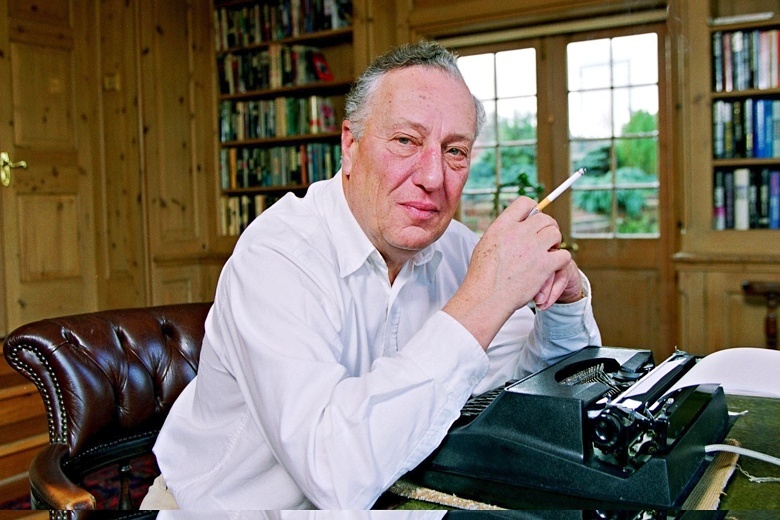
Image result for frederick forsyth

There was an explosive RAT-TAT-TAT. “The Outsider” let the violent burst of noise fade. His cold blue eyes surveyed his deadly work. He moved his trigger finger again. Another sharp RAT-TAT-TAT pierced the night. He stopped, taking a moment to admire his trusty weapon. The Nakajima AX-150. Those crafty Japanese, the Outsider mused to himself. With its typing speed of 12 cps, three levels of impression control and automatic centring, it was the most effective typewriter on the market.

There is something reassuringly old-school about the fact that Frederick Forsyth, a self-confessed “outsider” and two-finger typist, has written his 14th and latest novel on an electronic typewriter. Why shouldn’t The Fox, a thriller about cyberhacking, be created with the aid of typewriter ribbons? Forsyth, who is 80, tells me: “I’ve got three unused typewriters in a cupboard at home — enough to see me out.” He will not be silenced by any impending typewriter shortage.
Forsyth deserves his place among the thriller greats. His first three novels alone —The Day of the Jackal (published in 1971), The Odessa File (1972) and The Dogs of War (1974) — rightly give him silverback status. His great strength is that however fantastical the story might seem at first sniff, it is grounded in hard-nosed fact.
“I found myself saddled after Jackal with the reputation of getting the research right,” he tells me when we meet in a central London hotel. “I went the extra mile to bring in things that would not have been necessary. The minutiae of how a rifle works, how it is put together. It need not be in there, but it is interesting to me.”
The nerdy detail is a Forsythian signature. So in The Fox we learn about the Orsis T-5000 sniper rifle with its DH5-20x56 scope, the HADECS-3 speed cameras, even the difference between various Old Etonian ties (Forsyth went to the distinguished Tonbridge). He is annoyed that he made a small error in the proof of The Fox — he had special forces soldiers using head-mounted penlights. No, his balaclava-wearing sources told him, they would wear night vision goggles.
He is still pleased that when the mercenary Bob Denard launched a coup in the Comoros Islands in the Indian Ocean in 1978 he used The Dogs of War as a blueprint. “Amusingly, as his French mercenaries came up the beach . . . they carried a paperback edition of Les Chiens de Guerre so that they could constantly find out what they were supposed to do next,” Forsyth recounts in his swaggeringly entertaining memoir, The Outsider.
In The Fox, a team of SAS men have to dispatch some foreign agents in the British countryside. A bit implausible? Not at all, he says. “In our own sweet way we do terminations, as the special forces call them. A total wipeout is unusual, but such orders have been ordered discreetly and deniably.” Remember the Loughgall ambush of 1987 in Northern Ireland, when the SAS shot dead eight IRA members, or the ending of the Iranian embassy siege?
He clearly loves the world of cloak and dagger. In conversation he drops in words such as “slotting” (for assassinating), “Bolo” (“be on the look out”) or “The Firm” (MI6). In the late Sixties and onwards, as a journalist, he did unpaid work for MI6. Information gathering, or delivering the odd parcel (letters really are pushed under hotel room doors at midnight). “The thing about using the amateur is that he has got an impenetrable cover. I really am the Reuters correspondent. Check it out.”
Many of his books are set in war zones or involve derring-do, so I ask whether he is a danger junkie drawn to the sound of gunfire. “I always wanted to know what was going on. But the idea of ‘Goody, it’s going to be dangerous.’ No!
“When I was a youngster I had this insatiable curiosity. If I saw a range of hills, I would have to know what was on the other side. If I saw a curve in the river, I had to know what was round the bend,” he says. “And that got me into scrapes — and I managed to get out of them unscathed. There are half a dozen occasions when it could have ended there. But I was very, very lucky. I got through a number of firefights in Biafra and never got touched. Had a man beside me get his head blown away. It could have been my head.”
As he puts it in The Outsider: “During the course of my life, I’ve barely escaped the wrath of an arms dealer in Hamburg, been strafed by a MiG during the Nigerian civil war and landed during a bloody coup in Guinea-Bissau. The Stasi arrested me . . . and a certain attractive Czech secret police agent — well, her actions were a bit more intimate.” All very boy’s own.
Anyhow, he says, “in recent years I’ve been doing novels and haven’t been in any war zones”. Then he remembers that for his thriller The Cobra he arrived in Guinea-Bissau to the sound of rocket-propelled grenades — and for The Kill List, his 2013 thriller, he went to Somalia. “Sandy [Forsyth’s wife] joked, ‘If you ever try anything like that again, I’ll see Fiona Shackleton [the Prince of Wales’s divorce lawyer].’ No more harum-scarum episodes. At 75, you don’t run like you used to.
“What turns me on now? Walking the f***ing dogs,” he says ruefully. He lives in a village outside Beaconsfield in Buckinghamshire with Sandy, his wife of 30 years, stepmother to his grown-up sons, and among other things, a former PA to the film directors Nicholas Roeg and Ridley Scott, then Elizabeth Taylor. They have three Jack Russells, including a puppy. “We sleep together — I can’t get a look-in edgeways. There’s a furry bloody head between us. At 80, I’ve been surpassed by a six-month-old.” I suspect age has gentled Forsyth, who in his memoir comes across as gung-ho, rumbustious, forthright, even cocky. He reckons himself to be a quiet chap. Indeed, he is rather self-deprecating.
Back to danger. He reported from Biafra in 1968 for the BBC — and that was when MI6 approached him. Forsyth has trenchant, Brexiteering right-wing views; his weekly column in the Daily Express — “an old codger sounding off from his pulpit”, is how he disarmingly puts it — could curdle the almond milk in a liberal softie’s fair trade coffee. But his views on the civil war in Nigeria show a different side to him.
The Igbo-speaking southeast region had declared independence from the British-backed Nigerian government. A nasty war ensued — in which between 500,000 and 2 million civilians died, many through starvation. “As a journalist of 12 years’ standing, I thought I had few illusions about the mendacity of power, but I had thought that there were certain things the British wouldn’t do. I did not think we would ever help a blood-stained military junta to kill children. It would be like helping Assad today,” he says. He likens the regime’s hatred for Igbos to the Nazi hatred of Jews.
His reports about starving babies were not welcomed by the Foreign Office — or his BBC bosses. “They pretended it was all an invention by people like me. It was a lie, and they knew it was happening.” MI6, he says, was “daggers drawn” with the Foreign Office so, after he was sacked from the BBC (“It’s still moot — I think I walked and my letter of resignation reached them before I was sacked”) he was recruited by MI6 to return to Nigeria “and give them the ammo to turn Harold Wilson” against the Foreign Office line.
It cemented an enduring prejudice against “the Establishment” and its culture of balls-up and cover-up. “Cover-up is part of what they see as their mandate . . . We cannot make a mistake, we will not admit a mistake. [The Foreign Office] said it would be a two-week war. Zero casualties. Two weeks became eight and eight became fifty and so on, and they would not say that had made a mistake.”
Has he ever thought about entering politics? No! “When you join the Establishment, you sacrifice too much. You can’t disagree. You can’t call the boss a fool, you can’t take a different line from the party line. I’ve never lusted for three things. One is power — I’ve never wanted to hire and fire: that cuts out politics, the civil service, commerce and industry. I’ve never lusted for money. I’ve never lusted for fame: that cuts out telly and showbiz.”
What about sex, the fourth great impulse? “Hello, memory lane,” he quips. That reminds me of a funny passage about the popping of his 17-year-old cherry in his memoir: “the only other thing of interest during those ten weeks in the hot, sunny spring of 1956 was a torrid affair with a 35-year-old German countess . . . She taught me many things a lad should know as he steps out on life’s bumpy road. She had the quaint habit of singing the Horst Wessel song during coitus.” Class.
Before he became a journalist, he did his national service with the RAF. As a boy, his heroes were fighter aces. He tells me that in the late 1950s “we used to fly over the North Sea and intercept Russian bombers trying to penetrate our air defences. We would see this bloody great Bison, probably with a nuke on board, and formate on it. And wave at the crew. The Russians never waved back, they would just stare.”
He says he “killed the bug” for flying by doing it. Anyhow, he was not a natural soldier — “the disobedience, it’s inbuilt. Question everything. Complain. Doubt. Disagree” — so he left after two years for “the hazards of the pubs of King’s Lynn” and became a reporter for the Eastern Daily Press.
Becoming a journalist provided him with the material for his first novel. He was a Reuters correspondent in Paris during Charles de Gaulle’s presidency. “France was on the threshold of revolution, civil war maybe, a coup d’état was on the cards.” That was when the idea took shape of a thriller about ultras from the OAS, the Organisation Armée Secrète, opposed to France giving independence to Algeria, hiring an assassin to kill de Gaulle.
By then an ex-BBC reporter, writing The Day of the Jackal was a “a way of getting me out of a jam. The craziest way, most impractical way of trying to settle all my debts. So I dashed off in 35 days this story I had been nurturing for seven years.” Most publishers rejected it, but Hutchinson took the bait. It started to do well.
Later “I was offered a buyout [for Jackal] by Hutchinson — 
75,000 quid. It sounded like a very good deal. I got £25,000 for the film rights.” He did not know he had written a thriller classic. “I had to watch them screen and screen, print and print for 50 years. Nothing for old rope. I’m not complaining, I’ve had great luck.”
Indeed, he has had a 47-year-long thriller-writing career. After The Kill List was published five years ago, he said that would be his last novel. Now, he is saying that The Fox will definitely be his last. “You may bury me if I break my word. I am not writing any more novels. The lust has gone. Even the interest has gone. Who wants to bore himself to his grave? One can’t go on for infinity without the quality going.
“Writing [The Fox] was much harder for me than 20 years ago. It drained me completely. The energy is not there.” While he used to manage ten pages of A4 a day, “this was down to five a day”.
Forsyth is not going to chain himself to his typewriter. The motivation has gone — he calls himself a “glorified mercenary” because he writes to earn moolah. “Do I need the money? Nooooo. I was never compulsive about writing. I don’t have a message for the human race.”
I wonder, though, will he really stop? Remember there is a cupboard with three typewriters waiting to be unleashed.
The Fox by Frederick Forsyth is published by Bantam. The author will be in conversation with fellow thriller writer Frank Gardner on Thursday, October 11. cheltenhamfestivals.com
A balanced introduction to Ronald Reagan the man


By Aram Bakshian Jr.
October 16, 2018
Image result for reagan spitz
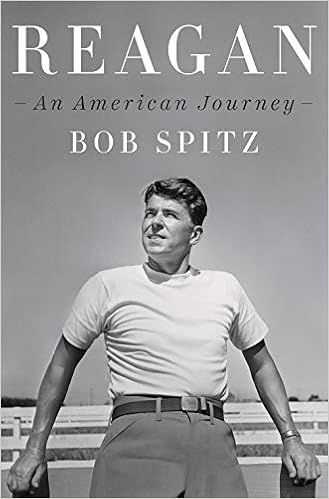
REAGAN: AN AMERICAN JOURNEY
By Bob Spitz
Penguin Press, $35, 863 pages
Question: What does Ronald Reagan have in common with Julia Child and the Beatles?
Answer: They’ve all been the subject of mammoth celebrity biographies by author Bob Spitz.
Which was why I approached reviewing Mr. Spitz’s “Reagan: An American Journey” with a somewhat jaundiced eye, expecting an overweight, cut and paste job that would read like a supermarket tabloid article on steroids.
I was wrong. Although over-long and often superficial in dealing with historical context, this is a book that probably comes as close to capturing the essence of Ronald Reagan the man — as opposed to Ronald Reagan the politician, actor, union leader or statesman — as any ever will. The result is worth reading, although patience and persistence are required to get through all 863 pages of a work that combines deep insights and shallow trivia in roughly equal measure.
Bob Spitz belongs to what I call the vacuum cleaner school of biography. He sweeps up everything he can lay his hands on in the hope that, when you sift through the contents of his vacuum bag you’ll be able to piece together the truth about his subject. He also takes a calm, almost apolitical view of Ronald Reagan the man, something which both ardent Reagan fans and fanatic Reagan haters have trouble doing because of their tendency to view our 40th president as a primarily political animal on whom they project their own partisan enthusiasms and pet peeves.
In doing so friend and foe alike sell Ronald Reagan short. He was much more than a politician. Indeed, his political career, begun relatively late in life, was the by-product of a personal odyssey that began in small-town middle America, was defined by a love of sports and drama dating from his college days, and propelled him to a respectable Hollywood career as both a second-tier movie star and a courageous union leader long before he gave a thought to running for any public office.
Like several other major presidents — George Washington and Dwight Eisenhower to name only two — Reagan was an accomplished, fully mature man of character who entered the political arena already tested and tempered by life. This is in stark contrast to the more common variety of compulsive politicians who start running for office at the student council level and spend the rest of their lives pursuing votes and applause as they struggle to climb the greasy pole. Many reach the top without really knowing who they are or what they stand for.
As Ronald Reagan’s director of presidential speechwriting during much of his first term, I had direct access to this truly remarkable man. What struck me most about him — aside from the fact that he was an incredibly likable, considerate man, full of confidence but devoid of vanity — was how genuine and consistent he was a human being. While he never stopped learning from his experience in the top job, he came to it as a true grown-up, a fully formed and formidable human being comfortable in his own skin rather than an applause craving narcissist with few if any inner convictions and no moral compass. Ronald Reagan was a man of strong convictions but moderate, self-controlled temperament, which more and more Americans came to appreciate as they got to know him.
While Bob Spitz sometimes drowns his readers with tedious details and is often politically tone deaf, he has captured the essence of Ronald Reagan the man. “One unassailable entry in the credit column,” he writes, “was Ronald Reagan’s heart. It was big and expansive. He never stopped believing in ‘the American miracle’ and the good people responsible for its achievements. He clung to the image of a nation populated by citizens ‘grounded in thoughtfulness and knowledge’ and governed by ordinary American ‘values and common sense’ In his final address to the nation … he looked into the camera like a benevolent father and reflected on his romantic view of America — the ‘shining city upon a hill’ — a place with ‘all kinds of people living in harmony and peace … ‘”
The meticulous, multi-volume Reagan biographical project of Craig Shirley remains the best source for understanding Ronald Reagan as a major historical figure. Lou Cannon’s first-hand accounts of the evolution of Reagan the candidate-politician are still second to none. But Bob Spitz has written clearly, convincingly and movingly about Ronald Reagan the man, a man who left the world a freer, better place than he found it, and who earned the respect of the people he served because he respected and appealed to what was best in them.
• Aram Bakshian Jr., a former aide to Presidents Nixon, Ford and Reagan, has written widely on politics, history, gastronomy and the arts.

Wednesday, October 17, 2018

Warren is a Fraud


By Rich Lowry
October 17, 2018
Political Cartoons by AL Goodwyn
Senator Elizabeth Warren (D., Mass.) has been telling a story for years. It’s a deeply romantic story about her parents and their young love, fraught with the familial bigotry of an earlier time. Here’s how she told it this week in a video she released in preparation for her 2020 run:
My daddy always said he fell head over heels in love with my mother the first time he saw her. But my daddy’s parents, the Herrings, were bitterly opposed to their marrying because my mother’s family, the Reeds, was part Native American. This sort of discrimination was common at the time. So when my momma was 19 and my daddy was 20, they eloped. And together they built a family, my three older brothers and me.
They were a regular Romeo and Juliet of the American plains.
There’s only one problem with Warren’s story: There wasn’t a shred of evidence that Warren had Native American ancestry, outside of her claims that she did. For years, she portrayed herself as Native American in legal directories. And she has maintained her Native American ancestry in politics as well.
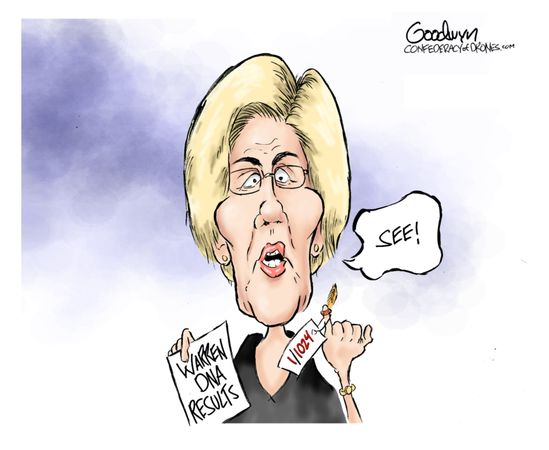
Whatever credibility Warren had on the issue was shattered this week — by Warren herself. Irked at President Trump’s irreverence regarding her purported bloodline, Warren released the results of a DNA study done by Professor Carlos Bustamante of Stanford University. Those results showed that a Native American ancestor may have existed in Warren’s family tree “in the range of 6–10 generations ago.” This would make Warren somewhere between 1/64th Native American and 1/1024th Native American.
It’s quite hilarious — and remarkably tone deaf — that Warren thought the study would make her problems go away rather than exacerbate them. But she was counting on a little help from her friends in the media. They did their best. The Daily Beast headlined, “Elizabeth Warren Fights Trump’s ‘Pocahontas’ Taunt with DNA Test Proving Native-American Roots.” NBC went with “Elizabeth Warren Releases DNA Results Indicating She Has Native American Heritage.” MSNBC cheered, “DNA Test Results Allow Elizabeth Warren to Turn the Tables on Trump.”
But by the end of the day on Monday, her narrative had absolutely collapsed: Even the Cherokee Nation released a statement blasting Warren for her pretentions to Native American group membership.


So, here’s the question: Why was this so important to Warren?
After all, she could rest on the fact that the Boston Globe reported just six weeks ago that Warren’s Native American status wasn’t a factor in her hiring at Harvard Law School. Why couldn’t Warren just say — as, in fact, she claims in the pages of the Globe — that she claimed Native American ancestry because she believed the stories she was told by her female relatives, and that those claims may have turned out to be false but had no impact in any case on her career development?
Because claiming minority status did and does have value to Warren. Her Native American ancestry claims may not have been a factor in her hiring at Harvard Law, but the University of Pennsylvania listed Warren’s 1994 teaching award in its Minority Equity Report. Harvard Law listed her as Native American in the university’s annual affirmative-action report; administrators listed her as such from 1995 to 2004. It took real action from Warren herself to be listed as Native American at the institutions at which she worked. Minority status adds luster to a résumé in academia.
And in politics. Warren knows that without her claims of Native American ancestry, she’s merely another successful white woman in an era in which the base of her party has dismissed white women as part of the privileged class. Claiming connection with a historically disadvantaged minority is politically useful to Warren — even if that connection is gossamer-thin. By the intersectional logic of the Left, ancestry is destiny, and those of minority ancestry are bound together by a common fate.
Warren wants to be seen as part of that coalition. She can’t be unless she can claim victimization on grounds of something beyond sex — female status isn’t enough these days. Thus, Warren, using a perversely race-centric view of the world that suggests one drop of Native American blood renders you Native American, has classified herself with emerging future of the Democratic party rather than with its demographic past.
Perhaps the Left will let her get away with it. Perhaps they won’t. But the saga of Elizabeth Warren demonstrates once again that the ugly new identity politics dominating the Left drives its own acolytes to radical dishonesty to avoid being cast out of the club.

Tuesday, October 16, 2018

Hillary’s #MeToo Nightmare

By Rich Lowry
October 16, 2018
Image result for bill hillary clinton 2018 tour
Hillary Clinton won the political battle over Bill Clinton's sexual misadventures in the 1990's at the cost of having to litigate them forevermore.
In the era of #MeToo, her defenses and rationalizations for Bill are especially tinny and embarrassing. But she can’t show any weakness — any more than she could in 1998, when she helped rally the White House — lest she implicitly admit that providing cover for her husband’s misconduct for years was a mistake, or at least a significant compromise of her feminism.


Advocating for “believing women” when your husband and political partner has had so many accusers is a test of audacity that Hillary remains determined to pass, as she demonstrated when two recent interviewers brought up the Monica Lewinsky scandal.
CBS News correspondent Tony Dokoupil wanted to know if a 49-year-old President Clinton carrying on with a 22-year-old intern was an abuse of power. Hillary rejected the notion out of hand. How, Dokoupil followed up, could an intern really consent, given the vast power dynamic? She was an adult, Hillary shot back.
About this she is obviously correct. Monica Lewinsky may have acted immaturely and foolishly, but there’s no doubt that she acted willingly, no matter how much she may — understandably — regret it now.


Bill Clinton’s role was blameworthy nonetheless. It doesn’t take a fourth-wave feminist to realize that a president of the United States having an intern he barely knows perform oral sex on him while he talks on the phone in the Oval Office is grossly exploitative. If this had been a movie director or a media executive, everyone would recognize it as an appalling abuse of power, even Hillary Clinton.
When Christiane Amanpour also asked Hillary about 1998 and what the difference is between what Clinton did and Donald Trump is accused of, Hillary replied, “the intense, long-lasting, partisan investigation in the ’90s.”
The investigation doesn’t make the underlying conduct any better, though. Clinton should have been fully aware of the potential political and legal consequences of his actions. That he initiated a sexual relationship with a White House intern while former Arkansas state employee Paula Jones pursued a sexual-harassment lawsuit was practically an invitation to get asked about Lewinsky under oath. Of course, when he did, he lied, and the rest is history.
Beneath Hillary’s answers in both interviews — and whenever Bill is asked about the scandal — there’s clearly a simmering anger. Both of them are still infuriated that he got caught and paid a price, and that it keeps coming up.


Usually, they are only asked about Lewinsky. But Clinton’s White House misadventure wasn’t a one-time lapse. In keeping with the most compelling #MeToo cases, there was a pattern of conduct going back decades. Clinton used Arkansas state troopers to procure women for him. Most troubling, Juanita Broaddrick accuses Clinton of raping her in the 1970s, an allegation that liberal journalists Chris Hayes, Michelle Goldberg, and Ezra Klein now say they find credible.
If Hillary doesn’t want to spend her time re-litigating 20-year-old scandals — as well as her loss in 2016 — she could simply step out of the public eye. It’s not as though her own side gains anything from her constant presence. Nor will the 2020 Democratic field lack for women candidates. All of those candidates will presumably be less conflicted talking about #MeToo, because they’ve never mounted bare-knuckled political defenses of their powerful, scandal-plagued husbands.
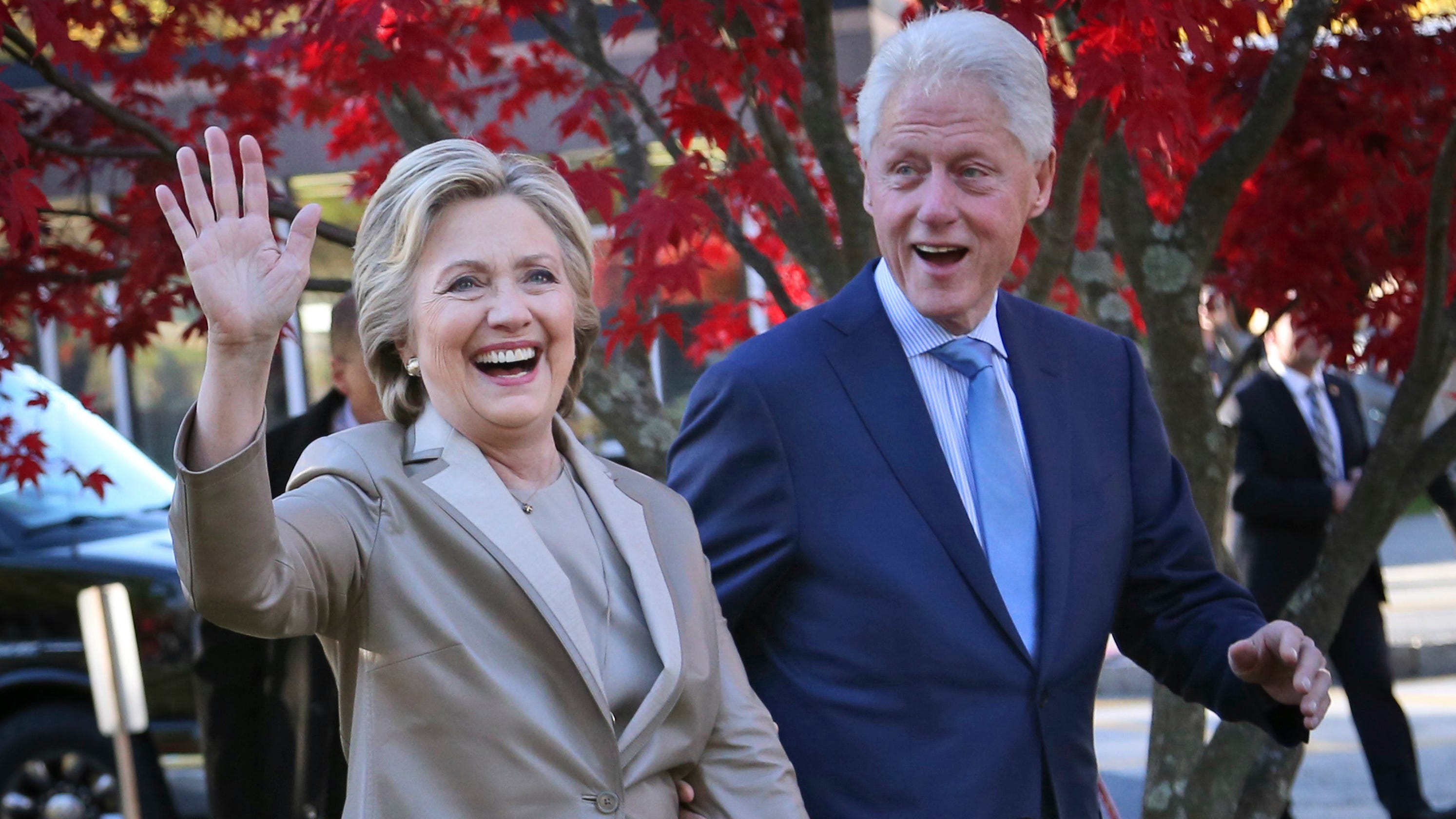
But Hillary isn’t going anywhere. She and Bill are about to embark on a nationwide speaking tour. Their prominence will serve as a reminder that no matter what progressives say now, when push came to shove and they had to decide between protecting one of their own in high office and their feminist principles, it wasn’t even a close call.
This is a public service of a sort, although one that no Democrat should welcome.