Sunday, August 04, 2019

The Opioid Epidemic from a Rural Prosecutor’s Perspective


By John Litle
https://amgreatness.com/2019/08/03/the-opiod-epidemic-from-a-rural-prosecutors-perspective/
August 3, 2019

The view of downtown Zanesville from Putnam Hill Park
Zanesville, Ohio (Thesteeleisreal)
I was at the end of a meeting with a mother whose child is a victim of the country’s opioid epidemic. “So, I’m trying to write about how the opioid epidemic is affecting us,” I informed her. She responded immediately: “It touches everyone, it’s everywhere. I mean, how did it get to this?”
“Where do I even start?”
Muskingum County, Ohio, is a typical Midwestern community full of kind, generous, and community-minded folks. Social and volunteer organizations flourish. Local philanthropists have made it a point to invest heavily here, to the entire community’s benefit.
Zanesville, the county’s seat, weathered the storm of the Great Recession better than many Midwestern small towns, but you can still see the scars.
Even so, the county has a little bit of anything you might want. You can live in a historical district, a downtown artist colony, or so far out in the country hills that you’ve got no mobile phone coverage. There’s farm-to-table food, fast-food joints, and Tom’s Ice Cream Bowl, voted USA Today’s “Best Ice Cream Shop in America” as every proud Zanesvillian is pleased to tell you. It’s Midwestern small-town America.
It’s a good community, with 86,000 decent, hard-working people. Yet every person here knows or is acquainted with someone who is affected by what the media calls “the opiate crisis.” It is a scourge our country allows to rage on, unfettered.
It’s been several years since Sam Quinones came through Zanesville to discuss Dreamland, his seminal work discussing the rise and proliferation of America’s opiate epidemic, in large part focusing on my part of the country. Earlier this year, Javier Peña and Steve Murphy, the agents portrayed in Netflix’s “Narcos,” spent a day-and-a-half here discussing their experiences with Columbian, and then later Mexican cartels smuggling mass quantities of narcotics into the United States. Meeting them and hearing their observations was a great opportunity, and very eye-opening.
But what I actually see prosecuting felony drug cases in Eastern Ohio today bears little resemblance to Quinones’s description of overprescribed Oxycontin and specialized Mexican poppy-towns. And for what it’s worth, there are no “Breaking Bad”-style Walter Whites or Jesse Pinkmans cooking meth here anymore, either.
No, what we face is industrially produced meth that makes it all the way to low-level distributors as “big as your thumb” crystals, and uncut fentanyl so dangerous that cops don’t dare touch the drugs they confiscate.
Cheaper and Deadlier
To the uninitiated in this world, some background is illustrative. Let’s say we want to work a drug trafficking case in my county, from a law enforcement perspective. Dope comes in kilos, half kilos, nine packs (nine ounces/quarter kilo), zips (ounces), half-ounces, quarters, eight-balls (1/8 ounce or 3.5 grams), and on down to tenths of grams. An eight-ball gets you to a third-degree felony.
Four years ago, this eight-ball would cost somewhere between $300 and $350, depending on the target and the way you were working the case. Those were Appalachian Ohio prices.
Last month, our department was able to purchase an eight-ball of meth for just $60. At that price, a single hit of meth is cheaper than a cheap cup of coffee in Zanesville.
It pours over the U.S. border with Mexico like a raging torrent. There are no meth labs anymore because no one can afford to make it. The combined price of the components (lithium batteries, Coleman fuel, lye, Sudafed, hydrochloric acid, etc.) is now considerably greater than the cost of the imported Mexican product.
In the early 1990s, major cities fought crack-fueled inner-city gangs. We spent much of 2018, in rural Muskingum County, Ohio, battling a meth-slinging prison gang running wild on our streets. We can strike back against these scourges when we have the will to do it.
The other new development is fentanyl and its derivatives. Fentanyl is a synthetic opioid that can be manufactured with the right chemicals—just like meth—in someone’s bathtub or garage. Fortunately or unfortunately, that’s not actually happening because much like meth, fentanyl is flowing into the country like a river. And it’s a lot more convenient than the heroin it is replacing. Smuggling one kilo of fentanyl across the border is the financial and narcotic equivalent of smuggling thirty (30) kilos of heroin. And fentanyl doesn’t require a field to grow.
Being 30 times as potent as heroin, fentanyl is administered medicinally as a fluid, or as a patch absorbed through the skin. Officers coming in contact with the substance on the streets similarly absorb it through their skin, leading to overdoses. A good friend of mine nearly overdosed after placing a bag of powder into the evidence container in the back of his cruiser and driving back to the station. He had to be “narcanned” on the side of the road.
Narcan is the common term referring to a drug called Naloxone, sometimes considered a “Lazarus” drug for its ability to immediately reverse the effects of an opiate overdose. It is so prevalent that “narcanned” has become common parlance.
Related image
Y-Bridge, Muskingum County, Ohio (Muskingum County)
Fentanyl Reigns Supreme
Drug dealers are smart and ingenious. Today, they’re using fentanyl for, and in, everything. It is so much more potent by weight and consequently so much easier to smuggle, conceal, and cut that it is showing up in a throw-back reference to the original hook of Quinones’s Dreamland, pills. Now, when you buy what is said to be a prescription pill on the streets of Ohio, the chances are good that the pill is actually fentanyl that has been pressed—properly colored, shaped, and marked—into a pill that looks just like your perc 20, (Percocet 20mg) or your Oxy.
Just a year and a half ago, in February and March of 2018, 17 people died in Muskingum County from overdoses related to fentanyl. Many of them I knew as names common from police reports and investigations. One of them I knew as the son of a dear friend, a friend so bent by grief that he died of a heart attack just two weeks later.
With some of the overdoses, the bulk trafficker of fentanyl to my area sent uncut product to his customer, and that man—the dealer selling the poison from a hotel in my community—wasn’t smart enough to compound it correctly in his heroin. This resulted in a string of overdoses among his users. Perversely, in these circumstances word spreads among the opiate addicts that the dealer with the strongest heroin has “the best stuff” creating a greater demand for the most dangerous drugs. Herein lies one of the moral hazards of narcan.
Some of the other overdose deaths had a separate, equally distressing cause, and one related to efforts to treat opiate addiction. Vivitrol is a monthly shot developed to combat opiate addiction. While expensive, vivitrol works pretty miraculously to block the effects of opiates on a person. Much as narcan reverses the effects of opiates acutely, vivitrol makes it so you cannot get high from opiates for up to a month at a time. Unfortunately, it still lets you get high from meth.
And addicts are not so much addicted to a specific drug as they are addicted to getting high.
So when an opiate addict can’t get high from opiates, getting high from meth is the next best thing. Worse, dealers have started making their meth “better” by cutting it with fentanyl. Without a prolonged medical discussion, when a person stops taking vivitrol, or relapses out of a period of recovery, they are significantly more opiate naïve than when they started treatment, and a lesser quantity of opiates than they are in the habit of taking will cause them to have a fatal overdose. For instance, the amount of fentanyl now mixed in with their methamphetamine might kill them, or the fact that they started vivitrol before fentanyl was on the streets might mean their first hit of “fetty” is deadly.
By the end of February 2018, we had the first of several multiple-overdoses in the county jail when an inmate—having hidden fentanyl in his rectum during a traffic stop and arrest—distributed to other inmates the fentanyl he smuggled into the jail.
In March 2018, my office laid down the first indictment for involuntary manslaughter against a dealer we could prove had sold the fentanyl that killed one of his customers. Such prosecutions are exceedingly difficult given that the addict is no longer alive, and fellow addicts tend to steal the evidence, tamper with the scene, and act to defend their drug supplier. Citizens and juries do not seem to be excited about the charges either, given that the drug is something an addict “chose to put in their body.” In contrast, my office views the charges as an opportunity to increase the risks inherent to dealing drugs, provide closure for survivors, and rid the streets of dangerous individuals.
In 2016, my office indicted 420 felony cases. In 2017, it was 500. In 2018, it was 758.
Now we are eight months into 2019, and what a difference a year makes. At this point, opiate users aren’t buying heroin cut with fentanyl anymore. They’re seeking out and buying straight fentanyl.
Hazardous Solutions
We made narcan over-the-counter, and we even give it away for free. Overdose deaths are down. But now addicts are having narcan parties. I am not making this up. Everyone gets their narcan together and sees how close they can get to dying, knowing the narcan is there to save them. EMS crews routinely have to utilize 10 or more doses of narcan to revive an addict for a single overdose, and just as routinely they have to revive the same addict more than once in the same 24 hour period. As I said, it’s creating a moral hazard.
In social circles, and more often in social media, it is not uncommon periodically to hear the refrain that “narcan should be illegal” or that it should be limited to a single use or application. Of course, serious discussion always leads to an acceptance that no decent person could live with allowing someone to die in front of their eyes if it were in their power to stop it from happening. But the expression exposes a deep frustration held by many about the intractable problem created by a cycle of synthetic opiate and methamphetamine abuse by persons with no interest whatsoever in reform, recovery, treatment, or rehabilitation.
The courts are not the solution to addiction. They’re a tool that sometimes helps certain addicts find their bottom, when family, friends, and self-interest have not been enough. Alternatively, the courts can shuffle off those who feast on the sores of addiction to be warehoused in a place where society is protected from their actions.
Cases aren’t just mounting in felony court. They’re mounting in juvenile court where my office takes custody of more and more children every year. They’re mounting at Job and Family Services, where more and more children have a single living functioning parent, or none. Another generation is being raised by grandparents. Children injured or killed due to the actions of their drug-intoxicated parents and caregivers used to be an unfortunate anomaly on the docket. Now it’s a routine problem. Another child died two weeks ago at the hands of a meth-addled assailant.
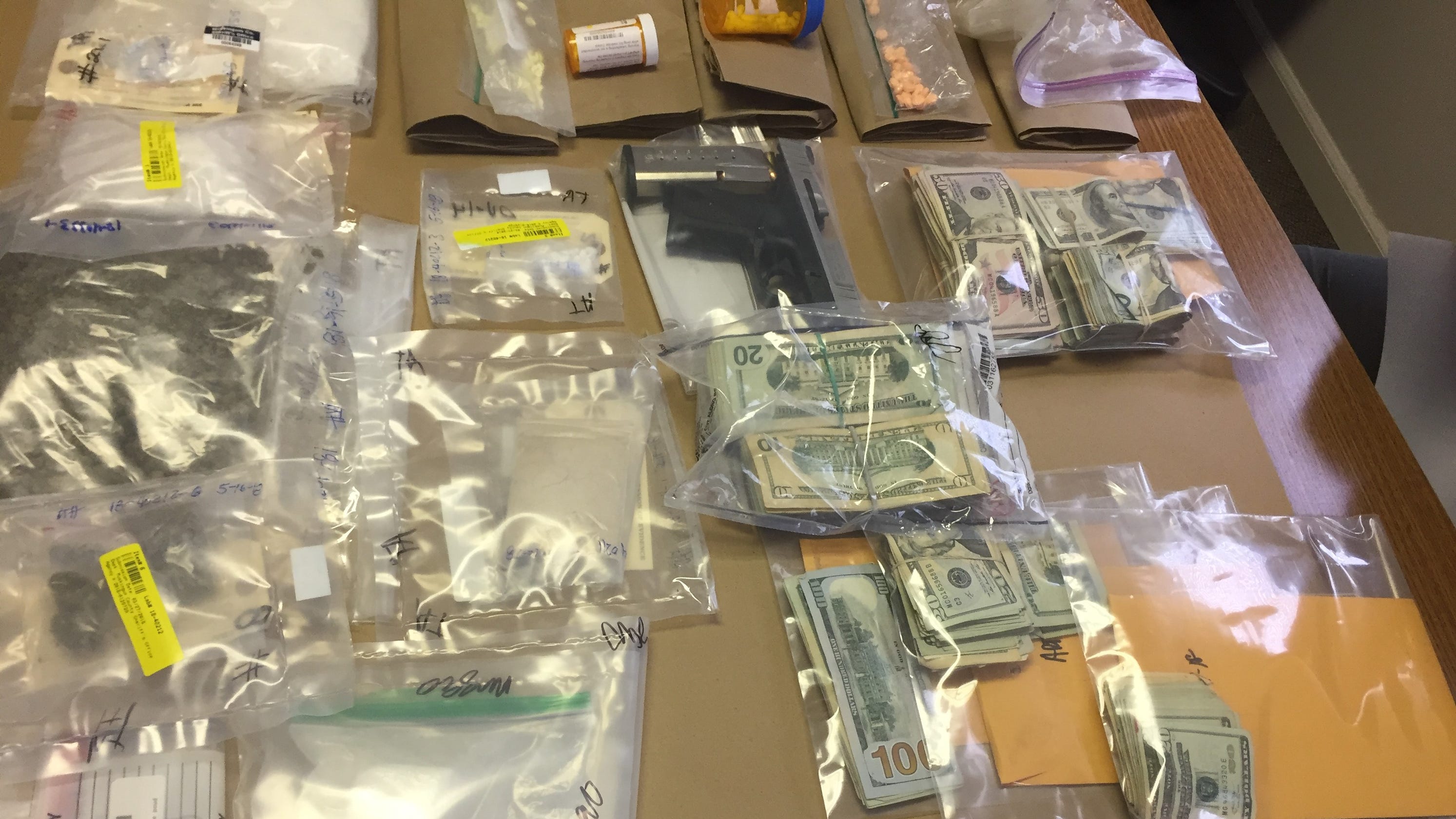
Image result for zanesville ohio drug bust
Drugs, cash and firearms seized in 2018. (Shelly Schultz/Zanesville Times Recorder)
People take it in stride. Ohioans are hardy and good-natured. Two years ago, one community initiative opened a restoration park including communal gardens, fountains, and green spaces for public movies and entertainment. The gardens are a hit, growing every year. Yet recently, caretakers have had to add the weekly chore of removing the needles and detritus left by voluntarily homeless addicts who treat themselves to the free vegetables. As in California, scores of voluntarily homeless people are a new and growing phenomenon in this place. It’s not acceptable. Is this to be the way of things?
There may be solutions. But we don’t appear ready to pursue them.
Give Addicts Shelter
It is rational to accept that drug addicts have an addiction but it is not rational to permit or enable their addiction. In a related matter, as a society, we have come to accept that victims of domestic violence struggle mightily to break free from the pressures of all types which keep them trapped in a hostile, dangerous and oftentimes deadly environment. They know the dangers and still stay. Even so, almost all communities have and maintain domestic violence shelters. These are places safety and confidentiality where a person can go to escape on perhaps the one day they have the strength to leave.
Without a waiting list, without judgment, without barriers, without court orders, and without others who have been ordered by the courts to be there, these shelters offer a haven. These shelters are, importantly, a place of refuge where no one can send a person, and where no one can force a person to stay. We have nothing like this for drug addicts.
This type of no-judgment, non-compulsory, no-wait narcotics shelter is an asset we desperately need. But it’s not as easy to set up a place like this as it is to establish a domestic violence shelter. There are medical needs. It’s far more expensive. Most importantly, people have a natural sympathy for victims of domestic abuse that is often absent in cases of drug abuse. That is to say, people feel a genuine desire to reach out and volunteer their time and effort—the real currency of intervention—to lift up women who have suffered at the hands of an abuser. Moreover, former victims of domestic abuse can intervene to assist others who are struggling to escape without risk of re-entering the danger. Most of these factors do not apply to the opiate epidemic.
Readers, social-media commenters, voters, and legislators believe it is the “right thing to say” that drug addicts should get treatment and care, but few and far between are those with a selfless interest in the vocation. It’s one thing to muse in an academic way over what could be useful in combating this crisis, but someone needs to pick up and carry the flag, and it’s not the type of work that draws out the passionate volunteer.
Addicts aren’t puppies, and if they were, Ohio would be experiencing an opiate rescue, not an opiate crisis. Addicts are liars, thieves, and fiends during their addiction. They will tell you so in recovery. So there’s no wellspring of sympathy or empathy for that.
Ohio’s approach to the opiate epidemic and the roaring return of methamphetamine—like much of the nation’s—has echoed the banal appeal to “treatment” as a cure. Budgets and legislation repeatedly throw money at politically-connected, court-subsidized, compulsory treatment facilities and “specialized docket” courts. The specialized docket courts, which meet weekly with a judge, and more often with counselors and probation officers, are considered the most successful approaches Ohio courts currently use for drug treatment. “Most successful” means at best a 15 percent rate of not returning to drug use or crime within three years. Fifteen percent is better than nothing, but it is not “success.”
What the Crack Epidemic Taught Law Enforcement
When it comes to law enforcement and the courts, we actually already know how to defeat the opiate epidemic. We’ve done it before. We beat the crack epidemic. We drove out the violent insanity which was destroying Ohio neighborhoods and families. And we did that by utilizing the criminal courts to treat people who were caught committing crimes as criminals; by treating people who sold crack as violent poison-pushers, not misunderstood future collegians; and by stemming the tide of drugs flowing into the country with concrete action, rather than spreading out a red carpet along all of our borders for drug cartels to bottom out the price of poison everywhere in the country.
We don’t have crack houses all over the place anymore because we took the people who ran the crack houses and we put them in prison for so long that not only would the crack crisis have passed before they got out of prison, but everyone else was forced to stand up and take note of their sentence. Economics is economics. If you are actually going to attempt to ban a substance that has high demand, you must make the risk/reward calculus obvious and simple. The risk of apprehension multiplied by the likely punishment must exceed in value by orders of magnitude the anticipated reward in light of the alternative opportunities. And in order to make that message heard by all, a multiplication factor must be applied.
Basically, the punishment for selling drugs needs to seem unfair, draconian, and very scary to those likely to deal drugs. It must be sufficient to cause them to forego easy money and choose a life either of legal hard work or, as is the sad reality of our nation, government-funded dependency. In the United States, we did that once, and we won the crack epidemic with a combination of punishment and economic opportunity.
In contrast, today federal lawmakers bicker over palace intrigue and leave the barn doors open while Mexico and China flood our streets with dirt-cheap poison. Ohio lawmakers seem intent on singing kumbaya in a drum circle, hoping it will all go away if we just love the addicts enough. It will not. So, we put on our latex gloves, pick the needles out of the cuke bed, head off to work, and do our best to clean the streets while too many of our friends and neighbors die.
The opiate epidemic is real and it connects with everyone, but the community here is stronger than the dope. Most people here probably rarely give it a thought, until it touches home again.

There Is No Epidemic of Racist Police Shootings


By Heather Mac Donald
July 31, 2019
Related image
The Democratic presidential candidates have revived the anti-police rhetoric of the Obama years. Joe Biden’s criminal-justice plan promises that after his policing reforms, black mothers and fathers will no longer have to fear when their children “walk the streets of America” — the threat allegedly coming from cops, not gangbangers. President Barack Obama likewise claimed during the memorial for five Dallas police officers killed by a Black Lives Matter–inspired assassin in July 2016 that black parents were right to fear that their child could be killed by a police officer whenever he “walks out the door.” South Bend mayor Pete Buttigieg has said that police shootings of black men won’t be solved “until we move policing out from the shadow of systemic racism.” Beto O’Rourke claims that the police shoot blacks “solely based on the color of their skin.”
new study published in the Proceedings of the National Academy of Sciences demolishes the Democratic narrative regarding race and police shootings, which holds that white officers are engaged in an epidemic of racially biased shootings of black men. It turns out that white officers are no more likely than black or Hispanic officers to shoot black civilians. It is a racial group’s rate of violent crime that determines police shootings, not the race of the officer. The more frequently officers encounter violent suspects from any given racial group, the greater the chance that members of that racial group will be shot by a police officer. In fact, if there is a bias in police shootings after crime rates are taken into account, it is against white civilians, the study found.
The authors, faculty at Michigan State University and the University of Maryland at College Park, created a database of 917 officer-involved fatal shootings in 2015 from more than 650 police departments. Fifty-five percent of the victims were white, 27 percent were black, and 19 percent were Hispanic. Between 90 and 95 percent of the civilians shot by officers in 2015 were attacking police or other citizens; 90 percent were armed with a weapon. So-called threat-misperception shootings, in which an officer shoots an unarmed civilian after mistaking a cellphone, say, for a gun, were rare.
Earlier studies have also disproven the idea that white officers are biased in shooting black citizens. The Black Lives Matter narrative has been impervious to the truth, however. Police departments are under enormous political pressure to hire based on race, despite existing efforts to recruit minorities, on the theory that doing so will decrease police shootings of minorities. Buttigieg came under fire from his presidential rivals for not having more black officers on the South Bend force after a white officer killed a black suspect this June. (The officer had responded to a 911 call about a possible car-theft suspect, saw a man leaning into a car, and shot off two rounds after the man threatened him with a knife.) The Obama administration recommended in 2016 that police departments lower their entry standards in order to be able to qualify more minorities for recruitment. Departments had already been deemphasizing written exams or eliminating requirements that recruits have a clean criminal record, but the trend intensified thereafter. The Baltimore Police Department changed its qualifying exam to such an extent that the director of legal instruction in the Baltimore Police Academy complained in 2018 that rookie officers were being let out onto the street with little understanding of the law. Mr. Biden’s criminal-justice plan would require police hiring to “mirror the racial diversity” of the local community as a precondition of federal funding.
This effort to increase minority representation will not reduce racial disparities in shootings, concludes the PNAS study, since white officers are not responsible for those disparities; black crime rates are. Moreover, lowered hiring standards risk bad police work and corruption. A 2015 Justice Department study of the Philadelphia Police Department found that black officers were 67 percent more likely than white officers to mistakenly shoot an unarmed black suspect; Hispanic officers were 145 percent more likely than white officers to mistakenly shoot an unarmed black suspect. Whether lowered hiring standards are responsible for those disparities was not addressed.
The persistent belief that we are living through an epidemic of racially biased police shootings is a creation of selective reporting. In 2015, the year the PNAS study addressed, the white victims of fatal police shootings included a 50-year-old suspect in a domestic assault in Tuscaloosa, Ala., who ran at the officer with a spoon; a 28-year-old driver in Des Moines, Iowa, who exited his car and walked quickly toward an officer after a car chase; and a 21-year-old suspect in a grocery-store robbery in Akron, Ohio, who had escaped on a bike and who did not remove his hand from his waistband when ordered to do so. Had any of these victims been black, the media and activists would probably have jumped on their stories and added their names to the roster of victims of police racism. Instead, because they are white, they are unknown.

The “policing is racist” discourse is poisonous. It exacerbates anti-cop tensions in minority communities and makes cops unwilling to engage in the proactive policing that can save lives. Last month, viral videos of pedestrians in Harlem, the Bronx, and Brooklyn assaulting passive New York Police Department officers showed that hostility toward the police in inner-city neighborhoods remains at dangerous levels.
The anti-cop narrative deflects attention away from solving the real criminal-justice problem, which is high rates of black-on-black victimization. Blacks die of homicide at eight times the rate of non-Hispanic whites, overwhelmingly killed not by cops, not by whites, but by other blacks. The Democratic candidates should get their facts straight and address that issue. Until they do, their talk of racial justice will ring hollow.

Saturday, August 03, 2019

11 QUESTIONS & A CUP OF COFFEE: AUTHOR AND FORMER NAVY SEAL JACK CARR


By 


Former U.S. Navy SEAL Jack Carr came out of the shadows after many years in the special operations community to release his debut novel “The Terminal List,” which features fictional former Navy SEAL James Reece going on the warpath after his family is murdered to help cover up a deeper conspiracy. The book was a fan favorite, and even No. 1 New York Times bestselling author Brad Thor said that it was “absolutely awesome! […]  rarely do you read a debut novel this damn good.”

Coming off those rave reviews, Carr is now set to release the second book in his Reece series, “True Believer,” in July. We sat down with Carr for an interview over a cup of coffee for Coffee or Die’s latest installment of 11 Questions.
COD: How do you take your coffee?
JC: I don’t just take it strong and black. I take it the same way that James Reece does in “The Terminal List” and “True Believer.” I wanted to humanize that character a bit. I like a light roast. Silencer Smooth. I put a little honey in there and a bit of half-and-half.
COD: How do you make your coffee?
JC: In Iraq, I loved the French press. The human intelligence guys had coffee sent from home. When I did my rounds as a Troop Commander, we would grind the coffee right there, put it in the French Press, boil the water, pour it in, let it sit for a little while, and press that thing down.
But with kids running around, the dog barking, my wife packing bags for school, making lunches — I don’t do that at home. As much as I’d like to do the French Press, we have one of the big machines that grinds it up and does everything for you.
COD: What’s the most bizarre/extreme place you’ve ever drank (or made) a cup of coffee?
JC: With mortars coming in while in the intel shop in Iraq.
COD: What’s the hardest thing you’ve ever done (physical or mental)?
JC: The toughest thing I’ve ever done is raise a child with severe special needs. Our middle child has a mutation of the NR2F1 gene, which is a gene that helps form the brain. It manifests itself as a global development disability, meaning he needs 24/7 full-time care for life. The additional stress that it puts on our family is difficult to describe.
My wife dealt with it all alone while I was deployed and continues to deal with it today when I am on the road and when I am home writing. We hope that our situation is making our family more loving, compassionate people. Our next mission in life is helping him reach his full potential, whatever that may be.
COD: What motivates you to do what you do?
JC: I’ve always wanted to do this since I was a little kid. I love reading, writing, and learning. My mother was a librarian. So, I naturally gravitated toward it.
COD: What do you think is the most misunderstood thing about you or the work you do?
JC: We were just guys who did a job. That job just happened to be special operations. The misconception may be that we are a lot stronger, tougher, and smarter than we actually are.
COD: How do you define success?
JC: In my case, I think success is looking back and seeing how your kids turn out. That they are good, compassionate people and citizens of this country. That they want to turn this country over to their kids with the same freedoms that they enjoyed.

COD: Mountain view or ocean view?

JC: I did the ocean-view thing for quite some time, so now it’s time for the mountain view.
COD: If you could have any superpower, what would it be?
JC: Going back in time would be a pretty cool superpower. I’d go back to 1873 as an 18-year-old when the Colt Single Action Revolver came out, so I could be quick on the draw.
COD: What are your hobbies, outside of what you are known for?
JC: I don’t consider myself a “hobbyist.” Everything I’ve done and everything I do defines my lifestyle. These days I ays think about being with my kids. It’s not a hobby, but that’s what I think about a lot. I love spending time with them.
COD: On a scale of 1-10, how confident are you in youralw ability to survive in a post-apocalyptic world (1= I’m dead on day one, 10 = king of the new world order).
JC: (Laughs) Let’s just say I’m prepared for the latter.


Friday, August 02, 2019

Finally, a Democrat worth supporting


By Brendan O'Neill
https://www.spiked-online.com/2019/08/02/tulsi-gabbard-finally-a-democrat-worth-supporting/
2 August 2019

Image result for tulsi gabbard
Tulsi Gabbard (AFP/Getty Images)
The liberal establishment is so scared of Tulsi Gabbard that they’ve convinced themselves she’s an unwitting stooge of Russia, being pushed by Putin’s evil online robots to destroy America from within.
Yes, in the febrile, conspiracist, Russian-bot-obsessed brains of the increasingly unhinged liberal elite, Ms Gabbard, the Democratic congresswoman for Hawaii and easily the most impressive 2020 presidential candidate, is the fave of those dastardly bots whose ultimate aim is to screw over the USA. Following this week’s Democratic candidates’ debate in Detroit, in which Gabbard made mincemeat of the California Democrat Kamala Harris on the issue of judicial authoritarianism, an actual New York Times writer said: ‘Beware the Russian bots and their promotion of Tulsi Gabbard and sowing racial discord, especially around Kamala Harris.’
This idea that Gabbard – the most principled critic of military interventionism to have emerged in the US mainstream in decades – is in the ascendant because Russian bots and other evil online forces are doing her bidding is becoming widespread among centrists.Newsweek columnist Seth Abramson says ‘there’s a concerted far-right effort (possibly involving foreign actors) to bolster Tulsi Gabbard’. He based this nuts claim on the fact that, during the Detroit debate, Ms Gabbard was the most-searched name online in every state in the US. Erm, isn’t it possible that viewers who weren’t entirely sure who Ms Gabbard is, but who were impressed by her articulate takedown of Harris and other candidates, took to the web to find out more? Surely that’s a more rational explanation than the idea that a Russian troll army and loads of fascists are on the web promoting Gabbard as chief wrecker of the United States.
It’s ceaseless. ‘Russia’s propaganda machine discovers 2020 Democratic candidate Tulsi Gabbard’, declares NBC News. What all this nonsense reveals is that Russophobic conspiracy theories play a really important role for dazed Hillary-era centrists. They are now the main means through which these people try to make sense of a political world that no longer conforms to their tastes or their ideology. So just as they used the Russian-bots rubbish to explain why Trump beat Hillary, now they use it to explain why a candidate who, horror of horrors, is opposed to US military intervention overseas is proving popular with viewers and voters. Given that Gabbard’s worldview runs so counter to theirs – on war, on free speech, even on identity politics – the only way they can explain her presence in politics is as a result of foreign, fascistic meddling. That tells us far more about their own political arrogance than it does about Gabbard’s Russian fanbase.
In a sense, they’re right to be scared of Gabbard. She feels like a genuinely fresh force in Democratic politics. A former soldier who served in Iraq, and now the Democratic member of the House of Representatives for the 2nd congressional district of Hawaii, she represents a challenge both to the old militaristic US establishment and to the newer, more woke wing of the establishment.

She is best known for her principled opposition to American militarism in Iraq, Afghanistan and Syria. ‘We were all lied to’, she said of the Iraq War in the Detroit debate. She described the spun stories about Saddam Hussein’s WMD and connections with al-Qaeda as a ‘betrayal of the American people’. Even more stingingly, she argues that far from defeating al-Qaeda in the post-9/11 period, the US has ended up backing al-Qaeda-derived forces, especially through its support for so-called ‘rebels’ in Syria who, as Gabbard rightly says, are in fact dangerous Islamist groups.
She gets a huge amount of flak for her anti-war stance. Establishment figures denounce her as an ‘Assad apologist’. She met with Bashar al-Assad during a fact-finding mission to Syria in 2017, and ever since she’s been called a friend of dictators by pro-militarist elements in the US. Kamala Harris, reeling from Gabbard’s attack on her authoritarian record as attorney general of California during this week’s debate, raised the Assad thing when the debate was over. And yet, as Gabbard has explained numerous times, she met Assad only because she wants to gather as much information as possible, from as many sources as possible, on how destructive the West’s ‘regime-change wars’ can be. Establishment stiffs simply fear the prospect of a president who would refuse to wage war overseas. ‘Tulsi Gabbard’s Syria record shows why she can’t be president’, sniffs the Washington Post.
If Gabbard horrifies the old warmongering elites, she worries, at least, the new woke elites. It is notable that unlike other young female political representatives, most notably the so-called ‘squad’, Gabbard is rarely cheered for her background. She was the first-ever Hindu and Samoan America to enter Congress. She’s the first Hindu to run for president. But you’ll be waiting a long time for the kind of people who never stop going on about the fact Ilhan Omar was one of the first two Muslim women to be elected to Congress to congratulate Gabbard on her identity achievements.
Not that Gabbard would want praise on that basis. Indeed, she’s a critic of both identity politics and political correctness, which is precisely why the woke are so iffy about her. She lists political correctness alongside overreaching government and Big Tech as one of the great threats to freedom of speech in 21st-century America. And she says of identity politics that it is ‘being used to kind of tear people apart’ when we should be ‘remembering and recognising what unites us’.
Her commitment to challenging PC and its strangling of open debate extends to criticising then president Barack Obama for his refusal to use the phrase ‘radical Islamic terrorism’. We should never cower from using the word Islamic in relation to Islamic terrorismbecause ‘it is important that you identify your enemy, you know who they are, you call them by their name, and you understand the ideology that’s driving them’, she said. Such moral clarity is rare in a time when politicians lamely insist that Islamist terrorism ‘has nothing to do with Islam’, as if such clipped, self-censoring utterances are ever going to solve anything.
Gabbard also dislikes Big Tech’s enforcement of PC speech codes online. Social-media giants have become a ‘threat to our freedom of speech’, she says. Their drowning-out, or outright banning, of both radical right and radical left voices is a threat to open debate, she says, and even ‘controversial’ and ‘distasteful’ views should enjoy freedom of expression.
Her anti-authoritarianism was on full display in her showdown with Kamala Harris this week. She dragged Harris for her record as Californian attorney general from 2011 to 2017. During that time, thousands of people were incarcerated for marijuana possession (and yet Harris effectively admitted that she herself has smoked dope), numerous people were kept in prison for unnecessarily long periods of time, and Harris withheld evidence that would have freed someone from death row. Gabbard’s confrontation with Harris won her many new fans and also helped to puncture the shallow identitarian cheering of Harris that has been happening on Twitter and elsewhere for the past few weeks.
Gabbard is a candidate worth supporting. She wants the US to reject identitarian division and ‘reclaim patriotism’, she wants an end to American wars, she likes freedom of speech, and she’s not afraid to call Islamist terrorism by its name. If I was American, I’d vote for her.

Thursday, August 01, 2019

Book Review: “Symbol or Substance?: A Dialogue on the Eucharist”


By Kaitlyn Facista
https://www.teawithtolkien.com/blog/symbol-or-substance
April 16, 2019

Image result for kreeft symbol or substance


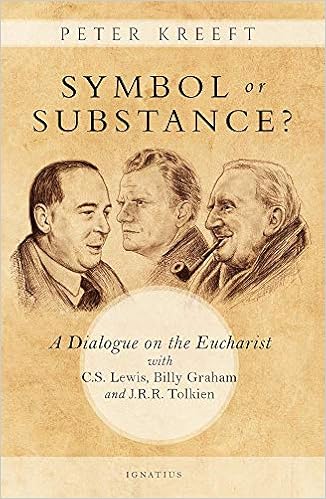
Peter Kreeft’s The Philosophy of J.R.R. Tolkien has been one of my favorite resources in understanding the role Tolkien’s Catholic faith played in the shaping of Middle-earth, so I was incredibly pumped to learn of Kreeft’s latest book, Symbol or Substance?: A Dialogue on the Eucharist with C.S. Lewis, Billy Graham, and J.R.R. Tolkien. And it was incredible. 10/10 recommend.
Kreeft is the author of over a hundred books on Christian philosophy, apologetics, and theology. He’s written extensively on J.R.R. Tolkien and C.S. Lewis, and has taken great care in accurately recreating the voices and beliefs of each of the men represented in this book. If there’s anyone I trust to write this sort of dialogue, it’s Peter Kreeft.
Rather than presenting it as a scholarly work, Kreeft introduces the book as a “supposed” dialogue between Lewis, Graham, and Tolkien which focuses on the Eucharist but also addresses several other aspects of Christian belief and the differences between their traditions. The book addresses the question:What are the differences between these theologies, and do they matter? (Yes, they do.)
Kreeft explains in the introduction, “The following conversation is fictional. It never happened, at least not in this world. However, it very well could have… So the literary genre of this book is neither simply fiction or simply nonfiction. It is what C.S. Lewis called a “supposal"…”
So that’s the whole idea of it; it’s a style Kreeft is quite good with, and I thoroughly enjoyed it as a reader. I couldn’t help but imagine these three meeting for a pint in heaven as I read along.  
Drawing from various writings and a deep understanding of each viewpoint, Kreeft presents a dialogue which represents each of these men quite well, allowing readers to be a fly on the wall for this imagined conversation. The topic at hand is the question of the Eucharist: What is it? Is it truly the Body, Blood, Soul, and Divinity of Jesus Christ as Catholics claim? Is it merely a symbol? Or something in between?
While Kreeft himself is Catholic and mentions this in the introduction, I felt that he fairly represents the Anglican and Evangelical perspective expressed by Lewis and Graham. Having been raised in an Evangelical church and later converting to Catholicism, I was the least familiar with the Anglican perspective and I enjoyed learning about Lewis’ understanding of their theology.
This charitable conversation is not meant to be a debate and no one “wins” in the end, which felt incredibly refreshing when compared to the way most people speak to one another these days (particularly online). This sort of dialogue can serve as an example for all of us, in my opinion.
Apart from the Eucharist, Kreeft also briefly brings up the issues of Apostolic Succession, Sola Scriptura, Confession, infant baptism, the role of both faith and works in salvation; I thought these made nice additions to the conversation as a whole.
Their conversation flows well and there are bits of humor sprinkled in throughout, which made the book a light-hearted yet practical read. Tolkien also drags Lewis quite a bit for not converting all the way to Catholicism while also trying not to press the issue too hard, which felt very on-brand for their friendship.
The focus of this conversation leans more toward the purpose of understanding what one another believe, rather than trying to force their beliefs on each other—since, of course, that wouldn’t make any sense at all in the context of a supposed conversation.
In the end, readers will finish the book with a deeper understanding of the differences and similarities of these three branches of Christianity and feel well-equipped to go out and have conversations of their own. This is the sort of book I’d consider giving my Evangelical family members as well as my Catholic friends because of its charitable tone, well-researched talking points, and its connection to Tolkien and Lewis (and Graham, of course).


Why Didn't Anyone Tell Me, a Loathsome Millennial, That 'Frasier' Was So Good?


By Shane Ryan
July 29, 2019
Image result for frasier tv show
I’m 36 years old, which means I was 10 when Frasier first came on the air and 21 when it ended in 2004. I spent those formative years doing Millennial-type things, such as eating avocado toast, sneering, and skateboarding while neon lights sizzled in the air around me. And sure, I caught the odd Frasier episode on syndication here and there, but I had no concept of what the show was really like. My impression, vaguely held, was that at least half of the episodes revolved around Frasier having two dates at the same time in the same restaurant, and excusing himself to go to the “bathroom” frequently as he rushed back and forth between tables, trying to keep the women from suspecting that anything was amiss. That, no joke, is what I thought Frasier was all about. I would have called it “wacky.”
Why did I think this? Did I actually see that scene play out, at some point? Did I dream it?
No clue.
Turns out, I was very wrong. I have now watched the entire first season of Frasier on Netflix, 24 episodes strong, and I can tell you that the restaurant caper of my imagination is not the plot of a single episode. Maybe it comes up later, but I doubt it. The truth of this show has been revealed to me, and I am furious: Why didn’t any of you tell me it was so staggeringly good? You people, who are supposed to be my friends and family, let me go almost half of a standard male American lifetime completely IGNORANT of a comedic masterpiece.
Because that’s what is! Frasier is an absolute gem, the jokes are stingers, and the storytelling is mind-blowing when you consider the limitations of the 22-minute laugh track sitcom. The writers were clearly virtuosos, to the point that they even manage to tug at my frayed Millennial heartstrings. Point is, holy shit, Frasier really holds up.

I’ll get to the funny stuff, but first I want to talk about the heartstrings. One thing I absolutely hate about old sitcoms is the cheeseball morality you have to sit through, which is presented with all the subtlety of an After School Special written by Aaron Sorkin. That’s why Seinfeld was so great—it didn’t bother trying to uplift anyone. It was the kingdom of the selfish. But Frasier sometimes does bother with it, and what’s wild is that it’s actually good and meaningful.
Let me give you an example: In the Season One finale, called “My Coffee with Niles,” most of the drama hinges on a question Niles presents to Frasier early in the episode: “Are you happy?” It takes Frasier by surprise, and he turns it around on his younger brother, who’s ready with a quick response: “No, but we’re not talking about me.” Frasier won’t let it go, presses Niles as to why. The speech that follows doesn’t seem to belong in a 1990s sitcom:
“I was watching PBS the other night in my study and they were showing this documentary on the Great Depression. Vintage Steinbeck – desperately poor people escaping the Dust Bowl, their meager possessions strapped to rickety old trucks heading to what they thought was their salvation. Then there was this scene with this scruffy boy being handed a brand-new pair of shoes by the Salvation Army. Frasier, if you saw the look on that boy’s face…it was a look of pure and utter happiness. I have never experienced that kind of happiness, not in my whole life.”
Shit, man!
That one really got to me, and while they tried to take the air out of the moment with a joke about Niles’ $400 shoes in the next line, it wasn’t possible—Niles’ words were profound in a way that I’ve never seen in that format before, and they express so much about modern life and the nature of struggle with so few words. It was heartbreaking, actually, and a good reminder that David Hyde Pierce is more than just a brilliant comedic actor.
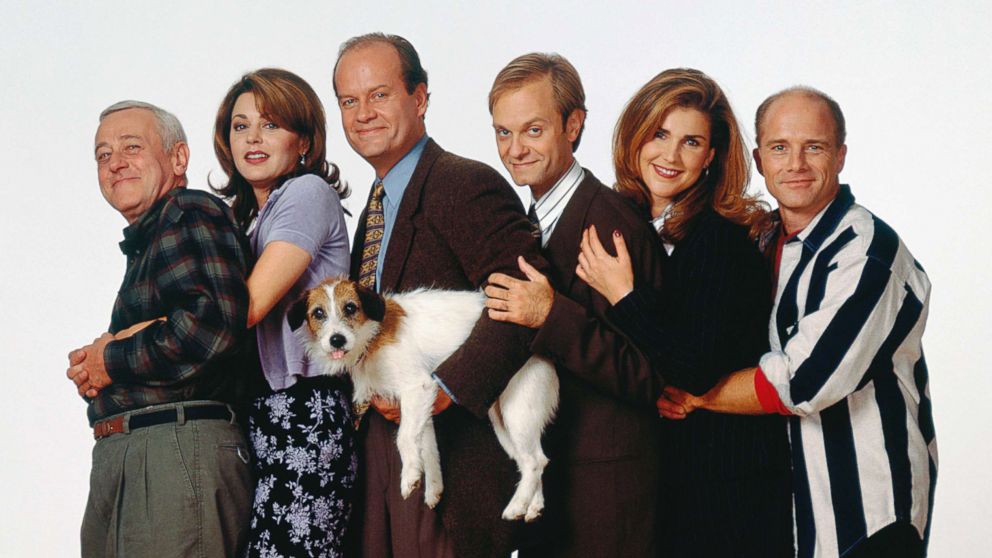
I’ve thought about that monologue ever since, but it’s not the only example. Throughout the first season, Frasier is constantly at odds with his father Martin, a retired cop who lives with him after a bullet to the hip ended his career. Niles is in a loveless marriage with his hypersensitive waif Maris (who, as Paste’s Keri Lumm pointed out, is the most inexpensive character of all-time, since we never see her), and is falling in love with Daphne, Martin’s live-in caretaker. Frasier’s radio producer, Roz, can’t find love, and his co-worker Bulldog is a wannabe alpha male whose insecurities are all the more painful when they shine through. And yes, everyone takes their shots at each other, and in some cases they are extremely hard shots, but these characters are more than two-dimensional punchline vehicles. Their problems and neuroses and heartaches are always treated with respect, and—warning, this will sound like some 20-year-old discovering jazz for the first time—it changed my opinion about exactly how profound a laugh track sitcom can be, at its best.
Oh, and it’s funny as hell. I also didn’t expect that. I have to admit, my own personal prejudice was that really funny TV shows, by which I mean the kind that can make a depraved idiot like me laugh out loud, started with Seinfeld but mostly came after the turn of the century. This is a kind of blind snobbery, I get that, and I invite you to judge away. But I’m saying, I did not expect Frasier.
I’m about to hit you with a couple examples now, though I would issue the disclaimer that nothing looks quite as funny on paper, and a lot of the humor is wrapped up in the performances.
Anyway, the line I found the funniest came when Niles joined Frasier on his radio show to speak on the theme of siblings. A woman called in and remembered the time she got a terrible haircut, was forced to shave her head, and expected her sisters to mock her ruthlessly. Instead, they shaved their own heads in solidarity. The Crane brothers are moved, and it leads to this exchange:
Frasier: Niles, I would shave my head for you.
Niles: A gesture which becomes less significant with each passing year.
Have you ever heard a better bald joke??!! Have you???
At another point, after Frasier agrees to go on a motor home road trip with Martin, he begins to have regrets. Niles tells him to back out, but Frasier knows he can’t:
Frasier: Oh, I can’t do that. He’s counting on this trip too much. It was his dream. He was going to go on this trip with mom.
Niles: Yes, but she lucked out and died.
There are great one-liners too, emerging in particular each time Niles refers to one of the therapy groups he runs. For instance:
“I’m conducting a seminar on multiple personalities and it takes forever to fill out the name tags.”
“I’m due at my sexual addiction group, and I don’t like to leave them alone too long.”
“I have my ‘fear of abandonment’ workshop today and I’ve already been a no-show twice.”
Frasier: I filled in for you when you were too sick to meet with your “Fear of Intimacy” group!
Niles: I wasn’t sick. They were just getting too close.
And the performances! They’re all top-notch, but I didn’t quite realize how obscenely funny both Kelsey Grammer and David Hyde Pierce were. Grammer alone is one of those men who can convey six emotions at once using only a single facial expression, and all of them end up being hilarious. And Pierce—who, as you see above, gets many of the best lines—is just magnificent as the prissy, perpetually wounded Niles. That’s not to throw shade on any of the supporting actors, but those two, together, are just a walking (mincing?) tour de force.
Even the conceit of the show is a well-placed joke. Frasier, in my unprofessional opinion, is a godawful shrink. Psychotherapy by radio is already a fraught concept—Niles correctly calls it “psychiatry’s answer to the drive-through window”—but even by that standard, his advice to callers is either dismissive or glib. If you were a fictional character with mental health problems, the only worse shrink you could find is Dr. Hannibal Lecter. And the writers know it, to an extent. Sure, they give Frasier his moments, but they never go easy on the idea that he plies his trade on the radio and cares more about celebrity and status than helping his “patients.”
And, he and Niles are inveterate snobs. One of the most painful episodes came when they took Martin to one of his favorite restaurants, a homey steak joint, and proceeded to mock everything around them until their father left in disgust. It’s not that they lack heart, but unless someone calls them out, they’re totally blind to their own pretensions in ways that can be galling or hysterical, depending on the situation. With Frasier, especially, I found myself going back and forth between wanting to be his friend and wanting to see him get punched.
But it works! Their flaws are not just hinted at, but often exposed, and the process of trying to be good people is not easy for them. There, too, the show excels in its honest treatment of middle-aged, nearly modern men.
There’s also a mandatory warning to convey, re: the era—to enjoy this, you’re going to have look past some problematic material. Niles is always leering at Daphne, or trying to touch her, or trying to get her to touch him. Frasier forces Roz to hug him against her will at one point; Roz also gets slut-shamed by everyone, all the time. The worst moment, though, came when Frasier was deliberating about whether to do a promo for a Chinese restaurant—would it destroy his integrity?—and Bulldog steps in to do the job. He uses the most racist accent ever, and finishes by hitting a gong, all of which could be a commentary on Bulldog himself, at a stretch…except that the laugh track people choose that moment to employ the “breathless laughter followed by ecstatic applause” button. So, you know…judge it for its time, and all that.
For the most part, though, Frasier was well ahead of its time, and that’s why it still hits so hard today. It’s the humor, yes, but it’s also the humanity. There aren’t many shows that can pull them off simultaneously, as in this moment when Frasier recalls waking up on his couch to find his father rubbing his head in a rare gesture of affection:
Niles: Dad?! Did he say anything?
Frasier: Well, he said, “don’t you think it’s time you got a hair cut, you’re starting to look like bozo!” I know he was only covering though. But what do you think?
Niles: Probably wouldn’t hurt to get a trim.
And while the writers clearly mastered the humor, it’s their patience and comfort in the humanity that really makes the show timeless. And ask yourself this: How many sitcoms, for their first ever season finale, would have the courage to hinge the entire episode on that singular, fundamental, and awful question: “Are you happy?”
Shane Ryan is the Politics editor at Paste. Follow him on Twitter here:”https://twitter.com/ShaneRyanHere”.