Tuesday, January 29, 2019

Against Trump: Three Years Later

January 28, 2019
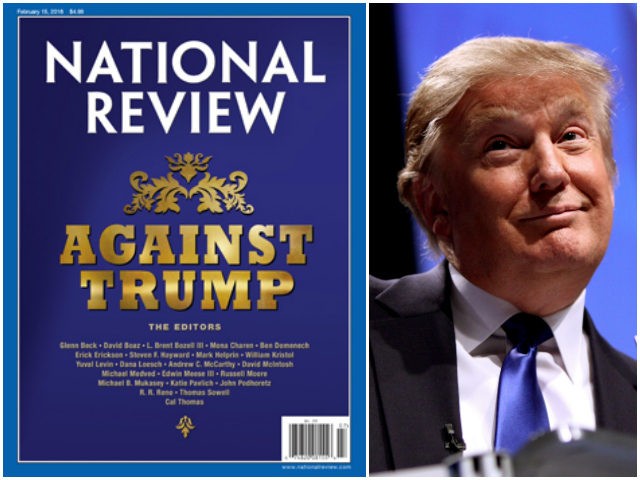
Image result for national review against trump
(Breitbart)
Three years ago this month, National Review published its controversial and now infamous entreaty, “Against Trump.” The issue was singularly devoted to making a case against Donald Trump’s then surging primary candidacy; it featured a roster of notable conservative influencers explaining why the brash Manhattan billionaire posed a dire threat to conservatism.
Exactly three years later, the magazine’s online version issued an apology for its early condemnation of Covington Catholic High School students, who, while attending the March for Life in Washington D.C., became the innocent victims of a social media ambush orchestrated and executed by the Left. Some conservative commentators who had contributed to the “Against Trump” issue quietly deleted their tweets criticizing the teens, without apology.
The irony surrounding the coincidence of the dates of those two circumstances might be considered either karma, comeuppance, or both. And it once again highlighted why Donald Trump is in the White House and Jeb Bush isn’t, and why Trump—and none of the self-proclaimed conservatives who opined in the pages of National Review three years ago—now is considered the standard bearer of American conservatism. When the Left attacks, the Right caves.
When Christian teenagers attending an event to support a cause that represents the heart of the conservative movement needed immediate and unflinching protection from a leftist mob, the self-appointed guardians of conservatism failed. Their mockery of “He Fights!” only exposes how they will not—or when they do fight they often pick the wrong battles, and how they find the whole business of political warfare beneath them—unless, of course, they can punch down at a target on their own side.
Don’t take my word for it. Here is a direct quote from that “Against Trump” issue: “[Trump’s] obsession is with ‘winning,’ regardless of the means—a spirit that is anathema to the ordered liberty that conservatives hold dear and that depends for its preservation on limits on government power.”
Still Clueless After All These Years
If anti-Trump conservatives have proven anything over the past three years, it is that they still have no clue how to prevail over the Left. With few exceptions, most notably the Brett Kavanaugh debacle (but with caveats even there), NeverTrumpers have sided with the Left. Many have fully abandoned their alleged fidelity to principles—limited government in particular—in order to cripple a president who conservatives voters elected in spite of their lofty commands to drop him.
Further, they still have no alternative to what they derisively call Trumpism.
“Trump nevertheless offers a valuable warning for the Republican Party. If responsible men irresponsibly ignore an issue as important as immigration, it will be taken up by the reckless,” the NR editors wrote in January 2016. “If they cannot advance a compelling working-class agenda, the legitimate anxieties and discontents of blue-collar voters will be exploited by demagogues. We sympathize with many of the complaints of Trump supporters about the GOP, but that doesn’t make the mogul any less flawed a vessel for them.”
So, three years later, what is the status of American conservatism, to the extent that it exists at all? Where is the working-class agenda they promised back in 2016? What’s their plan to mitigate pervasive anxieties about illegal immigration, permanent job losses, lousy trade pacts, and foreign intervention? And one year away from the Iowa caucuses, who will the Trump foes on the Right support for president?
Neoconservatism on the Ropes
To be fair, there was legitimate criticism of Trump in the “Against Trump” issue. Trump had given few reasons to believe he actually would govern as a conservative considering that many of his past positions were liberal and that he had been a reliable Democratic donor for years. Concerns about his ego and style were justified; his lack of expertise in foreign affairs and domestic policy warranted alarm. Since Trump’s election, some of the original critics have become fair-minded observers, even outright supporters, of the president. This includes NR’s editor Rich Lowry, who has challenged the “delusion” of the remaining, anti-Trump outliers.
But their initial warnings that Trump would defile conservatism and destroy the Republican Party were deeply amiss. To the contrary, it is NeverTrump that has suffered the most casualties over the past three years. The biggest fatality in the Trump era is neoconservatism, an ideology that stood in stark contrast to Trump’s far more broadly popular patriotism.
Several leading neocons contributed to the “Against Trump” issue, including Bill Kristol and John Podhoretz, whose fathers essentially founded neoconservatism. Far from adhering to conservative, or even neoconservative, principles, Kristol claimed to have found his “inner socialist” and “inner feminist” during Trump’s presidency, and has backed an authoritarian abuse of federal power in the form of Special Counsel Robert Mueller’s investigation into fictional Trump-Russia election collusion. Kristol’s anti-Trump endeavors are not funded by the kind of conservatives who funded his previous work, but by a billionaire leftist and sworn enemy of the president.
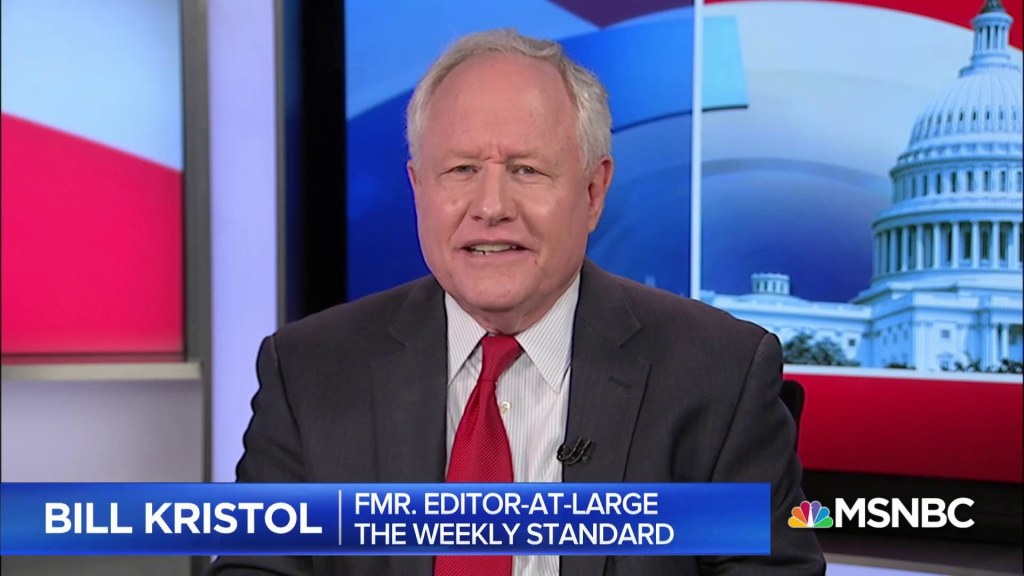
Image result for kristol weekly standard
In December, The Weekly Standard, the magazine Kristol co-founded that served as the organ for neoconservatism for more than two decades, was shuttered by its owner. Its writers and editors took refuge in a new outlet that makes no mention of neoconservatism. Commentary editor John Podhoretz—who compared Trump to vulgarians such as Andrew Dice Clay and Howard Stern in his “Against Trump” appeal—just deactivated his Twitter account after posting an anti-gay slur that mocked prison rape. (For what its worth, Podhoretz’s father, Norman Podhoretz, is a Trump supporter.)
Forward! Into the Past!
The NeverTrump crusade sparked by the “Against Trump” issue is adrift and angry. In the past three years, self-proclaimed conservatives of this variety have embraced the climate change agenda, opposed tax reform, and saved Obamacare. Some encouraged Republicans to vote for Democrats in the 2018 midterm election. Any suggestion that the ruling class has failed large swaths of the American electorate and willfully ignored the plight of millions of our countrymen in order to advance their own interests, as Tucker Carlson proposed a few weeks ago, is met with scorn.
NeverTrumpers have been silent about, or worse, helped to justify, the unconstitutional and alarming weaponization of the world’s most powerful law enforcement and intelligence apparatus to undermine a rival presidential campaign, then sabotage a duly elected president.
They now are poised to back a challenger to Trump in the 2020 Republican primary. Two possible candidates are former Ohio Governor John Kasich and current Maryland Governor Larry Hogan. There is nothing identifiably conservative about either candidate; in fact, their conservative credentials looks worse than Trump’s did in 2016.
In an op-ed published this month, Kasich offered plenty of blather about how the GOP needs to address “income inequality, urban violence, drugs, climate and environment, free trade, prescription costs, infrastructure decay, cybersecurity, education and workforce readiness, [and] student debt.” True as far as it goes, but Kasich offered no specifics about how to handle any of them. In one of his last acts as governor, however, he vetoed a fetal heartbeat bill.
In his column in the New York Times last week, NeverTrumper Bret Stephens called Governor Hogan “a serious and meaningful alternative to the corroded conservatism we have in Washington today.” Apparently non-corroded conservatism means being an “institutionalist” who is pro-gun control, anti-fracking, pro-Paris Climate Accord, and pro-abortion because these are all policies that Hogan supports. “Even if Trump didn’t run, he would get more votes than Hogan,” scoffed our publisher, Chris Buskirk, at the idea of a Hogan candidacy.
So, three years after the nation’s leading conservative outlet published a lengthy appeal to purge Donald Trump from its ranks, the president has an 80 percent approval rating among American conservatives. Trump has cut taxes; restrained the regulatory behemoth; appointed a legacy bench of conservatives federal judges; challenged lazy, ungrateful allies; rewritten outdated trade pacts; confronted a chronic border crisis; and reinvigorated the country’s manufacturing base. He’s defended the unborn, the working class, the patriotic, and the faithful while rejecting the stultifying chokehold of identity politics.
Meanwhile, his so-called conservative detractors are scrounging for primary challengers that sound more like Barack Obama than William F. Buckley, Jr. The damage they’ve done to the modern-day conservative movement will long outlast Trump’s presidency.
And three years later, they have largely proven—once again—that they are still very good at failure.

Monday, January 28, 2019

Rene Girard & The Covington Catholic Boys


By ROD DREHER 
January 27, 2019
Image result for rene girard
Rene Girard
If you want to understand what happened to the Covington Catholic boys at the Lincoln Memorial — and why things like this will continue to happen — you should read the late cultural critic and theorist Rene Girard.
I’m not the first one to say this. Bishop Robert Barron has long been a reader of Girard, and the other day interpreted the event at the Lincoln Memorial in terms of Girard’s theory about the scapegoating mechanism.  Barron wrote, explaining this theory:
Roughly speaking, it unfolds as follows. When tensions arise in a group (as they inevitably do), people commence to cast about for a scapegoat, for someone or some group to blame. Deeply attractive, even addictive, the scapegoating move rapidly attracts a crowd, which in short order becomes a mob. In their common hatred of the victim, the blamers feel an ersatz sense of togetherness. Filled with the excitement born of self-righteousness, the mob then endeavors to isolate and finally eliminate the scapegoat, convinced that this will restore order to their roiled society. At the risk of succumbing to thereductio ad Hitlerum fallacy, nowhere is the Girardian more evident than in the Germany of the 1930s. Hitler ingeniously exploited the scapegoating mechanism to bring his country together—obviously in a profoundly wicked way.
In his 2001 book I See Satan Fall Like Lightning, Girard, who was one of the great geniuses of the 20th century, explains his anthropological interpretation of the Bible — the Hebrew Bible, and the Gospels — and why they have the power to reveal and defeat the cycle of murderous violence that is deeply embedded in human nature.
(If you’re the kind of whataboutist whose knee is jerking to say “but Christians commit violence too!”, let me gently suggest that you read something about Girard’s thought. You could start with this recent big piece in the New York Review Of Books, which begins with this: “Not only are his ideas about mimetic desire and human violence as far-reaching as Marx’s theories of political economy or Freud’s claims about the Oedipus complex, but the explosion of social media, the resurgence of populism, and the increasing virulence of reciprocal violence all suggest that the contemporary world is becoming more and more recognizably ‘Girardian’ in its behavior.” If you can’t get through the paywall, try this very brief introduction to Girard’s thought, then explore elsewhere on the Internet. There’s a wealth of resources.)
In I See Satan Fall Like Lightning, Girard writes about how the “concern for victims” is what sets Judaism and Christianity apart from all other archaic religions. This concern for victims has now been virtually universalized, even — paradoxically — as Christianity has begun to decline, at least in the West. You could say — but Girard doesn’t, at least not here — that Communism is a godless absolutizing of the concern for victims. What sets it apart from Nazism is that Nazism was a massive attempt to refute concern for victims as a basis for society. Following Nietzsche, Nazism condemned Christianity as “slave morality” (Nietzsche’s phrase) because it taught people to have compassion for the weak and the unfit. Communism was a pseudo-religion that tried to put a victim class on top, in a utopian push to right historic wrongs, and ended up creating hell on earth.
In a fascinating chapter on Nietzsche, Girard credits the philosopher with understanding the anthropological meaning of Christianity, but faults him for rejecting it. Girard:
He opposes, so he believes, the crowd mentality, but he does not recognize his Dionysian stance as the supreme expression of the mob in its most brutal and its most stupid tendencies.
Christianity does not yield to ulterior motives of resentment in its concern to rehabilitate victims. It is not seduced by a contaminated charity of resentment. What it does is to rectify the illusion of myths; it exposes the lie of the “satanic accusation.”
Since Nietzsche is blind to mimetic rivalry [a key Girardian concept; this is what causes violence] and its contagion, he doesn’t see that the Gospel stance toward victims does not come from prejudice in favor of the weak against the strong but is heroic resistance to violent contagion. Indeed, the Gospels embody the discernment of a small minority that dares to oppose the monstrous mimetic contagion of a Dionysian lynching.
Now, here is where Girard becomes especially interesting, and relevant to our moment. He says that today, “we hear repeated in every way that we no longer have an absolute,” but in fact the concern for victims “is our absolute.” That is, it is the basis for our morality: “it is the concern for victims that determines what is most important.” This is the case because all other sources of absolute value have been lost. More:
The current process of spiritual demagoguery and rhetorical overkill has transformed the concern for victims into a totalitarian command and a permanent inquisition. … We are living through a caricatural “ultra-Christianity” that tries to escape from the Judeo-Christian orbit by “radicalizing” the concern for victims in an anti-Christian manner. … The intellectuals and other cultural elites have promoted Christianity to the role of number one scapegoat.
Girard says we are at the advent of what he calls “the other totalitarianism,” saying that it is
the most cunning and malicious of the two, the one with the greatest future, by all evidence. At present it does not oppose Judeo-Christian aspirations but claims them as its own and questions the concern for victims on the part of Christians (not without a certain semblance of reason at the level of concrete action, given the deficiencies of historical Christianity). The other totalitarianism does not openly oppose Christianity but outflanks it on its left wing.
This is the force of what in the Christian tradition is called Antichrist. You don’t have to believe in a literal Antichrist figure to grasp what Girard is saying here. Girard points out that in the symbolic language of the New Testament, Antichrist opposes Christ by imitating him and seeking to be better than him. More:
The Antichrist boasts of bringing to human beings the peace and tolerance that Christianity promised but has failed to deliver. Actually what the radicalization of contemporary victimology produces is a return to all sorts of pagan practices: abortion euthanasia, sexual undifferentiation, Roman circus games galore but without real victims, etc.
Neo-paganism would like to turn the Ten Commandments and all of Judeo-Christian morality into some alleged intolerable violence, and indeed its primary objective is their complete abolition. Faithful observance of the moral law is perceived s complicity with the forces of persecution that are essentially religious. Since the Christian denominations have become only tardily aware of their failings in charity, their connivance with established political orders in the past and present world that are always “sacrificial,” they are particularly vulnerable to the ongoing blackmail of contemporary neo-paganism.
Neo-paganism locates happiness in the unlimited satisfaction of desires, which means the suppression of all prohibitions. This idea acquires a semblance of credibility in the limited domain of consumer goods, who prodigious multiplication, thanks to technological progress, weakens certain mimetic rivalries. The weakening of mimetic rivalries confers an appearance of plausibility, but only that, on the stance that turns the moral law into an instrument of repression and persecution.
And what happens when, having cut down all the moral laws to build a Brave New World of unlimited satisfaction, the money runs out, and the economy collapses?
In his final chapter, Girard praises the “heroism” of the scattered disciples in the wake of Jesus’s resurrection. They had no power, and in fact, knew that they had participated in “the violent contagion that murdered their master” (e.g., Peter’s denial). What they had was the power of their belief, and their ability to communicate what they had seen and experienced. And this ultimately subverted the dominant paradigm of the ancient world, which believed that scapegoats were real and necessary.
Girard believes that only genuine divine power gave them the strength to do this. He believes that it is impossible to break the spell that drives humanity to scapegoating violence without believe in “a power superior to violent contagion.” In other words, the God of the Bible.
Girard, by the way, was an atheist who came to accept his baptismal religion, Christianity, through his literary and anthropological studies. He came to believe that the Gospels were anthropologically true. His story is absolutely fascinating. InI Saw Satan Fall Like Lightning (the title is a quote from Jesus), Girard explains that, in his view,
The Bible is unique in its disclosure of the standpoint of the victims, which means that form the standpoint of the narratives, God takes the side of the victim. Not all narratives do this, but a new perspective emerges in Israel. What the people or crowd want is to justify itself and its past, and they do this by blaming someone for all their troubles. In moments of crisis caused by deep-seated rivalries a person is unjustly accused of some offense or crime. … So from a purely anthropological viewpoint, the Bible unveils the victim mechanism that lies behind polytheism and mythology, but not only behind polytheism and mythology, for its full expression underlies everything we know as human culture. The Bible recognizes this in the story of Cain and Abel. Because Cain murders his brother, God bans him form the soil, making him a wanderer on the earth, and God puts a mark on him, a sign to protect him from suffering what he made Abel suffer. Then Cain builds the first city, and so civilization begins. The story in Genesis 4 tells us, in effect, that the sign of Cain is the sign of civilization. The cross of Christ is the sign of salvation, which is revealed as the overcoming of mimetic desire and violence through the nonviolence of love and forgiveness.
Now, what does this have to do with us, in particular, us orthodox Christians?
Girard wrote these lines around the turn of the century. Since then, the “radicalization of contemporary victimology” has produced even more of exactly the effects he said they would produce. And orthodox Christianity has become even more marginalized and despised, precisely because the post-Christian left needs a scapegoat upon which to blame the sins of the world. It is hard to come up with a more perfect scapegoat for this pseudo-religion of radical victimology than a group of white male pro-life Catholics from the South, wearing MAGA hats.
Understand what I’m saying here: the actual guilt of those boys was completely beside the point in the minds of the mob. It’s not about what those boys did, or didn’t do. It’s about who they are. Their identity as white male Christian supporters of Donald Trump was the only thing that mattered to their accusers.
Similarly, the fact that Nathan Phillips, the elderly Native American, flat-out lied about the boys did not matter, nor did the fact that the Black Israelites, a hysterical hate-mongering sect, had been taunting both the white boys and the Indians with racial and sexual slurs prior to the confrontation. Those instigators were non-white, which, in the eyes of the accusing mob, made them innocent, or at least not guilty.
This is our social reality now. If you are the kind of person who thinks that if only you reject Trump and MAGA hats, you’ll be counted among the Elect, you had better wake up. Today it’s MAGA hats. One of these days, it’s going to be crosses.
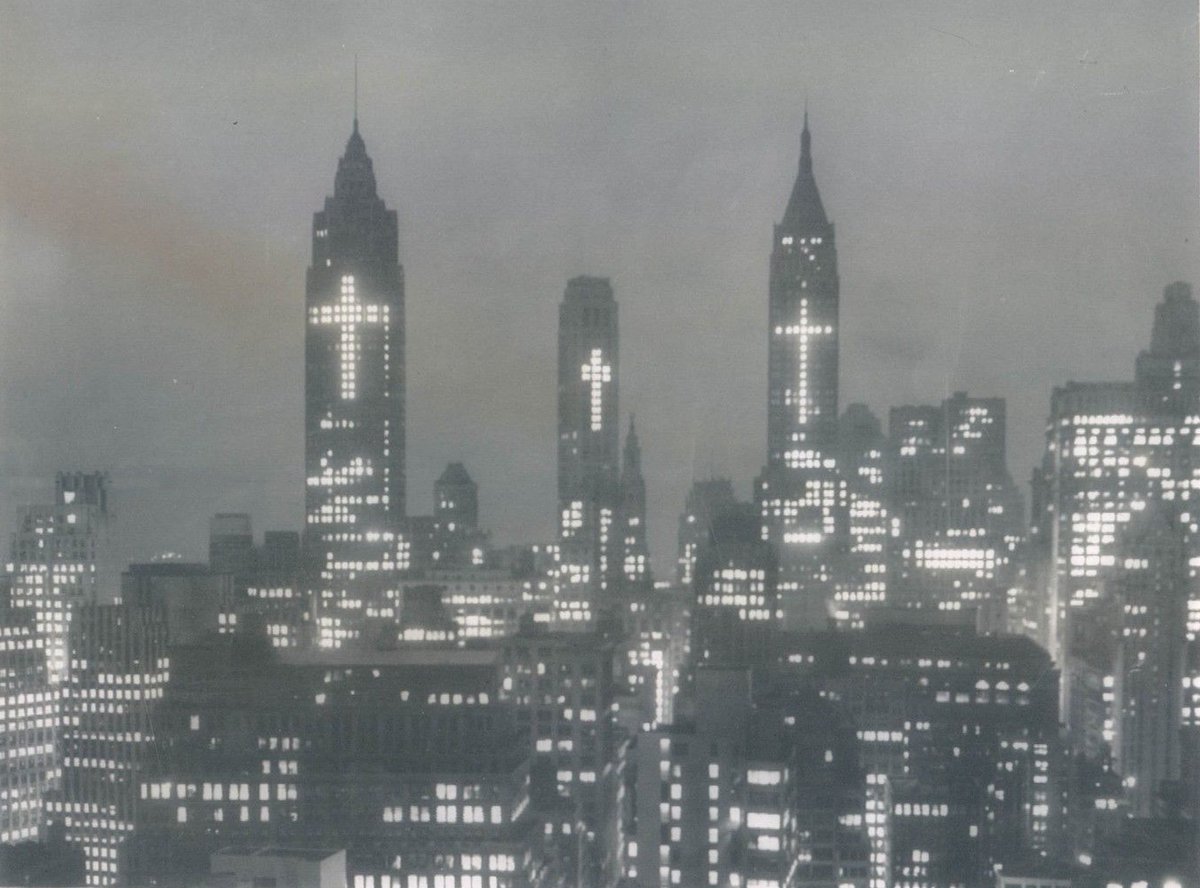
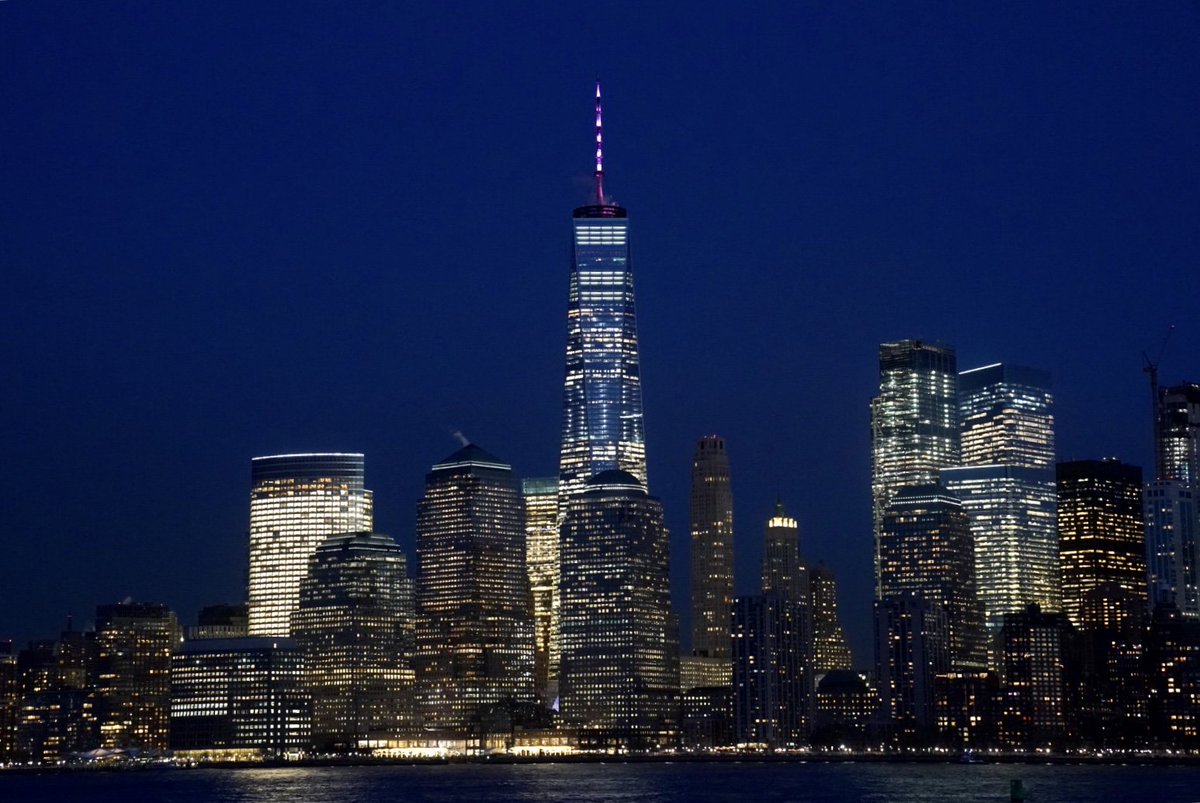
Here is an apt symbol of the world that has ended, and the world that is now here. The photo on the right is the new World Trade Center lit up pink on the order of the barbaric New York Gov. Andrew Cuomo, to celebrate the state legislature having affirmed legal abortion up until the point of birth:
1956 vs. 2019

It’s going to get worse — a lot worse. Christians, and conservatives, need to be prepared for it. This is why I wrote The Benedict Option, and now it’s becoming ever more difficult to deny its diagnosis. Girard is right: the abolition of what we believe in is the long-term goal. This is what #ExposeChristianSchools is about: scapegoating, straight up, with the aim of marginalizing and ultimately eliminating any public manifestation of orthodox Christianity.

One immense challenge to Christians is to find a way to fight this scapegoating, and to endure it when it can’t be fought, without returning hatred for hatred. I can imagine that it would be easy for those Covington boys to be tempted by far-right white nationalism, especially given the disgraceful spectacle of some of their own woke Catholic bishops throwing them under the bus. (This is what Girard meant when he talked about churches today being “vulnerable to the ongoing blackmail of contemporary neo-paganism.”) But that would be morally wrong, and even a betrayal of the Gospel. When we lose sight of the fact that we ourselves can be part of the mob, and start to see ourselves as innocent by virtue of our identity (racial, sexual, religious, etc.), then we fall into the same scapegoating mechanism that has captured those who hate us.
I don’t know how we’re going to do this. But I know we had better get busy figuring it out. What is happening now in our civilization is not primarily political, and it won’t be solved through better politics. Read Girard. This is something happening at the most fundamental level of social psychology and cultural anthropology, and it has been building for a very long time. This is what Girard calls the “other totalitarianism.” If you’re a Christian believer, your faith tradition should have prepared you to read these particular signs of the times. Let the reader understand.

Highbrows Vs. Deplorables


January 27, 2019

Image result for european union leaders

British prime minister Theresa May, left, speaks to the press as European Commission president Jean-Claude Juncker greets her as they arrive on the first day of a summit of European Union (EU) leaders at the EU headquarters in Brussels, on March 22, 2018 | Ludovic Marin/AFP via Getty Images

“The idea of Europe is in peril.” Thus begins an 800-word open letter published on Friday in the French newspaper Libération and other several European dailies. Written by Bernard-Henri Lévy, the French philosopher, it was signed by thirty “top intellectuals” (as the Guardian put it) from twenty-one countries.

Now, anyone familiar with current affairs will readily agree that Europe – at least Western Europe – is imperiled. It’s imperiled by a European Union whose unelected leaders are determined to convert it into a sovereign superstate with its own army and with ever-expanding powers. And it’s imperiled by hordes of Muslim migrants who, having been forced upon it by those EU leaders, will, barring dramatic reversals, eventually turn the countries of Western Europe into sharia states.

But this isn’t what these “top intellectuals” mean. Note the wording of their letter: they’re not concerned with the well-being of the peoples of Europe; their preoccupation is with the idea of Europe, which is to say with the preservation and fortification of the European Union.

And their message is that the EU is imperiled by – who else? – Europeans themselves.
Who are these “top intellectuals”? The signatories include the renowned novelists Salman Rushdie, Ian McEwan, and Milan Kundera, plus an assortment of philosophers, historians, activists, and social critics, some more famous than others. Their tender concern for the EU’s health is not surprising. The EU was always a project of privileged highbrows, who helped it advance from strength to strength by lying to the governed, acting without their consent, and overruling their votes. Now, with Eastern European governments rejecting dictates from Brussels and with Western European electorates, at long last, demanding that their voices be heard and their wishes respected, the EU’s architects and partisans are balking at the audacity with which the deplorables – the peons, the peasants, the proles – are standing up to them. Lévy writes:

“Enough of ‘building Europe’!” is the cry. Let’s reconnect instead with our “national soul”! Let’s rediscover our “lost identity”! This is the agenda shared by the populist forces washing over the continent. Never mind that abstractions such as “soul” and “identity” often exist only in the imagination of demagogues.
Pace Lévy, a feeling of national identity has long been a potent force in the souls of men. For him and other devotees of the “idea” of an EU superstate, it has been Job One to try to eradicate that patriotism and replace it with a newly forged sense of “European identity.” Unfortunately, these EU boosters have discovered that that particular abstraction thrives only in their own demagogic imaginations, and that most of the people of Europe want nothing to do with it.

Lévy’s letter goes on:
Europe is being attacked by false prophets who are drunk on resentment, and delirious at their opportunity to seize the limelight. It has been abandoned by the two great allies who in the previous century twice saved it from suicide; one across the Channel and the other across the Atlantic.
The degree to which Lévy manages to turn everything upside down here is impressive. The actual false prophets are the EU’s unelected leaders and their collaborators, lackeys, and running dogs, such as Lévy and his pals. They’re the ones who are, to borrow Lévy’s metaphor, drunk – specifically, drunk on unearned power that they’ve seized from the once free citizens of Europe’s nation states. As for Britain and the U.S. – yes, they did save Europe from suicide twice in the twentieth century. Today, in keeping with that history, the Brexiteers in Britain and the Trump administration in the U.S. recognize the EU as, like Nazi Germany and the USSR, a misbegotten imperial project – an ideologically rooted effort, conceived and driven by an arrogant and self-regarding elite, that has steadily encroached on individual liberties, steadily weakened economies, and steadily evolved into something that looks increasingly like a suicide pact.

If twentieth-century Europe was almost destroyed by various totalitarianisms, twenty-first-century Europe now risks destruction either at the hands of Islamic totalitarianism, to which the EU honchos have kowtowed for two generations, or at the hands of the burgeoning totalitarianism of the EU itself. Or both. “Europe as an idea,” Lévy tells us, “is falling apart before our eyes.” Good. The key lesson of the twentieth century – which the multitudes are waking up to even if the “intellectuals” aren’t – is that Europe’s Achilles heel isn’t populism but a susceptibility to control-happy “ideas” for the organization of societies.

Several paragraphs into his letter, Lévy spells out his immediate fear: namely, that the upcoming elections to the European Parliament, which are scheduled for May, will be won by anti-EU forces who will quash “the legacy of Erasmus, Dante, Goethe and Comenius.” If the European electorate votes against the EU project, warns Lévy, “A politics of disdain for intelligence and culture will have triumphed. There will be explosions of xenophobia and antisemitism. Disaster will have befallen us.” Again, it’s all topsy-turvy. Intelligence? Culture? It’s the EU that’s importing into Europe a mentality that has room for only one book – a manifesto of hate – and whose notion of culture is barbaric. Antisemitism? It’s the EU that’s flooding Europe with toxic Jew-hatred, which is preached at EU-subsidized mosques and taught at EU-subsidized madrassas. Disaster? It’s the EU that, for these and other reasons, is courting disaster.

As for xenophobia, very few native Europeans are infected with a blanket hostility toward foreigners; what’s happened is that more and more of them are opposing the introduction into their societies of primitive values and practices that could scarcely be more antithetical to their own.

As their text approaches its end, Lévy’s confrères stirringly affirm that they’re “European patriots” who “refuse to resign themselves” to a “looming catastrophe” and who are fighting “a new battle for civilisation.” Yes, there’s a battle for civilization underway. They’re just on the wrong side. They also make a confession: “we believed that the continent would come together on its own, without our needing to fight for it, or to work for it. This, we told ourselves, was ‘the direction of history.’” Translation: we believed that we could gradually transform a common market into a tyrannical superstate without the rabble ever catching on or fighting back. Alas, the serfs are on to them. The proletariat are resisting. In closing, Lévy and company invite readers to join them in fighting “for the idea of Europe.” We can only hope that they’re right to worry that a majority of European voters are opting, instead, to fight for themselves and their posterity – for the future, that is, of European freedom, a future in which there’s no place for a blight like the EU.

HE’S THE FIRST BLACK SHERIFF, NOW HE’S HURTING AFRICAN-AMERICANS BY PROTECTING ILLEGAL ALIENS


By Daniel Greenfield
January 28, 2019
Related image
Mecklenburg Sheriff Garry McFadden addresses an audience after he was sworn in, December 4, 2018. Photo: Jonathan Strayhorn.
“287(g) is going to be history in Charlotte-Mecklenburg,” Garry McFadden had declared in Charlotte.
The crowd cheered as the leftist reality TV star won the election to become Mecklenburg County's first black sheriff.
287(g) is an odd sort of applause line, unless you know what it stands for. It meant that law enforcement officers could turn over illegal alien criminals to ICE. McFadden, the former star of Discovery Network’s I Am Homicide, had always been savvy at cashing in on his brand and spotting the next big opportunity.
McFadden, who, unlike the other candidates in the race, had refused to release his personnel record, had been suspended three times. But he had a natural knack for being a celeb and becoming the story.
As national donors poured in barrels of cash into local sheriff races in counties from Mecklenburg to Harris to Travis to Los Angeles, minority lefties like McFadden, Sally Hernandez, Ed Gonzalez and Alex Villanueva ran on pro-crime and pro-illegal platforms, knowing that their career aspirations would benefit in massive and unprecedented ways from the backing of national groups and the media.
And that’s what happened.
The ACLU alone poured in $175K in ads into the race.  Sheriff Irwin Carmichael, who had been described as the "last conservative Democrat" in Charlotte, who had kicked off his campaign with a gun raffle, finished last. Sheriff Carmichael had become a target because he had cooperated with ICE.
The defeats of law enforcement officers, like the one in Charlotte, protected illegal alien districts while sending a message to other sheriffs that if they followed the law, they would be destroyed.
Sheriff McFadden certainly got the message. Supporting illegal aliens had taken him from reality TV on a trashy network to a major elected position. And then possible aspirations for higher office beyond.
Illegal alien criminals quickly found out that McFadden was their best friend. Sheriff Carmichael had believed in enforcing the law. But there was a new sheriff in town and he had a different idea of the law.
“We’re going to have to talk about race,” McFadden insisted. “Someone said, ‘Is that the job of a sheriff?’ Well, that’s the job of this sheriff.”
Freeing criminals? Defying United States law? Those were also the jobs of this sheriff.
287(g) had led to 15,000 illegal alien criminals being processed for deportation in Mecklenburg County. The men being held for ICE in Mecklenburg included murderers, rapists and drug dealers. 40% of the misdemeanor cases had involved assaults on women. But those women were about to be sacrificed to the illegal alien lobby
There’s no way to even begin to quantify the impact of numbers like that on area crime. But McFadden quickly began providing a short demonstration when he announced that 28 illegal aliens held under 287(g) had been released. And some have been alleged to pose a threat to the public.
One of the released men is Kevin Santos.
Santos, an illegal alien, shot a man during an attempted robbery. He was being held under 287(g) until McFadden came in and set him loose. Now he’s back on the street with nothing more than an ankle bracelet between him and his victim. And the illegal alien’s African-American victim is suffering.
Being shot had left him in pain and unable to live his life normally.
“I couldn't walk, do much (running.) I was joining the Army, and I can't because of it,” the African-American man shot by the illegal alien told a reporter.
Nor did he understand why the man who shot him was back on the street.
"I'm really confused about how and why.”
The ‘how’ and the ‘why’ is that the ACLU and the national pro-illegal lobby had used an African-American reality TV star as a trojan horse for implementing a pro-illegal alien policy.
A policy that hurt the African-Americans in Charlotte likely to fall victim to illegal alien crime.
The ACLU pumped a ton of cash into the sheriff’s race in Mecklenburg. And then it had walked away. African-American voters who had backed a man they thought would defend their interests had not grasped the impact that freeing illegal alien criminals would have on their communities.
The ACLU had attacked Sheriff Carmichael for supporting, what the leftist group misleadingly claimed, was Trump’s deportation force. But the alternative to ICE is putting men like Santos back on the street.
The rash of shocking illegal alien crimes nationwide is putting a new spotlight on the cost of pro-illegal law enforcement policies at a time when opposition to ICE has virtually become the Democrat platform, and House and Senator Democrats have shut down the government to stop the rise of a border wall.
Wilbur Ernesto Martinez-Guzman was arrested for murdering four people, three of them in their seventies or eighties, in Nevada. Guzman was an illegal alien from El Salvador.
In Abilene, Texas, three illegal aliens were arrested during a search for a child molester.
In California, a police officer and several other people were murdered during crime sprees by two illegal aliens, both of whom had been put back on the street because California’s sanctuary state law had prevented local sheriffs from complying with ICE holds.
And, again in California, an illegal alien was sentenced to 401 years in prison for three counts of rape, one count of kidnapping to commit rape and seven counts of lewd acts on a child.
Macario Cerda had been previously deported and had come back. The victim's sister had asked the court not to deport him again because he would come back again.
In a country with no wall, deportation isn’t enough because the criminals keep coming back. And sanctuary state laws in states and cities, combined with the political triumphs of pro-crime figures like McFadden, are set to unleash a new wave of crime by newly untouchable illegal aliens.
That crime wave will hurt all Americans, but it will hurt African-American communities in poorer areas, that often act as a magnet for illegal aliens, most of all.
Illegal aliens not only take away entry level jobs from African-Americans, and deprive them of political influence, but they terrorize their communities and take away their lives.
The Democrats claim that illegal migration is a civil right. But their backing for illegal migration is destroying the civil rights of African-Americans. And of all Americans.
Daniel Greenfield, a Shillman Journalism Fellow at the Freedom Center, is an investigative journalist and writer focusing on the radical Left and Islamic terrorism.

Friday, January 25, 2019

'The Cartel' author Don Winslow says 'The Border' sequel 'is going to make some people angry'


By Anthony Breznican
https://ew.com/books/2018/09/24/cartel-3-don-winslow-border/
September 24, 2018


Image result for don winslow the border
For years, fans knew it only as “Cartel Part 3” — but now author Don Winslow is ready to reveal the secrets of The Border, his latest thriller about the nexus of drugs, politicians, and global crimelords.
“I know this book is going to make some people angry,” he says. “I can live with that.”
The novel is out Feb. 26, and EW has the exclusive cover reveal — as well as an interview with Winslow about how he builds his fiction on a foundation of truth. The author of Savages and The Force is no stranger to provoking strong responses, sometimes getting death threats over his work.
The Border is a follow-up to his 2005 novel The Power of the Dog and 2015’s The Cartel, continuing the saga about international law enforcement, merciless drug traffickers, the press trying to cover the carnage, and the everyday people trapped in the crossfire.
It’s the culmination of decades of research and writing, but The Border also brings us to the present day — exploring real-life corruption in Washington D.C., the opioid epidemic sweeping the U.S., a new generation of brutal narcos, and how Wall Street and real estate moguls have helped launder untold amounts of blood money.
The full cover and interview are below:
ENTERTAINMENT WEEKLY: I know a great deal of your fiction is based on fact. What are some of the real-life incidents that inspired the new book?
DON WINSLOW: One of the things I try to do in The Border is to show, using the techniques of fiction, how Mexico fell even deeper into chaos not just following the extradition of Chap Guzman, but because of it. I use [fictional Sinaloa cartel kingpin] Adán Barrera’s death at the end of The Cartel to show that the power vacuum created in his absence spurs competitors and wannabes to try to fill the empty throne.
This is closely based on reality – in which Guzman’s family fell into conflict with each other, other elements inside the heretofore dominant Sinaloa cartel, and with other cartels who saw blood in the water and rushed in to attack. As a result, we swapped one wolf for a dozen coyotes.
I also have Art Keller [a DEA agent at the center of “Cartel” series] confront a culture of corruption within the United States – dirty money used to finance real estate deals that could compromise the government at the highest level.
Enough said.
You’ve written about the drug crisis as a journalist as well as a novelist. In 2016, you wrote an essay for Esquire that said marijuana legalization unintentionally created the opioid crisis, since the cartels needed a new illicit product to sell. Is that something you explore further in the new novel?
Absolutely — there’s a scene early in the book that flashed back to Adán Barrera taking his confederates out to marijuana fields and explaining that they’re losing money and need to go back to planting poppies for opium.
He says that the American pharmaceutical companies have created a market for opioids that the Sinaloa cartel can undercut with a cheaper and better product. And this is what happened.
I know you have lost people you care about to the opioid crisis. How did that personal loss influence this book? 
Deeply. I don’t know that a day goes by that I don’t think about these people, and I created a character in The Border, a young woman heroin addict, to try to take the reader behind the headlines to show a real human being — what an addict thinks, how she feels, what she goes through on a daily basis, how the addiction evolves.
It’s one thing to talk about the heroin epidemic as an abstract phenomenon, another to use the freedom that fiction gives to make it real and immediate, personal. That’s the great beauty of fiction, we can get inside the characters’ heads and hearts and hopefully let the reader feel a little of what they feel. I hope I did that well, I tried.
I owe that to the people who shared their lives with me and didn’t make it.
Is there ever any wish fulfillment in the fiction, a desire to deliver justice to those who often elude it in real life. Or is that an impulse you have to resist? 
Oh, there’s great wish fulfillment, but that’s a downside of fiction, isn’t it? The wish fulfillment isn’t real. But it’s not my job to deliver justice or even judgment.
My job is to bring the reader into a world that he or she otherwise couldn’t enter, so I have to keep it real. I can’t even fictionally deliver justice when there’s little or no chance that such justice could ever be rendered. I have to resist that impulse.
At the same time, it’s unrealistic to be continually pessimistic, so there are instances when I can choose for people to get their just desserts, as it were. For example, I’d have to admit that there was great satisfaction in killing Adán Barrera at the end of the last book. It felt really good.
How does it change things to dramatize these topics in fiction, as opposed to telling the facts through straight journalism? Is there something about the thriller narrative that makes it more compelling or accessible to readers?
Well, I think that it can be both. Some people who will not read journalism will read fiction, and vice versa. I find the best journalism to be compelling and accessible, but I think that fiction has certain freedoms that journalism doesn’t — or at least shouldn’t — take.
Basically, as novelists we’re allowed to make things up, to arrange events in a dramatic structure that real life doesn’t often have. We’re allowed to create dialogue and don’t have to rely on quotable quotes.
Most importantly, we can go into the inner lives of our characters — their thoughts and emotions, the “inner dialogue” that reveals so much. I was trained as a journalist and a historian, so I often have to remind myself that I’m writing a novel and not history, that I can rearrange chronology, be selective in what events I depict, and be creative with characters.
You’ve devoted decades of your life to this trilogy and writing about the issue of the war on drugs in general. Do law enforcement and political leaders seek your expertise? 
You know, I’ve actually spent a third of my life writing this trilogy. Which amazes me. Not many political leaders (assuming facts not in evidence) have contacted me, but I hear from cops all the time.
I’m humbled that my novels are used as textbooks in some departments and agencies, and I get calls from police departments to discuss drug policies, or sometimes they’re seeking insight into which DTO’s (Drug Trafficking Organizations) they might be seeing in their towns.
You’d be surprised, by the way, how many cops are for drug legalization.
Do they provide any insights in return that are helpful for your writing?
The communication is absolutely two-way. I have police sources who provide me with information and insights and have been extraordinarily generous in that regard. I could not have written these books without the cooperation of police officers all over the world.
As you mentioned, the main antagonist of the series met his end in The Cartel. How is the legacy of drug kingpin Adán Barrera still alive and well?
Adán is the noxious gift that keeps on giving — his legacy lives in the heroin epidemic, and the protagonist, Art Keller, is keenly and painfully aware that he might have rid the world of Barrera, only to have something worse take his place.
Adán becomes a narco-saint, replete with shrines and devotees and banners that read ‘Adán viva’. So his spirit is very much alive throughout the book — most of the characters are constantly reacting to his legacy, they’re trying to be the next him.
Let’s talk about Art Keller, now no longer a lone wolf field operative but a leader within the DEA. He has always been a hardened, damaged character who has lost and sacrificed a lot to do what he thinks is right. How comfortable is he in his new role?
Not at all. Keller is not a political animal, and this is a major factor in the book. Keller comes from a career spent entirely in the field, mostly on his own, taking action, and now he finds himself having to run a vast bureaucracy, dealing with politicians — senators and congressmen as well as a very hostile president.
He also has to deal with the media and the Internet world, all foreign to him. But he took the job to combat the heroin epidemic, and we frankly downplay his administrative duties to laser-focus on stopping the flow of heroin. The path he takes — basically “follow the money” — takes him deeper into conflict with the powers-that-be in Washington.
Since you’ve embedded him in the upper echelon of the DEA, does the book touch on the current political climate that has brought so much upheaval to the intelligence and law enforcement communities?
The current political climate is the heart of the book, it’s one of the big reasons that I wanted to write the book, to show how a corrupt and venal political climate is directly related to the heroin epidemic, mass incarceration, the disgrace of our immigration policies.
They’re all of a piece, as Keller discovers when he starts to unwind that tangled ball of yarn. He becomes, as they say, “embattled”, by Congress, certain elements of the media, Wall Street, his own attorney general, and especially by a president desperate to stop his investigation and who will use any means to destroy him.
There’s always a vast number of supporting characters in your books, so can you preview one or two in this one who are especially fascinating?
Well, there’s a kid, Nico, who is forced to flee his slum in Guatemala to try to make it into the United States to save his life. The obstacles that he faces are, sadly, drawn from real life, and he faces a horrific struggle just to get to the border.
I wrote the book before the current crisis involving Central American children being ripped from their parents, but the Nico chapters are very relevant. I really grew to love that character.
There’s another one, Ric, who is actually Adán Barrera’s godson. A party-going playboy, one of the Hijos — the sons of the cartel bosses who grew up rich and entitled, Ric has to decide between loyalty to his childhood friends or fealty to his father, Adán’s chosen successor, who is facing a rebellion. Again, it’s drawn from the actual story. I think that readers will be fascinated to see the lives of the new generation of drug traffickers.
I also brought back a couple of old character we haven’t seen since The Power of the Dog, but I think I’ll let the reader discover who they are and what roles they come to play in the current story.
Lastly, the title of the book — The Border — is a politically loaded phrase. And the cover shows a wall topped with razor wire. Why did you choose that for the name?
I chose that title because that’s what the story is about. Drug trafficking is about the border, immigration is about the border, the political conflict is about the border.
That’s the physical border, an external border, but the book is also about how every character confronts moral and emotional borders inside themselves, whether they choose to cross them or not, and, if they do, whether they can make it back.
Are you concerned about anyone misinterpreting your intention?
I understand that it’s a politically loaded phrase. But loaded phrases, like loaded guns, are more interesting, aren’t they? They certainly contain more threat. I never worry about anyone misinterpreting my intentions. My intentions in this book are pretty clear, but I think that each reader has a perfect right to his or her interpretation.
I know this book is going to make some people angry. I can live with that.