Thursday, January 18, 2018

Canadian psychologist Jordan Peterson: the ‘anti-snowflake’ crusader speaks out

To his fans, Canadian psychologist Jordan Peterson is a hero of rationality — but to his critics, he’s an alt-Right transphobe. Katie Law meets the controversial professor

By Katie Law
https://www.standard.co.uk/
17 January 2018


Image result for jordan b. peterson


This week Jordan Peterson has taken London by storm. The Canadian psychologist-turned-anti-snowflake crusader has been giving sell-out talks to promote his new book, 12 Rules for Life. 
On Monday night at the Emmanuel Centre in Westminster, the 1,000-seat conference hall was packed to the gills with mostly white young men, from bearded hipsters to bespectacled nerds, already clutching copies of his book. Extra seats had been laid out and were quickly filled. Rock music was playing and the windows were lit with dramatic red spotlights that flanked an enormous black and white photograph of Peterson, who walked onto the stage to the roar of loud applause. It was as if their messiah had finally arrived. 
Earlier in the day I met Peterson in a Holborn flat rented by his publisher to discover what all the fuss is about. A word-of-mouth phenomenon, according to his Penguin publicist, the 55-year-old professor of psychology at the University of Toronto lectures on subjects from the dangers of identity politics and use of gender-neutral pronouns, to the power of mythology and the Bible, to why the works of Jung, Nietzsche and Solzhenitsyn matter today more than ever. 
Peterson’s fire-and-brimstone views form the basis of the 12-chaptered book, which offers positive advice about telling the truth always, avoiding losers, finding meaning, standing up straight, doing tough-love parenting and listening to others, among other things. 
It is precisely the kind of hardline counselling for which he has long been revered, especially by 25 to 40-year-old men, who thank him profusely for helping turn their lives around. Peterson’s videos have clocked up 150 million views and he has 300,000 Twitter followers. But he is also accused of being an alt-Right, racist transphobe, and “the stupid man’s smart person”. In any event, he despises the far-Left and believes all ideologies are inherently evil.
“I lived through a tumultuous times when I was writing this book,” says Peterson, adjusting a pencil-slim gold tie that one of his fans has just given him. “Particularly around my actions in relation to Bill C-16.” This Canadian bill, which passed in 2016, means that it is now a criminal offence to refuse to call a person by their chosen gender pronoun, which Peterson has argued is an infringement of free speech.
“When I made a video saying I wasn’t going to abide by Canada’s new speech laws there were demonstrations at the university and a huge backlash against me — but only to begin with. Then I had a huge wave of public support. The trans-activists videotaped the talk in an attempt to discredit me but the comments were about 50 to one in favour of what I was saying. 
“I’ve had letters from trans people supporting me because they’re not happy. We’re in this weird time when if someone claims to be a member of a minority group and claims persecution of that group, then they can put themselves forward as valid spokesperson and everyone says OK. But, no, it’s not OK. Just because you’re a trans person doesn’t mean you’re a spokesperson for trans people.”
Soon after this Peterson became embroiled in the case of Lindsay Shepherd, an English graduate teacher at Wilfred Laurier University, Ontario, who was hauled up before faculty members after playing a video clip of Peterson on the gender- neutral pronoun debate to her students without first condemning it. She was told her actions were “like playing neutrally a speech by Hitler or Milo Yiannopoulos”. Shepherd covertly taped her inquisition and took it to the media. The story went viral, after which the university issued a public apology to her.
Peterson says this bears out his fears about the bill. “Except it was worse, since it was used to persecute an innocent person.” As for his own role, he says, half-jokingly, “I turned out to be Hitler himself. Or was I Milo Yiannopoulos? Take your pick. That shows exactly the intellectual level at which these ideologues play — they can’t even get their insults sorted out.”
It’s easy to see why Peterson attracts controversy. You get the sense he enjoys it, or rather that the evangelical zeal with which he talks compels him towards its flame. With his prairie cowboy style — he grew up in Fairview, northern Alberta — and intense gaze, he speaks in a high-pitched, torrential stream of invective, occasionally shouting, and repeating words to emphasise a point, sliding his wedding ring on and off his finger.  
“And then there was James Damore,” he starts up. Peterson video-interviewed the Google engineer after Damore was fired for a memo he wrote questioning the benefits of diversity programmes. Damore also suggested that "the distribution of preferences and abilities of men and women differ in part due to biological causes and that these differences may explain why we don't see equal representation of women in tech and leadership."  
“To understand Damore,” he says, “you have to understand engineers. Damore was asked by the HR department to a session about diversity, equity, inclusivity, white privilege and all those buzzwords these people use now. He was told they wanted comments, and being an engineer he thought they meant that they wanted comments, because engineers think that when you say something you actually mean it. Engineers aren’t political and there’s a reason for that, which is that if one of the dimensions in which people vary is their interest in ‘people’ versus ‘things’, and one of  the biggest gender differences between women and men is their interest in ‘people’ versus ‘things’, then engineers are way the hell over on ‘things’.”
He's delighted that Damore has just launched a lawsuit against the company for unfair discrimination “against a white male” at the same time as it faces another one over the gender pay gap. “Google is in the wonderful position as far as I’m concerned of being harassed legally on both sides, which is exactly what they deserve for playing identity politics.” 
Nor does it end there. “Look up ‘white couple’ on Google Images,” he says suddenly. “Then look up ‘black couple’, then ‘Asian couple’.” Peterson and I look together. If you Google ‘white couple’, the first four images on the top row show a white woman with a black man. “This is way more terrifying than you think, because it means that Google is messing about with algorithms that present information to the public according to a built-in political agenda.” 
Hardly surprisingly, he is just as contemptuous of #MeToo identity politics and can hardly contain himself when asked what he thought of Hollywood’s leading ladies parading in black dresses at last weekend’s Golden Globes. “What, you mean really sexually provocative black dresses? Those ones?” he snorts. “That says it all. If there’s one industry that capitalises on the exploitation of casual sex, it’s Hollywood. There are all sorts of reprehensible ways that men treat women, obviously, and I’m not saying Harvey Weinstein’s victims invited their own victimisation, but I’m not impressed by the fact that this went on forever and no one said anything. The issue isn’t male sexual misbehaviour, it’s sexual misbehaviour on the part of women as well as men. But we can’t have an intelligent discussion about that, because all the women are good and all the men are bad.” 
Take responsibility for your own actions, he says, and it’s ultimately the message of his book. “You can put things straight in your own life and have a massive effect on the world around you. It’s why the victimisation ideology is so corrosive,” he says in parting. 
Whether you agree or not, whether you think he’s a maniac or a messiah, or a little bit of both, Jordan Peterson is here now, and here to stay. 
12 Rules for Life: An Antidote to Chaos (Allen Lane, £20) is out now.

Wednesday, January 17, 2018

Trump’s right about the need to pick immigrants for skills


January 16, 2018
Image result for trump shithole
The world fell on Donald Trump’s head — yet again — when he said in a White House meeting that we should be trying to get immigrants from Norwayrather than “shithole” countries in the Third World.
The media has treated Trump’s remarks, made in a heated exchange with senators over a proposed immigration deal, as an explicit confession of racism. Why else would he scorn immigrants from places like Haiti and Somalia, while yearning for those from lily-white Scandinavia?
He was almost surely trying to say that we should pick immigrants for skills (he reportedly mentioned Asia as well as Norway), but typically stated his position in the crudest terms possible.
The ensuing controversy has created a cottage industry of TV and newspaper commentators declaring proudly that they came from shithole countries (Ireland! Russia!), and implying that as long as we are welcoming enough people from distressed countries, our immigration policy is on the right track.
This discussion is largely informed by a romantic view of the experience of the early 20th century, which is, unsurprisingly, not applicable 100 years later.
First, the economy has changed. We no longer can toss low-skilled immigrants into the maw of an insatiable manufacturing sector. “Many of the immigrants who arrived in the early 1900s,” economist George Borjas writes, “got jobs in the booming manufacturing sector. Those manufacturing jobs, which over time evolved into well-paid and stable union jobs, created a private-sector safety net that protected the pay and economic status of the immigrants and their children and grandchildren.”
Even so, Borjas notes that the evidence suggests there was no real improvement over the lifetimes of the Ellis Island immigrants, and initial differences in income among different groups “persisted into the grandchildren’s generation.”
In short, the wave of mass migration a century ago is not a warrant for a thoughtless immigration policy today. The fact is that immigrants from rich countries tend to do better here than immigrants from poor countries, and education level is a key factor.
According to the Migration Policy Institute, nearly half of Asian immigrants are employed in management, business, science or the arts, higher than the proportion of the native born. The median income of households headed by Asian immigrants is $70,000, higher than that of the native born.
The median income of a household headed by an Indian immigrant is an astonishing $105,000. This is largely because their level of education is off the charts. Three-quarters of Indian immigrants have a college degree or more. The Indian immigrants don’t reflect the norm back home, where the average person has less than six years of schooling, but we’re skimming off a more skilled element of the population.
Critics of Trump’s comments rightly point out that immigrants from sub-Saharan Africa, reportedly part of the shithole argument, are doing pretty well here. But it depends on the country. About 60 percent of Nigerian immigrants have a college degree and more than 50 percent work in management positions. In contrast, only 11 percent of Somalis have a college degree and half are in poverty.
The numbers for immigrants from El Salvador, to pick a country also reportedly part of the White House discussion, are less encouraging. According to the Center for Immigration Studies, more than half of Salvadoran immigrants don’t have a high-school degree and half are living in poverty or near it. This doesn’t mean they don’t work hard, or deserve to be insulted, but they are struggling.
We’re blessed to live in a country that many millions around the world want to move to. This affords us the luxury to be more selective in our immigration policy and, like Canada or Australia, establish a system emphasizing skills suited to a 21st-century economy. Some might be from Norway, some might be from s- - -holes — all should be prepared to thrive.

The Movie That Made Moral Idiocy Chic

By 
https://amgreatness.com/
January 11, 2018

Image result for bonnie and clyde beatty

Fifty years ago, the movie that changed the movies premiered. Anybody old enough to remember films before “Bonnie and Clyde” can testify to the jolting power of Arthur Penn’s kinetic blend of bluegrass slapstick, Depression-era nostalgia, and gruesome, stylized violence. But something else was revealed then, something that I, just 14 at the time, was too callow and ignorant to notice behind the movie’s aesthetic sheen—the moral idiocy that has since come to define so much of contemporary American popular culture.
“Bonnie and Clyde” staked a claim to a moral seriousness that supposedly validated the stylistic innovations and elevated the film beyond mere flashy entertainment. Clyde Barrow and Bonnie Parker, played with fashion-magazine glamour by Warren Beatty and Faye Dunaway, are “just folks,” as Dunaway says in the movie, salt-of-the-earth Americans driven to crime by the machinations of the evil banks they rob for some justified payback, Texan Robin Hoods admired by the common-man victims of American capitalism. Yet “the Man,” embodied in the sadistic Texas Ranger Frank Hamer, wouldn’t let them be, hunting them down and slaughtering them in the film’s famous bloody climax, just after Bonnie and Clyde had finally found the soft-focus sexual fulfillment long a cliché of Hollywood romantic sentiment.
“Social Bandits” on Screen
The Marxist folk-tale underlying the movie’s otherwise conventional star-crossed-lovers plot was obvious, and as such the cinematic innovations accounted for the film’s popularity with many critics (TheNew York Times’s Bosley Crowther was a noble exception). The movie was, in fact, a popularized version of Marxist historian Eric Hobsbawm’s 1959 “social bandit” thesis, a bit of communist agitprop arguing that robbers and thieves were really expressions of the “people’s” legitimate resistance to unjust economic and political structures. This notion helped to glorify and justify the violence against authority that exploded in the 1960s, from the bombing of college labs to the depredations of the Black Panthers, the Oakland street gang that was shrewd enough to exploit the delusions of privileged white kids in order to provide cover for the gang’s crimes.
The corollary to the “social bandit” idea was that those responsible for maintaining social order—particularly the police—were, in reality, the goons of an oppressive establishment, and as such legitimate targets of retributive violence. The “pigs” were now the enemy, at best oafish dupes of “the Man,” at worst sadistic crypto-fascists who delighted in inflicting pain on the “people”—the cultural infrastructure behind the Black Lives Matter movement.
This demonizing of legitimate authority is obvious in “Bonnie and Clyde,” where all the police are depicted as anonymous shock troops of capitalist oppression, genetically deprived hillbilly racists spraying bullets with moronic glee, as in the scene showing the capture of Clyde’s brother Buck. Frank Hamer is particularly creepy, obviously sexually oppressed and filled with vengeful rage over the gang’s playful kidnapping of him (which never actually happened). His sadistic nature is obvious in the film’s slow-motion climax, when he engineers the couple’s death with a fusillade of excessive force, repeatedly raking the bodies with machine-gun fire.
Related image
The Real Bonnie and Clyde
And here we come upon the monstrous lie at the heart of the film. The historical Clyde Barrow and Bonnie Parker were not beautiful Robin Hoods but psychopathic killers—Clyde had jug-ears and a weak chin, Bonnie the mean mouth and ferret eyes of a white-trash skank. Their sexual proclivities, which perhaps included their younger male accomplices, were sordid, not romantic.
And their violence was usually an unprovoked sadistic indulgence, like their killing of two highway patrol officers on Easter Sunday in 1934. Their 12 victims were mostly police officers who, in accord with the laws Barrow and Parker scorned, announced themselves as such before they were gunned down in cold blood. Nor did the gang rob that many banks, their targets just as often being small mom-and-pop stores. As for distributing the money to the “people”—those scenes in the film were actually based on anecdotes about John Dillinger—there is no evidence that these predators ever gave a dime to the victims of the Depression, some of whom the pair robbed.
So, too, with the movie’s despicable portrayal of Frank Hamer, the Texas lawman who doggedly tracked the two and put an end to their murderous career. Hamer’s methods do not meet our modern standards of police work founded on solicitude for criminals and a fetishizing of process. He lived in a tougher world where such luxuries were fatal. In fact, the reason he and his fellow lawmen killed Bonnie and Clyde the way they did was because of Clyde’s long record of resisting arrest and shooting down police officers on sight. In life, Hamer, who once single-handedly faced down a lynch mob trying to murder a black man in his custody, was one of those grim, unpleasant men whose bravery makes it possible for spoiled plutocrats like Warren Beatty and Arthur Penn to make “mock o’ uniforms that guard you while you sleep.”
This distortion of historical truth has come to dominate American popular culture, which has made the leftist libretto its default narrative, one immune to the repeated demonstrations of its falseness and bloody failure. Warren Beatty’s “Reds,” a ludicrous valentine to John Reed, one of Lenin’s most useful ofuseful idiots, used the same technique of papering over historical lies with cinematic glamour and wide-screen flair. Just about every war movie made is pretty much a lie, depicting brave Americans as psychopathic killers, pathetic idealists, or drug-addled victims drafted into an unjust war to serve the capitalist Evil Empire. In fact, if I ever needed 10 good men, I’d take any 10 Vietnam vets picked at random over any 10 college professors or reporters or movie directors.
Fashion vs. Truth
Just as bad, “Bonnie and Clyde” also enshrined the wrapping of this Orwellian reversal of historical truth in the glamour of style—the essence of what Tom Wolfe called “radical chic.” Truth doesn’t matter, as long as you’re in fashion. Politics isn’t about coherent principle and the possible, it’s about stylistic display, sensibility, and politically correct sentiment, a way for the privileged to show how much better they are than everybody else. Worse, this attitude has legitimized a complete disconnect between word and deed, between what one says and how one lives. Privilege and power can now be enjoyed and indulged, as long as one mouths the proper progressive pieties: conspicuous consumption is OK if one agonizes over income inequality, and King Kong-sized carbon footprints accepted if one rails against global warming.

In short, “Bonnie and Clyde” is a milestone in the transformation of American culture from one that reflects the mentality of adults, to one that enshrines the mentality of teenagers; one that celebrated moral intelligence to one that revels in moral idiocy. Unfortunately, an adolescent disregard for reality and an obsession with fashion and feeling are dangerous indulgences in a world filled with ruthless enemies who see our cultural immaturity as the sign of our moral exhaustion and deserved extinction.
Bruce S. Thornton is a Research Fellow at the Hoover Institution. His books include "Greek Ways: How the Greeks Created Western Civilization" and "Democracy's Dangers & Discontents: The Tyranny of the Majority from the Greeks to Obama."

Tuesday, January 16, 2018

Of Crudeness and Truth

Thoughts on President Trump’s latest verbal tempest
January 12, 2018
Image result for trump shithole
Nothing scandalizes a leftist like the truth. Point out that women and men are different, that black Americans commit a disproportionate amount of violent crime, that most terrorist acts are committed by Muslims, and the Left leaps to its collective feet in openmouthed shock, like Margaret Dumont after a Groucho Marx wisecrack. This is racism! This is sexism! This is some sort of phobia! I’m shocked, shocked to find facts being spoken in polite company!
No one is really shocked, of course. This is simply a form of bullying. The Left has co-opted our good manners and our good will in order to silence our opposition to their bad policies. The idea is to make it seem impolite and immoral to mention the obvious.
The bullying is highly effective and very dangerous. In England, in the city of Rotherham, at least 1,400 non-Muslim girls, some as young as 11, were brutally raped by Muslim immigrants over a period of years in the 2000s. Police and other officials worked to keep the facts hidden because, according to multiple reports, they were afraid of being called racist. Think about that: police officers did not want to seem racist, so they stood by and let their city’s children be raped. The same thing goes on in other cities in England and throughout Europe. And in fact, some who have spoken out have had their careers curtailed by manufactured scandal. The message is clear: it’s just not nice to tell the truth. It’s just not done. Don’t do it.
Here in the states, the First Amendment has so far allowed old-fashioned American loudmouths to fight the system whenever they could find ways around our monolithic corporate media. But the Empire of Lies is quick to strike back. Google/YouTube now stands charged by multiple accusers of singling out conservative voices for censorship, “fact-checking,” and demonetization. Hidden-camera videos released by Project Veritas this week show Twitter employees conspiring to “shadow ban” conservatives on their system. On campus, intelligent conservative speakers of good will like Ben Shapiro, Charles Murray, and Cristina Hoff-Somers have faced violent protests meant to shut them up.
No person of importance on the right seeks to silence anyone on the left. The Left, on the other hand, is broadly committed to ostracizing, blacklisting, and even criminalizing right-wing speech.
Enter President Donald Trump. He is a rude and crude person. He speaks like a Queens real estate guy on a construction site. And because he does not have good manners, he thoughtlessly breaks the rules with which the Left has sought to muzzle those who disagree with them. In this regard, I frequently compare Trump to Randle Patrick McMurphy, the loudmouthed, ill-mannered roustabout from Ken Kesey’s brilliant novel One Flew Over the Cuckoo’s Nest. McMurphy comes into an insane asylum controlled by a pleasant, smiling nightmare of a head nurse named Ratched. Nurse Ratched, while pretending to be the soul of motherly care, is actually a castrating, silencing tyrant. Her rules of good manners, supposedly fashioned for the benefit of all, are really a system of mental slavery. All of McMurphy’s salient character flaws suddenly become heroic in the context of her oppression. Only his belligerent ignorance of what constitutes good behavior can overturn the velvet strangulation of her rule.
For Nurse Ratched, read Hillary Clinton, CNN, the New York Times, Yale University, Twitter, and Google/YouTube—all the tender ministers of polite silence and enforced dishonesty. If Donald Trump’s boorishness crashes like a bull through the crystal madhouse of their leftism—well, good. It’s about time.
I don’t know exactly what Trump said in a closed-door meeting with senators at the White House this week. Unnamed sources say that he referred to some African countries and Haiti as “shitholes.” Maybe so; sounds like him. In any case, when it comes to a chance to attack Trump, our journalists don’t waste time with fact-gathering or source-identifying. Like Madonna, they just strike a pose. Various media knuckleheads have reacted to the alleged comment by calling Trump “racist,” “Nazi,” “Evil,” and a “terrorist sympathizer.”
(Personally, my first thought on hearing about the remark was: “What squirrely little tattle-tale of a weasel went running to the press with that?” But never mind. That’s just me.)
Let’s state the obvious. Some countries are shitholes. To claim that this is racist is racist. They are not shitholes because of the color of the populace but because of bad ideas, corrupt governance, false religion, and broken culture. Further, most of the problems in these countries are generated at the top. Plenty of rank-and-file immigrants from such ruined venues ultimately make good Americans—witness those who came from 1840s potato-famine Ireland, a shithole if ever there was one! It takes caution and skill to separate the good from the bad.
For these very reasons, absurd immigration procedures like chain migration, lotteries, and unvetted entries are deeply destructive. They can lead to the sort of poor choices that create a Rotherham. Trump’s suggestions—to vet immigrants for pro-American ideas and skills that will help our country—are smart and reasonable and would clearly make the system better if implemented.
So, when it comes to the Great Shithole Controversy of 2018, my feeling is: I do not care, not even a little. I’m sorry that it takes someone like Trump to break the spell of silence the Left is forever weaving around us. I wish a man like Ronald Reagan would come along and accomplish the same thing with more wit and grace. But that was another culture. History deals the cards it deals; we just play them. Trump is what we’ve got.
For all the bad language, for all the loose talk, I would rather hear a man speak as a man without fear of the Nurse Ratcheds in the press and the academy than have him neutered and gagged by a system of good manners that has been misused as a form of oppression. Better impoliteness than silence. Better crudeness than lies.
We have seen the effect of uncontrolled immigration on Europe. It is very, very bad. The fact is: some countries are shitholes. I don’t want this to become one of them.
Andrew Klavan is a novelist and City Journal contributing editor. His podcast is featured Monday through Thursday at the DailyWire.com.

Friday, January 12, 2018

CONFESSIONS OF AN ISLAMOPHOBE

A jolt of truth from Robert Spencer.
January 12, 2018
[To order Robert Spencer's "Confessions of an Islamophobe,CLICK HERE.]
If it weren't for the inherent triumphalist violence of Islam, Robert Spencer would probably never have been born. His maternal grandparents were Greek Christians from what is now Turkey, forced into exile by the Muslim rulers of the Ottoman Empire, one of whom declared in 1916 that “we must finish off the Greeks as we did with the Armenians.” If you've ever read Paul's epistles to the Galatians, Ephesians, or Colossians, you know that there have been Christians in that part of the world – Asia Minor, Anatolia – since the very beginning of Christianity; yet because of the Koranic directives to crush, conquer, and control, Spencer's grandparents ended up in America, where, in a touch of grand- historical irony, the little Greek Orthodox church in which his mother was baptized ended up being destroyed in the World Trade Center attack on 9/11. 
There are, then, as Spencer writes in his new book, Confessions of an Islamophobe, “very good reasons to be an Islamophobe, that is, to be concerned about Islam for the devastation that it brings to the lives of human beings both Muslim and non-Muslim.” Spencer has, of course, been called an Islamophobe ever since he began writing about Islam; leading figures on both the left and right have accused him of harboring a personal animus against Muslims. This is a charge he fiercely denies, and no honest, sane, and intelligent reader of his more than dozen books would ever believe him to be capable of such bigotry. But he's now decided that he might as well embrace the label of “Islamophobe,” given that he, as much as anyone on the planet, knows just how much the Islamic ideology and its most determined adherents deserve to be feared.
“By charging 'Islamophobia' whenever anyone dares notes any connection between Islam and terrorism,” Spencer points out, “the American Left and establishment conservatives are shouting down, and shutting down, a legitimate argument, and indeed, an argument that we must have sooner or later if we are going to survive as a free society.” Perhaps, he suggests, accepting the label “Islamophobe” –  and redefining it to refer not to “vigilante attacks or harassment of innocent Muslims” but to signify “sober and realistic appraisal of the nature of Islam and the ways in which it endangers free societies and free people” – can help rob the term of its power and thus make it more possible for that argument to take place.
That point having been made, Spencer proceeds to substantiate, chapter by chapter, the threat that Islam represents to women, gays, Jews, Christians, secular Christians, and secular Muslims. In each chapter, he explains the specific kind of harm that Islam, when practiced in an orthodox fashion, can do to members of the group in question; he cites the scriptural warrant therefor; he provides examples, mostly recent, of this harm in practice; and he quotes from fools and knaves, Muslim and not, on both the left and the right, who, in the name of social harmony and religious tolerance, have flat-out denied the grim reality that Spencer has so fairly and meticulously spelled out. 
It's this last category that makes for the most vexatious reading. However familiar one may be with the iniquitous directives set forth in the Koran, and however accustomed one may have become to the monstrous acts committed in its name, one never gets entirely used to the audacity with which true believers seek to whitewash the faith, or, for that matter, to the alacrity with which naive, stupid, cowardly, and/or self-deluding infidels in the media, academy, government, police, military, church, and other institutions echo their brazen lies.
For example, after the Orlando Pulse massacre, Loretta Lynch's Justice Department tried to get away with omitting Islamic references when releasing transcripts of perpetrator Omar Mateen's 911 calls. The Southern Poverty Law Center (SPLC) sought to pass this diabolical act of jihad off as a “right-wing plot.” A year after the massacre, gay activist Scott Simpson described the atrocity and its aftermath as having, in Spencer's words, “brought Muslims and gays together, united as victims against the forces of hatred and bigotry that Donald Trump represented.”
The bizarre conceit that Muslims and gays are allies in oppression, all evidence to the contrary, is a commonplace among self-appointed gay leaders. When the American Freedom Defense Initiative, an organization with which Spencer is associated, sought to snap San Francisco gays out of this absurd delusion by publicizing anti-gay pronouncements by Yusuf al-Qaradawi, Mahmoud Ahmedinejad, and other Muslim heavyweights on the sides of Bay Area buses, Spencer was accused of trying to “split gays and Muslims.” Even supposedly serious students of world affairs – people who recognize that ardent Muslims aren't exactly fans of homosexuality – are somehow capable of magical thinking on this front: Spencer quotes a writer for Foreign Policy, no less, who actually suggested in a 2015 article that if ISIS warriors were shown enough pictures of happy same-sex couples, they'd abjure violence against gays.
How can individuals in positions of responsibility be so deeply in denial about the fundamentals of Islam? In his last chapter, “Modern Man versus Reality,” Spencer explores the fact that when it comes to the likes of Lynch or Simpson or the SPLC, we're often dealing with people who are so habituated to civilized norms that they're incapable of processing the notion that other people – neighbors, co-workers – live by a belief system that, when lived out with full devotion, is nothing less than barbaric. Others of these reality-denying “modern” folk, meanwhile, aren't civilized at all but are, in fact, totalitarian ideologues, enemies of freedom who admire Islamic tyranny just as others, two or three or four generations ago, despite being fortunate enough to live in free and prosperous societies, gazed with fatuous admiration upon Nazi Germany, Soviet Russia, or Maoist China.
All of Robert Spencer's books have been valuable in their different ways, illuminating such specific topics as the Koran, Muhammed, ISIS, sharia, and jihad. But in Confessions of an Islamophobe he's given us a work that is at once a work of testimony more personal than any he's written before, a useful account of some of the more disturbing Islam-related events of the last two or three years, and a first-rate general introduction to the ways in which Islam's most ardent adherents and apologists imperil liberty. If you haven't read Spencer yet, this is a splendid place to start; if you've read all his books but have people in your life who need to be snapped out of complacency about Islam – and don't all of us have people like that in our lives? Isn't that the whole problem? – a few gift shipments may be in order. Every time another person in the West wakes up to the truth about the Religion of Peace, the chances increase – if only by a tiny amount – that light may ultimately overcome darkness.
Bruce Bawer is the author of “While Europe Slept,” “Surrender,” and "The Victims' Revolution." His novel "The Alhambra" has just been published.

Thursday, January 11, 2018

Donald Trump—the Grownup in the Room on Immigration


BY ROGER L SIMON
https://pjmedia.com/
January 9, 2018

trump daca meeting
President Donald Trump speaks during a meeting with lawmakers on immigration policy in the Cabinet Room of the White House, Tuesday, Jan. 9, 2018, in Washington. Associated Press/Evan Vucci

Donald Trump gets called crazy a lot. Or infantile. Or senile. More than a bit of projection may be operative in these allegations, however. Watching Tuesday's televised discussion of immigration (video here) with Democratic and Republican congressional leaders, which the president opened to the media, it was hard not to come to an opposite conclusion.
Donald Trump was the real grownup in the room.

Yes, he made occasional jokes, but that's what grownups do to relax tense situations. To get politicians from both sides of the aisle talking to each other cordially in the current hyper-partisan atmosphere is no easy feat.  But Trump did that.  He showed himself to be what many of us have thought him to be from the outset, whatever the attendant melodrama -- a pragmatic businessman with moderately conservative views, even, dare I say it, sometimes weirdly wise. Above all, he is a man who likes to make progress, who wants to move things forward to a better day while recognizing that there is no perfect. How adult is that.

And, yes, it's possible this event was arranged to counteract the bad publicity from Michael Wolff's bilious, factually challenged book, but so what?  Basically, Trump (with the help of the cameras) shamed his fellow and gal politicians into civility and evidently cajoled them into at least a partial solution,  later, in closed session, to that most intractable of problems - immigration.  If Trump were anything like his detractors say he is, he couldn't have done either.  He even urged them on to a more global solution on immigration, reminding the politicians at the table they were closer to that goal than they realized. If that's crazy, maybe we need more of it.

But what of this partial solution?  By its very nature, ideologues of the left and right will not be satisfied. (Are they ever?)  Lefties want to solve DACA first and then, once the "Dreamers" have their "pathway to citizenship," the left promises to deal with border security and such things as chain migration and the trendily named Diversity Visa Lottery later.  Of course, that's nonsense. They have no intention of doing anything to mitigate the latter two and to the former they will only pay lip service.

Every politician in the room knew that and so, of course, did Trump.  He made sure it didn't happen.

On the right, Anne Coulter and others of her ilk will doubtless be disappointed, to put it mildly, that an impregnable border wall will not immediately be erected across the entire Southern border and all eleven million illegal aliens summarily ejected from our country. They will claim Trump promised this during the campaign, and he did at moments, but if you were listening carefully, you knew where he was ultimately going -- he hinted at it and more many times -- compromise.

And why not? Short of revolution, that's the only way in the end to get what you want.  Trump's a negotiator and we're all lucky for it.  As of now it looks as if chain migration and the lottery are dead and gone.  Good thing too, because they were both conduits for lethal terrorism, as we have seen, potential murder weapons. As for the wall, that awful word compromise will apply again. Some of it will be built. The question is -- will it be enough? Probably not.  Second question is -- will border security be better than it is now?  Probably yes.

Call me a wuss, but in the real world, I'll take "probably yes" any time.  And also, while I'm being a slavish Trump admirer, which undoubtedly I am (I admit it), I will remind all of the conclusion of Monday night's fantastic football game.  As fans will recall, seconds after things looked disastrous for Alabama, its young quarterback sacked for a 25-yard loss or whatever, putting the game seemingly out of reach, the Tide's same prodigious 18-year old freshman threw a forty-some yard pass for a touchdown and victory.  He did this by "looking off" his opponents, making them think he was throwing in another direction.

That's what Trump does.  He looks us off a lot. Everyone, especially the press, goes running off in another direction.  Then, when we're not paying attention or when we think all is lost and calamity is upon us,  something good happens -- tax reform passes, the American embassy is moved to Jerusalem, etc.  For a crazy, eleven-year old idiot, this guy seems to know what he's doing. For now, he's the best quarterback we've got.

One more thing, as they say at Apple. Some are feigning outrage that Trump, at the same meeting, proposed something as retrograde as a return to the dreaded earmarks (unrelated pet projects added to bills to get them passed). Mon Dieu! Trump's advocating corruption.  Well, not exactly. He's a realist who realizes that there was something good in earmarks -- Democrats and Republicans actually talked with each other and worked together -- mixed in with the bad.  Whether a return to earmarks would be a solution to this or whether, as he indicated might be true, there is a way to reform earmarks to make them work is not clear.  But Trump made his point.  Our politicians should learn to cooperate for the good of the people the way they used to -- or we like to think that they used to. Whichever is the case, again, his point is made.

Roger L. Simon is an award-winning novelist, Academy Award-nominated screenwriter and co-founder of PJ Media.  His latest book is I Know Best:  How Moral Narcissism Is Destroying Our Republic, If  It Hasn't Already.

Wednesday, January 10, 2018

Everything you know about the Gospel of Paul is likely wrong

By David Bentley Hart
January 8, 2018
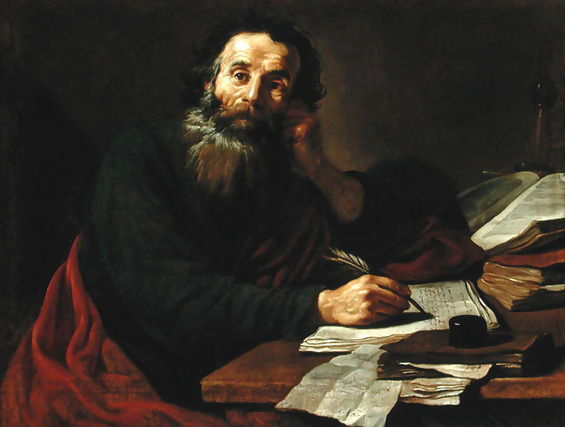
Related image
St. Paul the Apostle by Claude Vignon
This past year, I burdened the English-speaking world with my very own translation of the New Testament – a project that I undertook at the behest of my editor at Yale University Press, but that I agreed to almost in the instant that it was proposed. I had long contemplated attempting a ‘subversively literal’ rendering of the text. Over the years, I had become disenchanted with almost all the standard translations available, and especially with modern versions produced by large committees of scholars, many of whom (it seems to me) have been predisposed by inherited theological habits to see things in the text that are not really there, and to fail to notice other things that most definitely are. Committees are bland affairs, and tend to reinforce our expectations; but the world of late antiquity is so remote from our own that it is almost never what we expect. 
Ask, for instance, the average American Christian – say, some genial Presbyterian who attends church regularly and owns a New International Version of the Bible – what gospel the Apostle Paul preached. The reply will fall along predictable lines: human beings, bearing the guilt of original sin and destined for eternal hell, cannot save themselves through good deeds, or make themselves acceptable to God; yet God, in his mercy, sent the eternal Son to offer himself up for our sins, and the righteousness of Christ has been graciously imputed or imparted to all who have faith.
Some details might vary, but not the basic story. And, admittedly, much of the tale’s language is reminiscent of terms used by Paul, at least as filtered through certain conventional translations; but it is a fantasy. It presumes elements of later Christian belief absent from Paul’s own writings. Some of these (like the idea that humans are born damnably guilty in God’s eyes, or that good deeds are not required for salvation) arise from a history of misleading translations. Others (like the concept of an eternal hell of conscious torment) are entirely imagined, attributed to Paul on the basis of some mistaken picture of what the New Testament as a whole teaches.
Paul’s actual teachings, however, as taken directly from the Greek of his letters, emphasise neither original guilt nor imputed righteousness (he believed in neither), but rather the overthrow of bad angels. A certain long history of misreadings – especially of the Letter to the Romans – has created an impression of Paul’s theological concerns so entirely alien to his conceptual world that the real Paul occupies scarcely any place at all in Christian memory. It is true that he addresses issues of ‘righteousness’ or ‘justice’, and asserts that this is available to us only through the virtue of pistis – ‘faith’ or ‘trust’ or even ‘fidelity’. But for Paul, pistis largely consists in works of obedience to God and love of others. The onlyerga, ‘works’, which he is anxious to claim make no contribution to personal sanctity, are certain ‘ritual observances’ of the Law of Moses, such as circumcision or kosher dietary laws. This, though, means that the separation between Jews and gentiles has been annulled in Christ, opening salvation to all peoples; it does not mean (as Paul fears some might imagine) that God has abandoned his covenant with Israel.
Questions of law and righteousness, however, are secondary concerns. The essence of Paul’s theology is something far stranger, and unfolds on a far vaster scale. For Paul, the present world-age is rapidly passing, while another world-age differing from the former in every dimension – heavenly or terrestrial, spiritual or physical – is already dawning. The story of salvation concerns the entire cosmos; and it is a story of invasion, conquest, spoliation and triumph. For Paul, the cosmos has been enslaved to death, both by our sin and by the malign governance of those ‘angelic’ or ‘daemonian’ agencies who reign over the earth from the heavens, and who hold spirits in thrall below the earth. These angelic beings, these Archons, whom Paul calls Thrones and Powers and Dominations and Spiritual Forces of Evil in the High Places, are the gods of the nations. In the Letter to the Galatians, he even hints that the angel of the Lord who rules over Israel might be one of their number. Whether fallen, or mutinous, or merely incompetent, these beings stand intractably between us and God. But Christ has conquered them all.
In descending to Hades and ascending again through the heavens, Christ has vanquished all the Powers below and above that separate us from the love of God, taking them captive in a kind of triumphal procession. All that now remains is the final consummation of the present age, when Christ will appear in his full glory as cosmic conqueror, having ‘subordinated’ (hypetaxen) all the cosmic powers to himself – literally, having properly ‘ordered’ them ‘under’ himself – and will then return this whole reclaimed empire to his Father. God himself, rather than wicked or inept spiritual intermediaries, will rule the cosmos directly. Sometimes, Paul speaks as if some human beings will perish along with the present age, and sometimes as if all human beings will finally be saved. He never speaks of some hell for the torment of unregenerate souls.
The new age, moreover – when creation will be glorified and transformed into God’s kingdom – will be an age of ‘spirit’ rather than ‘flesh’. For Paul, these are two antithetical principles of creaturely existence, though most translations misrepresent the antithesis as a mere contrast between God’s ‘spirit’ and human perversity. But Paul is quite explicit: ‘Flesh and blood cannot inherit the Kingdom.’ Neither can psychÄ“, ‘soul’, the life-principle or anima that gives life to perishable flesh. In the age to come, the ‘psychical body’, the ‘ensouled’ or ‘animal’ way of life, will be replaced by a ‘spiritual body’, beyond the reach of death – though, again, conventional translations usually obscure this by speaking of the former, vaguely, as a ‘natural body’.
Paul’s voice, I hasten to add, is hardly an eccentric one. John’s Gospel too, for instance, tells of the divine saviour who comes ‘from above’, descending from God’s realm into this cosmos, overthrowing its reigning Archon, bringing God’s light into the darkness of our captivity, and ‘dragging’ everyone to himself. And, in varying registers, so do most of the texts of the New Testament. As I say, it is a conceptual world very remote from our own.
And yet it would be foolish to try to judge the gospel’s spiritual claims by how plausible we find the cosmology that accompanies them. For one thing, the ancient picture of reality might be in many significant respects more accurate than ours. And it would surely be a category error to assume that the story of Christ’s overthrow of death and sin cannot express a truth that transcends the historical and cultural conditions in which it was first told. But, before we decide anything at all about that story, we must first recover it from the very different stories that we so frequently tell in its place.

David Bentley Hart
is an Eastern Orthodox scholar of religion, and a philosopher, writer and cultural commentator. He is an associate at the Notre Dame Institute for Advanced Study, and his latest book is The New Testament: A Translation (2017). He lives in South Bend, Indiana.
This Idea was made possible through the support of a grant from Templeton Religion Trust to Aeon. The opinions expressed in this publication are those of the author(s) and do not necessarily reflect the views of Templeton Religion Trust.

Tuesday, January 09, 2018

KILLING EUROPE Producer Michael Hansen Talks About The Fall Of The Western World

Sorry, SEC, Nick Saban is still the king -- and he's not going anywhere

By Ryan McGee
January 9, 2018
Image result for saban smart january 8 2018
Alabama head coach Nick Saban holds up the championship trophy after overtime of the NCAA college football playoff championship game against Georgia, Monday, Jan. 8, 2018, in Atlanta. Alabama won 26-23. (David J. Phillip/AP)
ATLANTA -- The 2018 College Football Playoff National Championship had been over for nearly an hour and a half. The circular video board that hangs from the roof of $1.6 billion Mercedes-Benz Stadium read "Alabama Crimson Tide National Champions." Staring down from the 340-foot perch above the playing field in ultra-high definition was the trademark glare of head coach Nick Saban. On a three-story-tall video tower in one corner of the stadium there it was again. In the portrait he had his headset on, giving planet Earth a side-eye, pointed directly at the scoreboard display of "Alabama 26, Georgia 23 OT."
An overserved fan dressed in Bama gear and sitting alone in Section 135, the one beneath the towering image, stood, turned to face the giant face and began a bowing motion.
"All hail our crimson god!"
Meanwhile, in the tunnels beneath and behind that place of worship, the deity himself was on the move. He'd already addressed his team, leaving them sweaty and shouting so that he could make his mandatory meeting with the national media. When he left that stage he passed behind a black curtain into a secret pathway that led toward a series of ESPN cameras. The path between was covered with verbal palm fronds, congratulations from people begging for some perspective on the history they'd just witnessed from the coach who'd written it.
Coach, is this the best of your six national titles? "Oh, I don't know. I do know I've never been happier after a game."
Coach, where do you think this ranks you in coaching history? Was this a legacy-defining game? "That's not up for me to decide. My job is to win the next game on the schedule. We did that tonight."
Coach, did it feel extra special to beat Kirby Smart?
He paused. He winked. Then he disappeared around the corner, bound for the next stop.
You see, this was supposed to be the night when Saban finally suffered defeat at the hands of the very monster he hath created, the assembly line of coaches who learned at his right hand, departing one after the other for head-coaching jobs. They have been hired away by rival schools, so downright desperate to finally defeat Alabama they went with "can't beat 'em, join 'em" and attempted to replicate the success on his watch by bringing in someone who helped him construct the tower.
In the days leading up to Monday night's all-SEC title bout, even the most casual of college football fans likely became exhausted with hearing the following statistic: Nick Saban was 11-0 when facing teams coached by his former assistants. Mark Dantonio of Michigan State is 0-2. Derek Dooley, formerly of Tennessee, was 0-3, as was Jim McElwain, formerly of Colorado State and Florida. This very season started with a defeat of Florida State and former LSU lieutenant Jimbo Fisher.
Not only had they not beaten them, they hadn't come close. The thinnest margin being McElwain's Gators in the 2015 SEC championship, when Florida lost to Alabama by two touchdowns.
But Kirby Smart had been Saban's most loyal apprentice. While the others bolted for bigger paychecks, he'd chosen to stay and work alongside Saban for more than a decade in all, from LSU to the Miami Dolphins to Alabama. When Smart was hired by Georgia, his alma mater, two years ago, he didn't do what the others had, trying to modify Saban's sacred "Process" with his own additions. He cloned it all, all the way down to his scowl in halftime interviews. And why not? Heck, all four of Saban's national titles in Tuscaloosa had come with Smart's assistance.
But now Saban has a fifth (and six overall), and it did not come with Smart's help. It came at his expense. Smart easily came the closest to snapping the elder's winning streak. But he didn't. So, now that teacher/student, master/apprentice, Palpatine/Vader stat has been adjusted to 12-0.
"They said we weren't supposed to be here! Now look at us!" Running back Damien Harris shouted it over and over again as the team dashed and hugged and cried on the field moments after the overtime victory. He continued the barking in the locker room later. Alabama, the only non-conference champion to make the playoff field, had been the target of some criticism. "They said that Coach Saban, he was out of moves, didn't they? Well, it doesn't look like he was, does it? Am I right, Tua?!"
Tua Tagovailoa was not the starting quarterback in the 2018 national title game. That honor went to Jalen Hurts, who had started every game in 2017 and all but one in 2016, coming within seconds of leading Bama to a championship one year ago. But Saban, sensing a chance that Georgia might be on the cusp of putting the game away, yanked his leader of two seasons midgame. He inserted Tagovailoa, a true freshman from Hawaii.
That's not the move of a coach who, at 66, is done taking risks. It was simply one of the gutsiest coaching moves ever pulled on college football's biggest stage. Even as the Alabama sideline appeared to be losing control. The third quarter ended with a personal foul, a sideline fight when the player who committed that foul went after a coach, all while another teammate was being carted off on a stretcher after fainting.
Bama trailed the game 13-0 at the half. The Tide never led in regulation. They ended that regulation with perhaps the most god-awfully shanked would-be game-winning field goal attempt ever witnessed. They started their OT drive, down by a field goal, with an equally god-awful sack and loss of 16 yards all the back to the 41-yard line.
But they won. Again. Thanks to a shockingly gorgeous rope pass from true freshman Tagovailoa to another true freshman, DeVonta Smith.
Now Saban owns six rings. Only one other active coach, Ohio State's Urban Meyer, owns more than one and he has only half as many as Saban. His fifth title in nine seasons is the most successful stretch by any coach in college football's poll era. That reaches back to 1936, which means it covers all the legends who only need be identified by one name. The guys already enshrined in a building just a few blocks from Mercedes-Benz Stadium, the College Football Hall of Fame.
Bo, Woody, Joe, Bowden, Osborne, even Bear. They are not at the head of the line. Nick is.
"He's the best for a reason," Smart said Monday night. "I will always be indebted to what he taught me. Always. But dangit, man. That just makes me want to beat him so bad."
Smart will likely have other chances. Georgia, like Bama, is built for the long haul. His fellow former Saban understudies also will have their shots, and soon. Next season Saban is guaranteed to face off against at least two of his former employees. Jeremy Pruitt, the same defensive coordinator who figured out how to slow down Georgia in the second half, is the new head coach at Tennessee, one of the Tide's most loathed rivals.
Meanwhile, Fisher has left Florida State to lead another annual Alabama opponent, Texas A&M. On Monday night he was in Mercedes-Benz Stadium, taking part in ESPN's Megacast coverage of the game. While the celebration was erupting on the field in the distance, Fisher was bolting for the door and heading to his new home of College Station.
"Good for Nick," Fisher begrudgingly praised. "I really thought Kirby had him. One of us will finally get him one of these days. One of these days."