Tuesday, December 05, 2017

A Land of Mini-Coups


By Mark Steyn
December 4, 2017

Image result for michael flynn court
Former Trump national security adviser Michael Flynn leaves federal court in Washington on Friday. (AP)

Following Michael Flynn's guilty plea for "lying to the FBI", there seem likely to be further feverish developments in Robert Mueller's "Russia investigation". Professor William Jacobson asks the obvious question:
Why is Robert Mueller even investigating the presidential transition?
The Order appointing Mueller concerns election interference, not post-election political decisions of the winning candidate.
Indeed. First, it shouldn't be a crime to lie to the FBI given the way the FBI lies to us with impunity. Yours truly thirteen years ago:
Martha, it seems, will be going to jail for telling a lie. Not in court, not under oath, not perjury, but merely when the Feds came round to see her about a possible crime. They couldn't prove she'd committed a crime, so they nailed her for lying while chit-chatting to them about the non-crime. And for that they're prepared to destroy her company. 
It's true that it's an offence to lie to the Feds. But, as my New Hampshire neighbours Tom and Scott, currently in my basement stretching out a little light carpentry job to the end of the winter, are the first to point out, the Feds lied to the public about Waco and Ruby Ridge (another bloodbath) for years. If the Feds can lie to the people, why can't the people lie to the Feds?
Martha Stewart wound up behind bars for telling a lie in a matter in which there was no underlying crime. In the case of Flynn, I heard some bigshot in Congress argue that Flynn's lies were somehow "material" to the investigation. But, as Professor Jacobson points out, it's hard to see how Russia can "interfere" with the election after it's been held. Flynn's conversations occurred in his capacity as a senior figure in the incoming administration. That's the normal business of diplomatic relations - and it is most emphatically not the business of minor policemen within a leaky and insecure permanent bureaucracy.
So Flynn's "lies" are not material - unless the Deep State is "investigating" the winning side in the election for engaging in the usual business of government.

Second, I happened to speak to the FBI about a certain matter a couple of months back. Very pleasant lady. Thought it all went well. But my lawyers were dead set against it - because, if you go to see the Feds in the context of some or other investigation and you chance to be infelicitous about this or that, you'll find that suddenly you're the one being investigated for, as noted above, the one-way crime of lying to the authorities. Did Flynn, in fact, lie? When you're shooting the breeze with G-men, mistakes or faulty recollection can be enough to land you in prison - if the Feds think it useful to them to threaten you with that. When Flynn pleaded guilty, was he, in fact, guilty? Or was he rather a ruined and broke man who could no longer withstand the pressure of the metaphorical electrodes with attendant billable hours?

I think we all know the answer to that. As I always say, the process is the punishment. And the Federal Government (which wins 97 per cent of cases it brings to court) can inflict a more punishing process than anyone this side of Pyongyang. This is a vile business that does no credit to a civilized society.

Third, as longtime readers, listeners and viewers know, I strongly dislike the uniquely American "presidential transition" period. As you know, in, say, the Westminster system, if a prime minister loses on a Thursday, his goes to the Palace to resign on the Friday, and he moves out of Downing Street on the weekend. The new cabinet ministers are in place the following Monday or Tuesday. The "transition" is part of the general institutional sclerosis of Washington, and certainly no friend to swamp-drainers: A year after Trump's election, key positions in every cabinet department - Deputy Secretaries, Assistant Secretaries, Under-Secretaries, Deputy Assistant Secretaries, Assistant Deputy Secretaries, Deputy Assistant Under-Secretaries - are still held by Obama appointees.

Well, you say, that's business as usual with Chuck Schumer. What can you expect? But in this case the losing party decided to take the opportunities afforded by the transition to the next level. As I put it back in October:
During the stupid and anachronistic two-and-a-half-month electoral "transition", the outgoing Administration worked round the clock to de-legitimize and cripple their successors.
Hence Susan Rice and Samantha Power frantically "unmasking" all the way up to inauguration day.

If there is any justification for this absurd "transition", it is that a US presidential administration is uniquely unwieldy and is constitutionally required to go through ever more molasses-speed confirmations of key figures. Therefore, it helps to keep the old government around to have someone to answer the telephone in case Little Rocketman nukes Cleveland. 
That justification would only have merit if the outgoing administration behaved with a degree of circumspection and deference to the people's verdict. That's to say, they should be keeping the seat warm, not making substantive policy moves at odds with the positions of the duly elected incoming government.

Obama's decision to pick a last-minute fight with Moscow and expel a bunch of Russian diplomats does not seem to me to be appropriate for a placeholder president on the way out the door. So it is not just that the incoming administration's attempts to ameliorate the damage were, pace Mueller, entirely legitimate, but that it is Obama's actions that are, in the sense of political decorum, wholly improper.

Since January 20th, the party that lost the election has been, supposedly, out of power. But its appointees remain in charge - to the point where the President has to go to court to evict the in effect self-appointed head of the Consumer Financial Protection Bureau - a lawless and unaccountable body so beyond the much vaunted "checks and balances" of the US Constitution that it can shake down its targets (banks) and transfer the proceeds to its ideological allies (anti-capitalist activist groups). The permanent bureaucracy's argument re the CFPB is that elections don't matter. Primitive countries have coups against the president; subtler systems have a thousand below-the-radar coups in every rinky-dink bureau and agency.

As Peter Roff puts it in US News:
In case anyone still doubts it, the deep state is real.
So it is. Whatever else may be said about them, Republicans make good losers: Nixon to Kennedy, Bush Sr to Clinton, McCain to Obama... For a generation, Democrats have convinced themselves that there is no such thing as a legitimate Republican victory: Bush Jr was the "selected" president, and the tag was sufficiently effective that even the murderous assault of 9/11 provided only a brief respite. The strategy this time round is a kind of inversion: Trump may be the elected president, but at the CFPB, the Justice Department, State, Homeland Security et al the self-selected permanent state cruises on.

~We had a busy weekend at SteynOnline, including my special audio interview with rock legend Ted Nugent, covering everything from feral cats to Mitt Romney. We also marked the fortieth anniversary since Ted warmed up "Cat Scratch Fever" for me. In a different musical vein, mySong of the Week celebrated a classic novelty number - and my weekend movie column told the tragic tale of a great comic, Charlie Chaplin's heavy.

We also presented my radio serialization of Scott Fitzgerald's story "The Rubber Check" in three episodes: Parts OneTwo and Three. I'll be starting a special Christmas edition of Tales for Our Time this coming weekend. If you were otherwise distracted these last 72 hours and missed any or all of these delights, I hope you'll check out one or two of them.

If you're thinking of giving the gift of Steyn this holiday season, we've introduced a special Mark Steyn Club Christmas Gift Membership that lets you sign up a chum for the Steyn Club and then choose a personally autographed welcome gift for them - either one of two handsome hardback books or a couple of CDs. You'll find more details here - and scroll down to the foot of the order form for the choice of books/CDs.

And, for members and non-members alike, there are bargains galore in our Steynamite Christmas specials.

Saturday, December 02, 2017

Mueller Investigation: Politics, Not Law Enforcement or Counterintelligence


By Andrew C. McCarthy
December 2, 2017

PHOTO: Former U.S. National Security Adviser Michael Flynn arrives for a plea hearing at U.S. District Court, December 1, 2017. (Jonathan Ernst/Reuters)

Former U.S. National Security Adviser Michael Flynn arrives for a plea hearing at U.S. District Court, December 1, 2017. (Jonathan Ernst/Reuters)


Here’s what I’d be tempted to do if I were President Trump: I’d direct the Justice Department to appoint a special counsel to investigate Iran’s efforts to acquire nuclear weapons, including any Obama-administration collusion in that enterprise.

I would make sure to call it a “counterintelligence investigation,” putting no limitations on the special counsel — just as with the investigation that Special Counsel Robert Mueller has been unleashed to conduct into Trump “collusion” with Russia. That is, I would not restrict the prosecutor and investigators to digging for specified criminal violations. Or, indeed, any criminal violations. I’d just tell the special counsel, “Have at it” — with unbound authority to scrutinize the negotiations surrounding the eventual Iran nuclear deal (the Joint Comprehensive Plan of Action).

Would I really expect the special counsel to find that Obama officials conspired with the mullahs to obtain nukes for Tehran? No . . . but hey, as the “Trump collusion with Russia” crowd says, “You never know.” Meantime, under the guise of investigating this highly unlikely “collusion,” I’d want the special counsel to scrutinize closely any variances between what Obama-administration officials were telling Congress and the public about the negotiations and what they were telling the Iranians; to probe any side deals the administration agreed to but failed to disclose to Congress; and to consider whether any laws or policies were violated in such matters as President Obama’s payment of a cash ransom in exchange for American hostages held by Iran.

Why would I do this? Well, because I disagree with Obama-administration foreign policy, of course. Under the Mueller “collusion” precedent, it is evidently now American practice to criminalize foreign-policy disputes under the pretext of conducting a counterintelligence investigation.

It is difficult to come to any other conclusion based on the guilty plea that Mueller just pried out of Michael Flynn.

Let’s think about what has happened here.

The Justice Department did not, as the pertinent special-counsel regulations require, identify specific crimes it suspected had been committed by Trump-campaign officials. Deputy Attorney General Rod Rosenstein disclosed no factual predicate calling for a criminal investigation from which Trump’s Justice Department would be ethically required to recuse itself.

Instead, Mueller’s investigation was rationalized by the need to conduct a counterintelligence inquiry into Russia’s “cyber-espionage” meddling in the 2016 presidential election. Though there was no probable cause to believe Trump-campaign officials had participated in Russia’s hacking (and remember: the FBI and Obama Justice Department had been investigating for months before the special counsel was appointed), Mueller was encouraged to focus on whether Trump-campaign officials somehow “coordinated” in Russia’s perfidy.

Mueller’s investigation was not a criminal investigation. It started out as a fishing expedition, under the vaporous heading of “collusion,” into “contacts” between Russian officials and Trump associates — notwithstanding that collusion is not conspiracy and that it was perfectly legal for Trump associates to have contacts with Russia (just like Clinton associates did). It was to be expected that the Trump campaign and transition would have such contacts once it was apparent that Trump could well become — and did in fact become — the next president of the United States.

Only one conceivable crime could have arisen out of the “collusion” that was the pretext for Mueller’s probe: the knowing complicity of Trump associates in Russia’s hacking of Democratic email accounts. Of course, there was never evidence of such a scheme . . . but why should that matter? The point here was to have the theater of an investigation run by a prosecutor — the rest is just details.

See, we’re not following the normal rules, in which a prosecutor is assigned only after evidence of an actual crime has emerged. We’re in the wooly realm of counterintelligence, where anything goes. And in the event our aggressive prosecutor can’t find any crimes — which would be no surprise, since the investigation was not triggered by a crime — no matter: The special counsel is encouraged to manufacture crimes through the investigative process. Misleading assertions by non-suspects made to investigators probing non-crimes can be charged as felony false statements.

The end game of the investigation is the removal of Donald Trump from the presidency, either by impeachment (which does not require proof of a court-prosecutable crime) or by publicly discrediting Trump to such a degree that his reelection becomes politically impossible. The latter can be accomplished by projecting the appearance of a critical investigation (notwithstanding that there is no underlying crime), turning administration officials into suspects, and hopefully generating the false-statement prosecutions that help depict the administration as dishonest and icky.

While all that plays out, though, behold the frightening thing Mueller’s investigation has become: a criminalization of politics. In the new order of things, policy differences are the grist for investigation and prosecution.

There is no evidence that Flynn or any other Trump associate was involved in Russia’s election interference. Instead, after being elected on the promise of significant policy shifts from the Obama administration, President-elect Trump directed Flynn, his incoming national-security adviser, to make contact with foreign counterparts, including but not limited to officials from Russia. This is standard operating procedure when administrations change — that’s why they call it a transition.

Nevertheless, Trump’s victory caused consternation in the Obama administration for two reasons. First, and most obviously, Obama did not want his policies reversed. Second, neither Obama nor his party could abide a judgment of history holding that the election of Trump, the bane of their existence, was a result of the American people’s rejection of the Obama agenda and of Hillary Clinton, the hapless candidate nominated by Democrats to carry that agenda forward.

Consequently, while projecting a public image of cooperation in the transition, the Obama administration used the weeks following the election to do two things: protect Obama’s priorities from Trump, and promote a political narrative that Mrs. Clinton’s defeat was the result of sinister collaboration between Trump’s campaign and the Kremlin.

One major Obama-administration priority was to solidify the policy of blaming Israel for the enduring Israeli–Palestinian conflict — specifically, downplaying the ideological roots of Palestinian terrorism and framing as the real culprit Israeli settlement-building in disputed territories that Obama, like Israel’s enemies, regarded as illegally “occupied.” Thus, in his administration’s coup de grace, Obama orchestrated a U.N. Security Council resolution condemning Israeli settlement activity — a stark departure (as I wrote at the time) from America’s commitment to Israel’s security and policy of shielding Israel from such U.N. intrigues.

Based on a statement of facts filed by Mueller in connection with Flynn’s guilty plea, we now know that, on December 22, right after this resolution was proposed, a “very senior member” of Trump’s transition team — who has been identified as Jared Kushner, Trump’s son-in-law, in a Bloomberg report by Eli Lake — directed Flynn to contact officials from the various foreign governments on the Security Council, including Russia. Pursuant to these directions, Flynn informed his counterparts that Trump opposed the resolution — which opposition, by the way, Trump was quite clear about publicly. Flynn encouraged them to vote against the resolution, or at least delay it until Trump would assume office in January.

The following day, December 23, Flynn again contacted the Russian ambassador, Sergei Kislyak. As we have noted, Kislyak was the subject of monitoring under the Foreign Intelligence Surveillance Act (FISA), so we should assume the FBI was recording all his conversations with Flynn. Kislyak told Flynn that, despite Trump’s opposition, Russia would not vote against the resolution if it came down to a vote. Some collusion!

As discussed in my column yesterday, Obama imposed sanctions the following week — promoting the “Russia hacked the election” storyline. Kislyak contacted Flynn on December 28, the day Obama signed the relevant executive order. Afterwards, Flynn sought guidance about what to tell the Russian ambassador from “a senior official” on Trump’s transition team — headquartered during the holiday season at Trump’s Mar-a-Lago resort in Palm Beach. Flynn and this official (who, as this is written, has not been identified) discussed how the sanctions might affect Trump foreign-policy goals. The official told Flynn that the transition team did not want Russia to escalate the situation — meaning, to respond too aggressively to Obama’s move.

Flynn immediately called Kislyak, asking that Russia not escalate — that it restrict itself to a measured, reciprocal response (which, we note, is what any American should have wanted). On December 30, Putin announced that Russia would not take retaliatory measures at that time, and the next day Kislyak explained to Flynn that this was done in deference to Flynn’s request. Flynn had made no promises to Russia about the sanctions, but Putin rationally concluded his best shot at getting relief was to refrain from taking retaliatory measures that would make it more difficult for Trump to accommodate him.

Because of surveillance coverage on Kislyak, the Obama administration knew the substance of Flynn’s conversations with the Russian ambassador. The FBI knew there was no suggestion, in any of the activities just described, that Flynn or Trump had anything to do with Russian espionage. There was no evidence that Flynn had committed a crime. There was every indication that the incoming national-security adviser was engaging in transition activities to be expected in preparation for an administration that had foreign-policy priorities very different from Obama’s.

So . . . why did the Obama administration decide to investigate Flynn, resulting in the FBI interview?

I believe the explanation is threefold: (1) to punish Flynn, and derivatively the incoming Trump administration, for opposing Obama’s anti-Israel legerdemain in the Security Council; (2) to promote the political narrative that Russia–Trump collusion had cheated Clinton out of her rightful election victory; and (3) to tie this collusion narrative to sanctions relief, thereby making it politically impossible for Trump to roll back Obama’s sanctions once he was sworn in — a boon for the Democrats’ collusion narrative since the sanctions stand as a reminder of Russia’s election meddling.

The ongoing Mueller probe is not a good-faith investigation of suspected espionage or other crime. It is the exploitation of the executive’s intelligence-gathering and law-enforcement powers in order to (a) criminalize Trump political policies with which the Obama administration disagreed and (b) frame Clinton’s electoral defeat as the product of a traitorous scheme rather than a rejection of Democratic-party priorities.

We can stipulate that General Flynn is a very foolish man. He was not required to speak to the FBI when agents came to interview him on January 24. He is, moreover, the former head of the Defense Intelligence Agency: He had every reason to know that the FBI must have been monitoring Kislyak (and perhaps other foreign officials with whom Flynn was in contact). He had every reason to know that the Bureau must have had recordings of the conversations the agents wanted to ask him about. Astonishingly, he chose to submit to the interview anyway, and to lie. It is fair enough to say that he has no one to blame but himself, and that a person of such poor judgment should not be the president’s principal adviser on national-security matters.

We can also stipulate that the Trump administration will be badly bruised by its deceptive performance, in which ignorance was feigned about whether Flynn discussed the sanctions with Kislyak.

Trump could easily have signaled his disagreements with Obama’s actions. It is not illegal for the incoming administration to undermine the incumbent administration — the Logan Act, which purports to criminalize foreign-affairs freelancing by unauthorized citizens, is unconstitutional and absurd. If it weren’t, Mueller would have charged Flynn with violating it.

It is rightly observed that we have only one president at a time. Thus, it remains unseemly for an incoming administration to undermine the incumbent administration in such an active way — negotiating with foreign powers against the policy of a president who is still lawfully governing. Clumsily doing so ratchets up political heat on transition officials to deny their contacts with foreign officials. In matters of foreign affairs and intelligence, U.S. officials often find it expedient to say one thing in private communications with foreign diplomats and something quite different in public appearances. Just ask Susan Rice, Hillary Clinton, or Barack Obama.

All that said, what is going on here is politics, not law. No sensible person thinks the Trump campaign colluded in Russian espionage. If there were such evidence, I’d be first on line demanding the president’s impeachment and removal. Nor did Trump obstruct the investigation of this non-crime by firing the FBI director — what he did was exhibit incompetence and boorishness. Rather, Mueller’s investigation is a semblance of law-enforcement disguising the brute reality that Trump is being punished for winning the election and defying Obama policy.

If that is the way the game is going to be played, if the purpose of a special-counsel “collusion” investigation is to humiliate the opposition party by exposing its wayward foreign-policy objectives and unsavory horse-trading, then let’s investigate Obama and Iran.


— Andrew C. McCarthy is a senior fellow at the National Review Institute and a contributing editor of National Review.

San Francisco's Shame


December 1, 2017
Image result for kate steinle
Advocates for illegal immigrants are unrepentant after yesterday’s shocking acquittal on all homicide charges of an illegal-alien confessed killer. The advocates are defending the sanctuary policies that had set in motion the 2015 killing in San Francisco; they have also doubled down on their opposition to any deportation of illegal aliens, criminal or otherwise. If ever there were a clarifying moment regarding what is at stake in the battle for the immigration rule of law, this is it.
Jose Ines Garcia Zarate was a poster boy not just for the folly of sanctuary policies but also for the mass low-skilled Hispanic immigration that has transformed California. A barely literate drug dealer from Mexico with a second-grade education, no English, and a penchant for criminal aliases, Garcia Zarate had been deported five times by federal immigration authorities following convictions for various crimes.
Despite his record, Garcia Zarate was the sort of immigrant that the San Francisco authorities apparently believed that this country needs. Having completed a federal sentence in March 2015 for his sixth felonious reentry into the country, Garcia Zarate had been sent to the San Francisco County Jail to serve time for a marijuana charge from which he had absconded two decades ago. Immigration and Customs Enforcement requested that when the San Francisco sheriff released Garcia Zarate after his drug sentence, the sheriff would notify ICE so that the federal agents could pick him up for his sixth deportation. The sheriff, Ross Mirkarimi, ignored the marijuana charge and, most crucially, the ICE detainer request as well, instead freeing Garcia Zarate back into San Francisco’s streets before ICE could pick him up. This release followed the city’s sanctuary policy, which forbade local law enforcement authorities from cooperating with their federal counterparts in ICE: local authorities may not notify ICE of a criminal illegal alien’s release date or hold that criminal alien for ICE to pick-up.
Four months after Mirkarimi sent Garcia Zarate back into San Francisco’s illegal alien subculture, the felon picked up a gun on the Embarcadero and fatally shot Kate Steinle, 32, in the heart. He then tossed the gun into the San Francisco Bay and ran off. The drug dealer changed his story several times during police interrogation, first saying that he had been aiming at a sea lion, then claiming that he didn’t even know that he was handling a gun. The gun had been stolen from the parked car of a federal law enforcement agent four days earlier; Garcia Zarate’s story at trial was that he had picked up a rag with the gun hidden within it and that the gun had accidentally discharged. To no avail, the prosecutor contested Garcia Zarate’s claim that the pistol used in the crime, a Sig Sauer P239, could be fired without the trigger being deliberately pulled.
Donald Trump turned the Steinle case into a powerful rallying cry for immigration enforcement during his presidential run. The illegal-alien lobby, by contrast, denied that San Francisco’s sanctuary policy had anything to do with the killing. California even strengthened its status as an immigration scofflaw after the Steinle homicide. This October, Governor Jerry Brown signed SB 54, the California Values Act, which turns the entire state into an immigration-enforcement-free haven for all but the most heinous illegal-alien criminals. (Brown has been assiduously silent on the Garcia Zarate acquittal.) San Francisco imperceptibly tweaked its local sanctuary policy following the killing; today, it would again release Garcia Zarate if asked under the same conditions to hold him for ICE custody.
According to Garcia Zarate’s attorneys and other illegal-alien advocates, the only blame in this case belongs to Donald Trump and anyone who wants to enforce the immigration laws. “From day one, this case was used as a means to foment hate, to foment division and to foment a program of mass deportation,” public defender Francisco Ugarte said. Ugarte manages the immigration unit at the San Francisco Public Defender’s Office, where he advises criminal illegal aliens on how to avoid deportation for their crimes. “Nothing about Mr. Garcia Zarate’s ethnicity, nothing about his immigration status, nothing about the fact that he is born in Mexico had any relevance as to what happened on July 1, 2015,” Ugarte said. Actually, the case is almost exclusively about immigration policy; had this country had the ability to protect its borders and deport illegal alien criminals, Garcia Zarate would not have been sunning himself on the Embarcadero on July 1, 2015, but would have been back in Mexico.
But just because Garcia Zarate was acquitted on all homicide and assault charges (the jury, which contained three immigrants, found him guilty only of illegal gun possession) doesn’t mean that all is well for illegal alien criminals in the Golden Sanctuary State. The people we should really be concerned for now, according to former San Francisco Supervisor David Campos, are illegal aliens themselves. “I’m afraid the immigrant community is going to be made to pay for something that the jury decided appears to be a very tragic accident,” said Campos, now chair of the San Francisco Democratic Party. Trump and pro-enforcement forces would react to the verdict by “ramping up their rhetoric.”True to form, a sitting San Francisco supervisor turned the case into a gun control matter. “I always thought this is not an immigration issue, as Trump made it out to be— this is a gun management issue,” said Sandra Lee Fewer. “A car is not a safe and secure place to keep a gun, knowing the amount of car break-ins we have in San Francisco.” Now why might San Francisco have so many car break-ins? Because of California’s Proposition 47, which forbids prison sentences for most thefts, and which has led to a sharp increase in property crimes. But Supervisor Fewer treats car thefts as a fact of nature—like illegal immigration—that society has no power to quell.
California’s once-unrivalled status as the country’s most educated state has long since disintegrated under the waves of low-skilled, low-social-capital Mexican and Central American immigrants. Now, California's K-12 system rivals Mississippi and Alabama as an education backwater. The state’s school-age population, now majority Hispanic, lacks competitive linguistic and math skills.  (Of course, defense counsel conducted part of their post-verdict press conference in Spanish, oblivious to the symbolism.)  California is becoming another Brazil, divided between fabulously wealthy elites hunkered down in their own coastal sanctuaries, and a poor, Third World population. Before the rest of the country ends up in the same situation, the immigration policies that gave rise to the Steinle homicide must change. Attorney General Jeff Sessions has been conducting a largely unheralded effort to end sanctuary jurisdictions, but the illegal-alien lawyer’s lobby has fought him at every turn.
Sessions’s efforts would be immensely aided if Congress finally passed the No Sanctuary for Criminals Act sponsored by Virginia congressman Bob Goodlatte. That bill would clarify ICE’s authority to enforce federal detainer requests and would confirm the attorney general’s authority to withhold federal funding from scofflaw jurisdictions. Most importantly, it would allow both the federal government and victims of sanctuary policies to sue sanctuary governments. The Steinle family had sued San Francisco and former sheriff Ross Mirkarimi in 2016 for their failure to notify ICE of Garcia Zarate’s release, but a federal judge threw out the case earlier this year. The Goodlatte bill would have allowed their suit to proceed. The passage of “Kate’s Law,” which lengthens the federal sentences for felonious reentry following deportation, is less urgent.
While building a border wall is an important part of a sound immigration policy, preserving the rule of law inside the country is even more important. The advocates’ agenda is clear: they want to stop all deportations and in so doing eviscerate our sovereignty once and for all. Their ultimate aim is to transform the country culturally and demographically. Sanctuary policies are one of their most powerful weapons in that crusade.
Heather Mac Donald is the Thomas W. Smith Fellow at the Manhattan Institute and a contributing editor of City Journal, and the author of the New York Times bestseller The War on Cops.

Friday, December 01, 2017

No Justice for Kate Steinle


Illegal’s attorney says "not guilty" verdict is “all about immigrant rights.”


By Lloyd Billingsley
December 1, 2017

Related image

A San Francisco jury on Thursday found Jose Ines Garcia Zarate, also known as Juan Francisco Lopez Sanchez, not guilty of the murder of Kate Steinle on a San Francisco pier on July 1, 2015. The jury of six men and six women, including three immigrants, found the Mexican national not guilty of all murder and manslaughter charges and guilty only of felony possession of a firearm.
For Garcia’s Zarate’s attorney, Matt Gonzalez, Ralph Nader’s running mate in the 2008 presidential election, the trial was all about Donald Trump.
“For those who might criticize this verdict – there are a number of people who have commented on this case in the last couple of years,” Gonzalez said after the verdict, “the Attorney General of the United States and the President and Vice President of the United States. Let me just remind them, they are themselves under investigation by a special prosecutor in Washington D.C. and they may soon avail themselves of the presumption of innocence beyond a reasonable doubt, so I ask that they reflect on that before they comment or disparage the results of this case.”
“From day one this case was used as a means to foment hate, to foment division and to foment a program of mass deportation,” added defense attorney Francisco Ugarte. “It was used to catapult a presidency along that philosophy of hate of others. I believe today is a day of vindication for the rights of immigrants.”
Alex Bastian of the San Francisco prosecutor’s office told reporters the verdict “was not the one we were hoping for,” but the Steinle family could be forgiven for any reasonable doubts about the prosecution.
“We’re just shocked — saddened and shocked ... that’s about it,” Jim Steinle, Kate’s father, told the San Francisco Chronicle. “There’s no other way you can coin it. Justice was rendered, but it was not served.” Kate’s brother Brad was “stunned that they couldn’t even get him on using the weapon.”
Attorney David Wohl told Fox News that with negligent discharge of a firearm, the defendant’s action met every standard for involuntary manslaughter. The verdict, Wohl said, was “an utter and complete and total failure by the prosecutor.”  
Conservative Ben Shapiro told Fox news the verdict was “horrifying. . . Politics trumps evidence in California once again.” For Jeff Sessions San Francisco’s sanctuary city policy “led to the preventable and heartbreaking death of Kate Steinle.” According to the Attorney General’s statement, the Justice Department “will continue to ensure that all jurisdictions place the safety and security of their communities above the convenience of criminal aliens.”
For his part, President Trump tweeted: “A disgraceful verdict in the Kate Steinle case! No wonder the people of our Country are so angry with Illegal Immigration.”
Mexican national Jose Ines Garcia Zarate, 54, is a seven-time felon and has been deported five times. In 2015 federal authorities sought to detain him for deportation. San Francisco Sheriff Ross Mirkarimi chose to defy the feds and release the Mexican national. On July 1, 2015, the criminal illegal picked up a Sig Sauer .40 caliber pistol, stolen from a Bureau of Land Management officer, and fired the shot that killed Kate Steinle, only 32 years old. 
The Mexican national and career criminal enjoyed all the rights of the American legal system, the presumption of innocence, and a high-profile defense attorney funded by American taxpayers. During the trial, former vice presidential candidate Matt Gonzalez claimed that Garcia Zarate’s background and nationality played a role in his prosecution. As Gonzalez argued, “If this was a college student or Swedish kid would he be charged with murder?”
That sort of politically correct nonsense plays well in San Francisco, so any observer of the case could be forgiven for believing that prosecution and defense both got the outcome they wanted, regardless of the tragedy for the Steinle family. The felony firearms charge, the only charge on which Garcia Zarate was found guilty, carries a sentence of 16 months to 3 years. Since Garcia Zarate has been languishing in jail, the authorities could commute any sentence to time served and he could walk free within weeks.
San Francisco is not likely to hand the felon over to ICE for deportation. Should that happen, Garcia Zarate has already proved five times that anybody can get away with violating U.S. immigration law. He has already proved that in the sanctuary state of California, false-documented illegals are a privileged class.
Jose Ines Garcia Zarate, or whatever his real name is, has also proved that a career criminal who is not even supposed to be in the country can literally get away with murder in broad daylight. When that happens, the killer’s public defender will call it a “vindication for the rights of immigrants.”
In San Francisco, and across California, this verdict will surely give new meaning to the cry of “no justice, no peace.”

Thursday, November 30, 2017

Today's Tune: The Killers - Run For Cover

Khatallah’s Acquittals on Benghazi Murders Show, Again, Need for New System


We need a designation of the enemy that homes in on its ideology.

By Andrew C. McCarthy — November 29, 2017
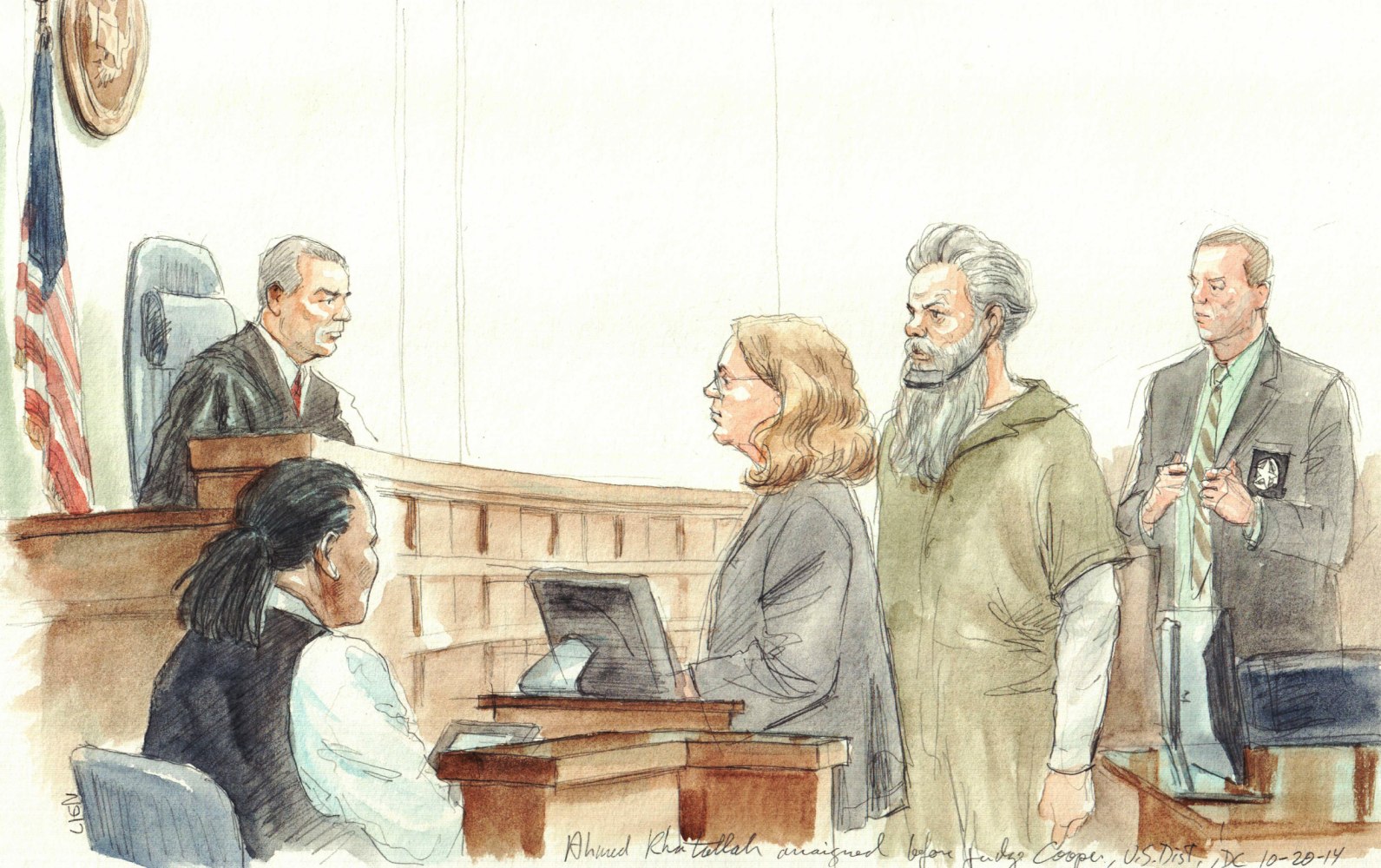
Image result for ahmed abu khatallah trial
There was never going to be justice for the American war dead of the Benghazi attack. The jihadist strike on the eleventh anniversary of the 9/11 atrocities was too bound up in the politics of the 2012 presidential election. Moreover, the prosecution of the lone defendant charged in the attack was a product of the progressive ideological insistence that acts of war can seamlessly be downgraded into mere penal offenses, adjudicated with all the due-process strictures that implies.

This bull-headed conceit is a fiction, and thus the experiment is a failure.

It is not my purpose to make a competing “I told you so” claim that Ahmed Abu Khatallah should have been designated an enemy combatant and consigned to military detention and trial. Yesterday, after an eight-week trial in civilian federal court in Washington, Khatallah was acquitted on the most important charges against him — the charges that arose out of the murders of U.S. ambassador J. Christopher Stephens, State Department employee Sean Smith, and CIA security contractors Glen Doherty and Tyrone Woods. Despite these 14 acquittals, he was convicted on four charges involving material support for terrorism, destruction of property, and carrying a firearm during a violent crime. There is no reason to believe that the outcome would have been more just — or even that we would have an outcome yet — had the case been assigned to the existing, deeply flawed military-commission system.

Instead, in positing two points, I want to restate a plea that we stop playing with fire and move beyond the deadening “military v. civilian” debate — Is it a war or is it a crime? — that has undermined American counterterrorism for 16 years.

Point One: The identification of our wartime enemy must be made with more precision — which is to say, the Authorization for the Use of Military Force (AUMF) under which we have been operating since October 2001 badly needs superseding. It is the AUMF that determines who can properly be regarded as an unlawful enemy combatant. Only unlawful enemy combatants may be detained, interrogated, and prosecuted outside the civilian justice system. It is not clear that the AUMF would have supported Khatallah’s designation as an enemy combatant, notwithstanding his murderous jihadist attack on U.S. government facilities. Part of that is because of the way the Obama administration distorted al-Qaeda, but another part is the increasing obsolescence of the AUMF.

At present, many if not most of the jihadist organizations we confront did not even exist when the AUMF was enacted (although most carry the DNA of al-Qaeda, as that network existed 16 years ago). The problem has long been obvious, even if we remain willfully blind to it: Our enemy is not a particular jihadist network; it is sharia-supremacist ideology, drawn from a fundamentalist interpretation of Islam, which spawns virulently anti-American, anti-Western jihadist factions. The factions come and go, their names changing over time — al-Qaeda, ISIS, Ansar al-Sharia, al-Shabaab, al-Qaeda in the Islamic Maghreb or in the Arabian Peninsula, and on and on. The constant is the ideology. It is what catalyzes the jihadists and knits their ever-evolving forces together.

We need a designation of the enemy that homes in on the ideology and brings within its sweep all these conforming groups. The current AUMF, to the contrary, is circumscribed by a long-ago event (9/11) and the entities (whether terrorist organizations or nations) that were complicit in it.

Point Two: To repeat what I have been arguing for over a dozen years, we need a national-security court. At the moment, we have two models for prosecuting enemy-combatant terrorists: the civilian justice system and the military-commission system. Neither one of them is a good fit. Khatallah’s case underscores the incurable deficiencies of civilian prosecution for acts of war that occur outside U.S. jurisdiction — as did the 2010 trial of Ahmed Ghailani, who was acquitted on 284 of the 285 terrorism counts arising out of his participation in al-Qaeda’s 1988 bombings of American embassies in eastern Africa. Yet, the military justice system is also inadequate to the task of addressing a non-traditional enemy who crisscrosses between the civilian sphere and combat operations.

We are well into a second decade of partisan philosophical argument on this subject. It has gotten us nowhere.

Progressives fantasize that all national-security challenges can be resolved by lawsuits and diplomatic gambits — fallaciously reasoning that, because a conflict may not have a military solution, the solution should not have a military component. They insist that the civilian justice system “works” for terrorism because the comparatively few terrorists who are tried get convicted of at least something — even Ghailani, with his hundreds of acquittals, got a life sentence for the single count of conviction, and a similar fate awaits Khatallah. But apologists for civilian due process ignore that most terrorists cannot even be apprehended, much less tried in our judicial system. Most terrorist planning and attacks occur in dangerous territories where our investigative agencies do not operate and the writ of our courts does not run.

Scores of terrorists were involved in the Benghazi attack. Yet, only two have been captured in the ensuing five years — Khatallah and Mustafa al-Imam, who recently appeared in federal district court in Washington after being captured in Libya. The likelihood of many more arrests is nil. Investigations and captures in these cases rely on foreign intelligence that often cannot be presented in court, and on foreign sources who must be rewarded for their cooperation in ways that would never happen in ordinary U.S. prosecutions. Indeed, a major issue in Khatallah’s trial was an informant easily discredited because our government paid $7 million for his assistance.

In addition, an overseas military battlefield is patently not a domestic law-enforcement crime scene. Case in point, again, the Khatallah trial: Unable to secure the Benghazi compounds from jihadist militias, and angry at the Obama administration for fraudulently claiming that the attack was instigated by an anti-Muslim video, what passes for the Libyan authorities delayed for three weeks the FBI’s access to the relevant sites for an all-too-brief brief forensic examination. This delay fatally compromised the integrity of physical evidence. As my friend Cliff May has quipped, we are not filming an episode of “CSI Kandahar” here. When civilian due-process protocols apply but the exigencies of a war zone taint the FBI’s retrieval and processing of evidence, cases are easily dismantled by competent defense lawyers.

These problems, it should be noted, are separate and apart from the main challenge: It is impossible to try terrorists under civilian due-process protocols without providing them generous discovery from the government’s intelligence files. This means we are telling the enemy what we know about the enemy while the enemy is still plotting to attack Americans and American interests. That’s nuts.

The patent downsides of treating international terrorism as a law-enforcement issue are why critics, myself included, were hopeful that a shift to military prosecution of enemy combatants would improve matters — more protection of intelligence, and due process limited by the laws and customs of war. We were wrong. The experiment has been a dismal failure. To catalogue all the delays, false starts, and misadventures of the military-commission system would take another column or three. Suffice it to say that it was unfair and unrealistic to task our armed forces with designing a legal system on the fly even as they fought a complex war in which, unlike prior American wars, swaths of the American legal profession backed the enemy — volunteering to represent jihadist belligerents in challenges to military detention and prosecution.

Furthermore, even if the military system had performed adequately, it is not clear that Khatallah could lawfully have been prosecuted in it. This goes back to the politics of the 2012 election and the outdated AUMF.

As the incomparable Tom Joscelyn relates, Khatallah was a member of a Libyan jihadist militia, Ubaidah ibn al-Jarrah, that was absorbed into Ansar al-Sharia (AAS) after Qaddafi was overthrown. In Libya, AAS has factions in Derna and Benghazi that have close ties to al-Qaeda. (The head of AAS-Derna, Suffian bin Qumi, was an al-Qaeda operative before being detained for a time at Guantanamo Bay.) The two chapters of AAS, along with three other al-Qaeda tentacles that emerged in the post-9/11 years (al-Qaeda in the Islamic Maghreb, al-Qaeda in the Arabian Peninsula, and the Mohammad Jamal network), colluded in the Benghazi attack.

This attack and its aftermath, including Khatallah’s capture, occurred in the context of President Obama’s preposterous claim that al-Qaeda had been “decimated.” This political narrative, supported by our politicized intelligence community, held that the killing of Osama bin Laden was the death knell of the terror network. ISIS (“the JV team”) was only just emerging, and the remaining constituents of al-Qaeda were depicted as disorganized neighborhood gangs animated by local disputes. We were to believe that a transcontinental network pursuing global jihadist aspirations was a thing of the past (just like Russia was no longer a geopolitical foe and Iran was no longer seriously interested in “death to America”). To summarize the storyline: The al-Qaeda of 9/11 no longer existed.

That’s rather a problem when the AUMF that describes the enemy we continue to fight is premised on the al-Qaeda of 9/11.

In the airbrushed Obama universe, al-Qaeda was not a factor in the Benghazi attack . . . notwithstanding that, as I’ve recounted, attacks on Americans had been called for by bin Laden’s successor, Ayman al-Zawahiri, who sought to avenge a Libyan al-Qaeda leader killed by American forces. Thus, there was no mention of al-Qaeda in the indictment against Khatallah. Prosecutors limned him as an on-site commander during the attack. But with Obama having sought to erase al-Qaeda from the public mind — rather than to emphasize how al-Qaeda threaded the Libyan factions persisting in the anti-American jihad — it was unclear to the jury exactly what Khatallah was supposedly a commander of.

Again, that’s not to say that military prosecution would have fixed things. If we were going to pretend that the al-Qaeda of 9/11 no longer exists (rather than that it is transformed), what would have been the justification for treating Khatallah as an enemy combatant covered by the al-Qaeda-centric AUMF?

We need to overhaul how we do this.

The jury’s verdict is not rational: Khatallah was convicted of conspiring to provide material support to terrorism that resulted in deaths, yet he was acquitted of causing these deaths — acquitted of murdering American officials in the course of attacks on federal facilities. Nevertheless, the material-support count carries a potential life sentence. It would not be surprising if, as in Ghailani’s case, the judge imposes a life term. And then, naturally, the crowd that regards terrorism as a law-enforcement issue will crow that “the system worked” — despite how close the case came to a disastrous end, despite the scores of jihadists still at large after killing four Americans.

We can forge a hybrid system tailored to the sharia-supremacist threat we face — independent Article III judges overseeing detention, interrogation, and trial of jihadists, as well as intelligence-gathering matters, in a law-of-war framework. Or we can keep doing what we’re doing. The latter should not be an option. Khatallah’s case, like Ghailani’s, should be a wake-up call that we need to leave behind the debate over military-versus-civilian justice. It is long past time to blend what’s best from both systems.


— Andrew C. McCarthy is a senior fellow at the National Review Institute and a contributing editor of National Review.

Wednesday, November 29, 2017

Elizabeth Warren, Progressive Fraud


By David French
November 28, 2017


Related image


My favorite Elizabeth Warren story involves a cookbook. Warren, who was at that time posing as a trailblazing Cherokee, actually contributed recipes to a recipe book with the name, I kid you not, “Pow Wow Chow.” But here’s the best part of the story. She plagiarized some of the recipes. Yes indeed, her version of “pow wow chow” came directly from a famous French chef.

My second-favorite Warren story involves breastfeeding. She once claimed to be the first “nursing mother” to take the New Jersey bar exam, making her, I suppose, the Jackie Robinson of lactating lawyers. The problem? There’s no evidence this is true. Women have been taking the New Jersey bar since 1895, and the New Jersey Judiciary was “not aware” whether they tracked the nursing habits of test-takers.

Warren is a bit of an academic grifter. She’s willing to fake her way to the top. When she came to Harvard Law School, she was — believe it or not — considered by some to be a “minority hire.” She listed herself as a minority on a legal directory reviewed by deans and hiring committees. The University of Pennsylvania “listed her as a minority faculty member,” and she was touted after her hire at Harvard Law School as, yes, the school’s “first woman of color.”

This was no small thing. At the time, elite universities were under immense pressure to diversify their faculties (as they still are). “More women” was one command. “More women of color” was the ideal. At Harvard the pressure was so intense that students occupied the administration building, and the open spaces of the school were often filled with screaming, chanting students. One of the law school’s leading black academics, a professor named Derek Bell, left the school to protest the lack of diversity on campus.

I remember it vividly. I was there. I arrived on campus in the fall of 1991, just after Bell left, and liberal activists were seething with outrage. They were demanding new hires, and the place almost boiled over when the school granted tenure to four white men. My classmate, Hans Bader, notes that the school wasn’t just under political pressure to make a “diversity” hire, it was under legal pressure as well. The Massachusetts Commission Against Discrimination had issued a “probable cause finding” that the school had discriminated against a professor named Clare Dalton when it denied her tenure. In Bader’s words, “Harvard’s faculty badly wanted to racially and sexually diversify their ranks to show their commitment to diversity, so that MCAD would not view future denials of tenure to unqualified minorities and women as being motivated by a discriminatory animus.”

No one can know whether Warren would have landed at Harvard without faking her ethnicity (Harvard of course denies her alleged minority status was a factor), but we do know that she spent years holding herself out as a Native American. We do know those claims were extremely dubious. We also know that she made those claims exactly at the time when they could most help a young career.

These facts would be bad enough, but the great Warren con doesn’t end there. Let’s take, for example, her signature work of academic scholarship. She made a name for herself in the pre-Obamacare years with a pair of studies claiming that medical bills were responsible for an extraordinary share of American bankruptcies. This research presented the Left with an ideal talking point. The American medical system wasn’t just broken, it was oppressing the little guy.

No doubt medical bills do drive some bankruptcies, but you wouldn’t know how many from Warren’s scholarship. As Megan McArdle points out in a detailed take-down in The Atlantic, Warren and her co-authors not only classified a “medical bankruptcy” as any bankruptcy that included at least $1,000 in medical debt (in her 2001 paper) or $5,000 (in her 2007 paper), their methodology was “quite explicitly designed to capture every case where medical bills, or medical loss of income, coexist with some other causal factor — but the medical issues are then always designated as causal in their discussion.”

Warren’s work even obscured the fact that medical bankruptcies fell dramatically between 2001 and 2007. McArdle noted, “This is, to put it mildly, sort of a problem for the thesis that exploding medical bills are shoving people into bankruptcy.”

McArdle’s conclusion was devastating:
Does this persistent tendency to choose odd metrics that inflate the case for some left wing cause matter? If Warren worked at a think tank, you’d say, “Ah, well, that’s the genre.” On the other hand, you’d also tend to regard her stuff with a rather beady eye. It’s unlikely to have been splashed across the headline of every newspaper in the United States. Her work gets so much attention because it comes from a Harvard professor. And this isn’t Harvard caliber material — not even Harvard undergraduate.
It’s a neat trick Warren’s accomplished. She’s likely leveraged her fictional Native American heritage into a plum spot at Harvard Law School. She leveraged her Harvard job to foist garbage scholarship on a gullible media. And now she has leveraged all of that into a plum Senate seat, from which a multimillionaire Ivy League professor has recast herself as progressive populist heroine.  

But it turns out that past ideologically convenient incompetence is a good predictor of future ideologically convenient incompetence. Her signature public achievement (aside from trash-talking Donald Trump on Twitter) is proposing and helping establish the Consumer Financial Protection Bureau (CFPB), an unconstitutional monstrosity that was designed to exist above and outside our nation’s system of checks and balances.

Last year, the United States Court of Appeals for the District of Columbia Circuit ruled that the CFPB was “unconstitutionally structured.” Its opinion was not subtle. According to the Court,
The CFPB’s concentration of enormous executive power in a single, unaccountable, unchecked Director not only departs from settled historical practice, but also poses a far greater risk of arbitrary decisionmaking and abuse of power, and a far greater threat to individual liberty, than does a multi-member independent agency.
But wait, there’s more:
In short, when measured in terms of unilateral power, the Director of the CFPB is the single most powerful official in the entire U.S. Government, other than the President. Indeed, within his jurisdiction, the Director of the CFPB can be considered even more powerful than the President. It is the Director’s view of consumer protection law that prevails over all others. In essence, the Director is the President of Consumer Finance.

The Constitution doesn’t provide for bureaucratic god-kings. The CFPB’s structure was rotten from its inception — more bad fruit from Warren’s poisonous tree.

Yesterday Donald Trump made headlines when he once again called Warren “Pocahontas.” This time in front of Navajo “code talkers” — heroic veterans of World War II. Outrage abounded, but it was disproportionate to the offense. Yes, Trump was rude, but Warren is still the primary offender here. The desire to lionize the victims of Trump’s wrath should blind no one to Elizabeth Warren’s progressive fraud.

READ MORE:

— David French is a senior writer for National Review, a senior fellow at the National Review Institute, and an attorney.