Tuesday, August 22, 2017

'Wind River' is a Blistering Expose of Violence Against Native American Women


By Mary Kaye Schillling
http://www.newsweek.com/
July 28, 2017

Related image
In the final moments of the film Hell or High Water, Sheriff Marcus Hamilton, played by Jeff Bridges, visits one of the brothers responsible for a string of bank robberies in several small, struggling towns of West Texas. After taking stock of what those acts have cost in lives, as well as what they have yielded for the brother and his family, Bridges chuckles: “The things we do for our kids, huh?”

The screenwriter, Taylor Sheridan, has a way with a wryly humorous and understated line. He came late to writing, but he came at it hard. The film Hell or High Water, only the second script he has written, was nominated for several Oscars, including best original screenplay (it was also 2016’s highest-grossing indie). His first script, Sicario, another critical and commercial smash, came out the year before. Sheridan’s latest, Wind River, he got to direct himself.

A loosely linked trilogy, the three films, all located in the modern American West, hold up a mirror to some very bad shit: Sicario centers on the militarization of the drug war in southern Arizona; Hell or High Water highlights the latest chapter in the multigenerational story of West Texas poverty, this one sparked by predatory loans; Wind River addresses violence against Native American women on the Wind River Reservation in Wyoming, a place of near-impossible conditions, natural and otherwise. “The films explore how much and how little has changed since the American West was settled, as well as the consequence of that settlement.” The reservations, he adds, are the most tangible remnant of that, as well as “our country’s greatest shame.”

Thrillers—heavy on action and violence, lightly dusted with conscience—are Sheridan’s sweet spot. If there are heroes in these stories, they’re at the discretion of the audience; even the men and women in white hats sometimes get results in morally ambiguous ways. Hell or High Water’s good sheriff is a casual racist, and the antihero most people root for, played by Chris Pine, is “a 40-year-old fuck-up who finally realized that his kids were growing up to be just like him, because he’d given them no alternative,” says Sheridan. “He’s not a Robin Hood. He’s not altruistic.” Many people, though, can relate to his hatred of banks and house foreclosures, no matter that the mess he’s in is largely self-created.

“There’s not a lot of pure evil in the world, but it’s amazing how little it takes to do great damage,” says Sheridan. “Most of us don’t confront pure anything. What our life does involve is a whole lot of 60/40 and 70/30. Bad people sometimes do good things, and good people do really bad things, or do something the audience disagrees with. I can’t wait for PETA to get on me about what Cory Lambert’s job is.”

Wind River’s Lambert, played by Jeremy Renner, is an animal tracker who shoots the coyotes and mountain lions that kill stock. “It’s a real job. Don’t bitch at me if you don’t like it,” Sheridan chides his imagined critics at People for the Ethical Treatment of Animals. “I didn’t romanticize the job, and I didn’t demonize it.”

Like his previous scripts, Wind River highlights a preoccupation of Sheridan’s: the stressors that tear family structures apart, like drug wars or reverse mortgages or entrenched racist laws. Each of his stories features a father who will do anything to make up for, as he sees it, failing his family. Lambert is enlisted by a rookie FBI agent, played by Elizabeth Olsen, to investigate the rape and murder of a young woman on the Wind River Reservation. Lambert used to live there with his Native wife; they split up over the apparent death of their eldest child, a teenage daughter who disappeared three years before the film begins. “With Wind River, I became fascinated with the notion of how you overcome a tragedy—accepting it, making whatever peace you can with it, without ever knowing what really happened,” says Sheridan. “I wanted to watch someone go through that struggle.”

Likewise, he wanted to explore a subject that is largely ignored. “The social issues that Native Americans face are the same as in other parts of the country—domestic abuse, poverty, drug addiction, alcoholism—but on the reservation, no one is watching or listening,” he says. Most chillingly, rape—by Native and non-Native men—has become a rite of passage for adolescent girls, some of whom simply disappear. A note at the end of the film reads, “While missing person statistics are compiled for every other demographic, none exist for Native American women.” Sheridan had hoped to include an exact number. “I had two attorneys spend three months trying to get that statistic. But no one knows how many are missing.”

Until 2013, he adds, “sexual assault of a Native woman by a non-Native couldn’t be prosecuted because it was a state crime on federal land. At the same time, if you were a Native accused of assaulting a non-Native, you could be prosecuted twice, once by the federal government and once by the tribal police. It was a double standard of medieval proportions.”

Sheridan doesn’t want to, nor can he, offer solutions. “That’s not my job,” he says. “I can only pose the questions. Who wants to spend $15 on ticket and be preached to? I can’t stand that.” But he can suggest the only option for most people: the power of personal choice, of “how we conduct ourselves within our reality.” As Lambert says of the rez at one point, “There’s no luck here, just survivors.” For Sheridan, the mutable idea of heroism rests between responsibility and empathy.

Sheridan’s dialogue shares the pleasurable, easy lope of Larry McMurtry, who has written evocatively of the West’s past and present. They both grew up on ranches in West Texas, and each had to leave to find his way—Sheridan to Hollywood, where he spent 20 years as a journeyman actor, most famously playing a cop on the TV Series Sons of Anarchy. (He has said he learned to write screenplays from reading thousands of scripts, developing “an allergy to exposition” and a devotion to “absurdly simple plots.”) When I mention the overlap with McMurtry, Sheridan is silent for so long I begin to think he might be offended. But then, he says, “Lonesome Dove is one of the great books. It’s the first I read by choice—I mean other than for school. I had never seen anyone get Texas right, to go beyond the clichés and stereotypes. So I’m a huge fan. He was very influential of my style of dialogue.”

You can hear echoes of McMurtry in the affectionately tart banter between Sheriff Hamilton and his half-Native, half-Mexican deputy, played by Gil Birmingham, as well as in the friendship between Lambert and the father of the murdered girl, also played by Birmingham. You can see the influence, too, in Sheridan’s cast of indelible eccentrics, as well as the strong women characters (like Olsen’s and Emily Blunt’s FBI agent in Sicario) that sidestep stereotypes. Both writers are intent on demythologizing the American West, retaining the best of the frontier spirit—the self-reliance, the stoicism, the taciturn wit—while conjuring its worst aspects.

In addition to Wind River, Sheridan wrote the Sicario sequel, Soldado, due later this year, and is currently working on Yellowstone, the first series for the newly created Paramount Network (formerly Spike TV). The 10-episode show, which stars Kevin Costner, is set on a ranch in present day Wyoming, where the writer lives with his family, and focuses on the tensions that preoccupy him. “I’m in prep, which is the point where I always feel like this is the thing that ruins my career,” says Sheridan. “That one moment where you look at it and go, This is a really bad idea.”

Monday, August 21, 2017

‘No Enemies on the Left’ Is Still the Mantra of Too Many Liberals


The U.S. Civil Rights Commission refuses to condemn antifa violence.

By John Fund — August 21, 2017

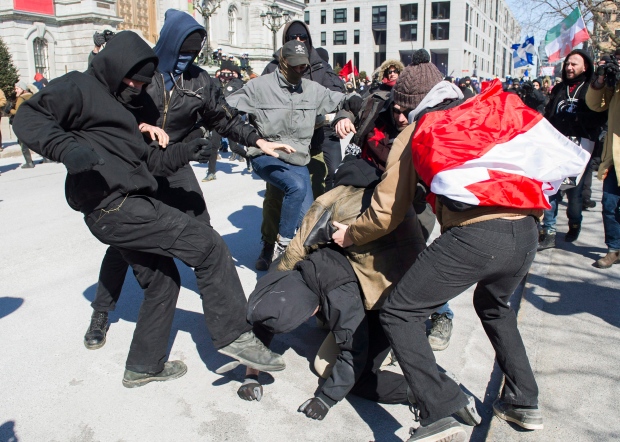
Antifa protesters "stomping Nazis" in Montreal on March 4th (mtlcounter-info.org)

One of the great gifts the British writer George Orwell gave us, in addition to his classics 1984 and Animal Farm, was a clear and uncompromising look at dangerous ideologies. In “Orwell and the British Left,” British writer Ian Williams recalls Orwell’s underlining of “the old, true and unpalatable conclusion that a Communist and a Fascist are somewhat nearer to one another than either is to a democrat.” Orwell’s well-observed conclusion nonetheless scandalized many on the left who rallied behind the Marxist phrase “no enemies on the left.”

Sadly, a quarter century after the fall of Communism, too many leftists are still ignoring Orwell and refusing to acknowledge the reality of left-wing brutality. In the wake of Charlottesville, eyewitnesses and reporters agreed that while the violence was instigated by neo-Nazis and white nationalists, it was countered with bloody counterattacks by left-wingers and black-shirted anarchists wearing masks. There was a clear asymmetric outcome to the violence: A white nationalist mowed down protestors with his car, killing a 32-year-old woman.

But that didn’t mean there were no victims of left-wing violence. Antifa — short for “anti-fascist” — protestors came armed with pepper spray, bricks, and clubs. Antifa members believe that racist speech is violence and that they must counter it physically, not just oppose it with rhetoric or better ideas.

As the New York Daily News reported, among antifa’s victims were journalists:
Taylor Lorenz of The Hill was punched in the face by an antifa for recording a fight between the two groups; she tweeted that her assaulter told her not to “snitch, media bitch.” A videographer from Richmond’s WTVR covering a counter-protest got a concussion from head blows with a stick.
In addition, Sheryl Gay Stolberg of the New York Times tweeted from Charlottesville:
The hard left seemed as hate-filled as alt-right. I saw club-wielding “antifa” beating white nationalists being led out of the park.
Nor is Charlottesville the only place that antifa activists have crossed the line. Peter Beinart has a piece in this month’s Atlantic magazine noting that rioting by antifa forces forced University of California at Berkeley officials to cancel speeches by Ann Coulter and Milo Yiannopolous earlier this year.

In April, threats by antifa supporters convinced the Portland, Ore., police department that they couldn’t guarantee security for the annual Rose Festival parade. The parade’s sin? Allowing the local Republican party to have Trump supporters march under the GOP banner in the parade. The parade was canceled, to the delight of many in the hob-nailed boot Left that makes Portland, well, such a special place.

But most of this has been swiftly swept under the rug or underreported by liberals and much of the mainstream media. On Friday, the U.S. Commission on Civil Rights held its monthly meeting in Washington. A liberal member introduced a stirring denunciation of the Nazi, KKK and white-nationalist participants in the Charlottesville rally.

But then Commission member Gail Heriot introduced an amendment that would have added the following:
Though we support peaceful protest and note that most of the counter-demonstrators were peaceful, we condemn violence by anyone, including violence by so-called antifa demonstrators.
Heriot, an independent, was supported in her amendment by Peter Kirsanow, a Republican appointee and African American from Cleveland. But they received no other support from the five commission members appointed by Democrats. Chairwoman Catherine Lhamon complained that Heriot’s amendment would “water down” the main resolution, when all it did was make clear that the commission wished to condemn violence of any kind.

Karen Narasaki, another commission member, scoffed at Heriot’s reading of Stolberg’s New York Times observation about the antifa activists in Charlottesville. As she voted against Heriot’s amendment, she noted, “You can’t believe everything you read in the media.” Apparently, the “paper of record” for so many liberals is to be considered bird-cage lining material if it contradicts the left-wing narrative. Heriot’s amendment was voted down 6–2. The original resolution was approved unanimously, as recorded in the “Statement on Charlottesville, Virginia, that the commissioners did adopt.

It’s pathetic that the dogma of “no enemies on the left” so clouds the judgment of the commission set up to protect civil rights.

Some clear-minded experts on extremist violence harbor no such ideological blinkers. Oren Segal, the director of the Anti-Defamation League’s Center on Extremism, categorically told CNN last week:
There is violence on the left. The anti-fascists engage with those they oppose through physical confrontation. And that is a problem. That is an extremist’s tactic. There is also bigotry on the left.
I would only add that if George Orwell were with us today, he would probably say that there is willful blindness on the left.

— John Fund is NRO’s national-affairs correspondent.

These Racist Black KKK and Nazi Statues Must Fall

August 21, 2017
George Lincoln Rockwell and members of the American Nazi Party attend a Nation of Islam summit in 1961.
George Lincoln Rockwell (center) and members of the American Nazi Party attend a Nation of Islam summit on June 25, 1961. Rockwell told reporters he considered the Muslims “black Nazis”. “I am fully in concert with their program and I have the highest respect for Mr. Elijah Muhammad”.
There are streets, schools and parks across the country named after a violent racist who urged the KKK to murder civil rights activists and claimed that racial integration was a Jewish conspiracy.
There’s a boulevard in Brooklyn named after a racist who admired Hitler and boasted of being the first fascist. Harvard has a prominent institute named after a bigot who defended Nazi bigotry.
New York City, Washington D.C. and Los Angeles all have streets named after a supremacist and nationalist who palled around with Nazis. New York City has a statue of him. Washington D.C. has an art tribute to him. If we are going to take down Confederate memorials, there’s no way he can stay up.
He must fall.
In 1961, Malcolm X introduced George Lincoln Rockwell, the leader of the American Nazi Party, on stage at a Nation of Islam rally. After Rockwell made a donation to the racist black nationalist hate group, Malcom X led a round of applause for the Neo-Nazi leader and called him, “Mr. Rockwell.”
There’s been a recent effort in Bethesda to rename Winston Churchill High School after Malcolm X. How can you rename a school honoring the leader who defeated Nazism after Malcolm, a Nazi collaborator?
Malcolm X wasn’t breaking any new ground by palling around with Nazis. There had been a longstanding alliance between black nationalist and white nationalist groups which shared a common belief in the racial inferiority of other races, opposition to the Civil Rights Movement and anti-Semitism.
The head of the American Nazi Party had described Nation of Islam boss Elijah Muhammad as “the Adolf Hitler of the black man.”
Malcolm X had previously met with the KKK. The Muslim racist bonded with the Nazi racist over anti-Semitism. "The Jew is behind the integration movement, using the Negro as a tool," Malcolm X told him.
Malcolm X’s Klan meeting was part of an alliance between the Nation of Islam and the KKK in opposition to the Civil Rights Movement. The Nation of Islam received protection for its mosques from the Klan.
J.B. Stoner, the KKK leader he met with, would be convicted of the bombing of the Bethel Baptist Church in Birmingham. The bombing had taken place three years before their meeting.
Malcolm X had even urged the KKK to eliminate “traitors who assisted integration leaders". The man after whom streets all over the country have been named was urging the KKK to kill civil rights workers.
"I sat at the table myself with the heads of the Ku Klux Klan," Malcolm X later admitted. "From that day onward the Klan never interfered with the Black Muslim movement in the South."
There's a statue of Malcolm X at the Audubon Ballroom in New York. It's some 40 blocks up from Malcolm X Boulevard. The Champions for Humanity Monument in Oakland's Kaiser Memorial Park includes Malcolm X. There’s a Marcus Garvey/Malcolm X installation in Washington D.C.
They must come down.
Wesleyan University hosts Malcolm X House. Berkeley has the Malcolm X Elementary School. San Francisco has the Malcolm X Academy. They must be renamed.
And all the streets named after Malcolm X must go. In New York, in Washington D.C., in Dallas, in Lansing and in Los Angeles. The signs must come down and their names must be changed.
It’s the only right thing to do.
Marcus Garvey Park sits east of Columbia University in New York. You can find the Marcus Garvey School in Los Angeles. And another one in Washington D.C. Not to mention Chicago and Memphis.
There’s a Marcus Garvey Boulevard in Brooklyn. It’s a street named after an admirer of Adolf Hitler.
Related image
Marcus Garvey (right) is shown in a military uniform as the 'Provisional President of Africa' during a parade up Lenox Avenue in Harlem, New York City in August 1922. (AP)
Garvey, an early black nationalist, had met with KKK leaders to undermine the NAACP. “Between the Klu Klux Klan and the NAACP group, give me the Klan,” he had said. “You may call me a Klansman if you will,” he had added.
There are schools in America named after a racist who admired Hitler and Mussolini, and claimed to have been the first fascist.
"We were the first Fascists,” Garvey boasted. He also contended that, “Mussolini and Hitler copied the programme of the UNIA.”
Marcus Garvey urged his followers to read Mein Kampf. “What the Negro needs is a Hitler,” he declared.
“Hats off to Hitler the German Nazi,” cheered the national hero of Jamaica.
Rename Marcus Garvey Park. Rename every school and street named after the Nazi collaborator.
Not far from Malcolm X Boulevard in New York, you’ll come across W. E. B. DuBois Avenue. The W. E. B. Du Bois Research Institute is hosted by Harvard. Fisk University has a statue of DuBois. The University of Texas at Austin has a DuBois sculpture. A huge 800 pound bronze bust of DuBois sits at Clark Atlanta University.
They must all come down.
W. E. B. DuBois, a co-founder of the NAACP, was never quite sure if he was a Communist or a Nazi. Despite his Communist sympathies, he also tried to find time for the Nazis.
DuBois praised Hitler who "showed Germany a way out when most Germans saw nothing but impenetrable mist." He suggested that the Nazis weren't really bigots and that their anti-Semitism "is a reasoned prejudice, or an economic fear." In "The German Case Against the Jews", he defended Nazi bigotry. Under Hitler, he claimed that there was “more democracy in Germany than there has been in years past.”
Take down his statues. Take away Henry Louis Gates’ cozy spot at the W.E.B. DuBois Institute.
If Confederate statues are unacceptable, then how can statues, streets and schools named after political allies of the KKK, Nazis and Neo-Nazis stay up? If General Lee must go, how can Malcolm X, Marcus Garvey and W.E.B. DuBois remain?
General Robert E. Lee never cheered the head of the American Nazi Party the way that Malcolm X did. Nor did he break bread with the Klan or defend the Nazis. If he must go, actual Klan and Nazi sympathizers like Malcolm X, Marcus Garvey and W.E.B. DuBois should be tossed in the trash.
The double standard that privileges the ugly racism of black nationalists doesn’t just protect them, but also covers up their racist alliances with Nazis, Neo-Nazis and white supremacists. It is impossible to end racism as long as special exemptions are made for certain forms of racism. That is not only true in the abstract, but in the concrete reality that black racists are allies and supporters of white racists.
The solidarity of racists against a color blind society is the cause of Charlottesville and the rise of racism. Black Lives Matter and the Klu Klux Klan feed off each other in the same way that Garvey, Malcolm X and the Klan and the American Nazi Party did. The left’s support for black racism keeps white racism alive.
There are statues of Martin Luther King everywhere, but the tragic truth is that Democrats rejected his vision and embraced the black nationalism of segregated safe spaces, racial supremacy and black racism.
Civil rights is dead. Malcolm X and the KKK won.
But if the left really wants to knock over the statue of a white racist, a prime opportunity has opened up in Manchester, England where a statue of Friedrich Engels, Marx’s Marxist collaborator, was just set up.
Engels referred to black people as “N___s” and “nearer to the animal kingdom”.
The left is welcome to topple that statue. But it won’t. It isn’t opposed to racism. It is racist.
What the left hates, what Malcolm X and the KKK hated, what Antifa and the Neo-Nazis hate, is a liberal society in which people actually get along with each other and don’t need a tyrant to “save” them. The left embraced identity politics to destroy American civil society. Their plan is working.
But if the left wants to start smashing statues, those of its racist leaders must also fall.  

Sunday, August 20, 2017

The Orwellian war on history

By Brendan O'Neill
The Australian
https://medium.com/@burntoakboy/the-orwellian-war-on-history-b0b67e91f8ff
August 19, 2017

Image result for durham confederate statue
A group of protesters cheer after toppling Confederate soldier statue during an “Emergency Durham Protest” at the old Durham County Courthouse in response to the violent protests Saturday in Charlottesville, on Monday, Aug. 14, 2017, in Durham, NC. The group proceeded to march to the site of the new police headquarters under construction.
Casey Toth ctoth@heraldsun.com

Read more here: http://www.heraldsun.com/news/local/counties/durham-county/article167619947.html#storylink=cpy


Everyone’s smashing statues. From Islamic State hotheads sledgehammering ancient artefacts in old Mesopotamian cities to plummy students at Oxford demanding the removal of busts of old colonialists, waging war on the past is all the rage.

A Year Zero mentality is on the march. People seem hellbent on wiping out history, making it invisible, and starting society all over again, cleansed of the likenesses of dead people of whom they disapprove.
This fury against monuments is presented as good and radical. The statue-smashers say they simply want to erase the faces and names of people who did bad things to show how far society has progressed and to make minority groups feel more comfortable when they’re out in public.
In truth, there’s nothing good in this mob-like erasure of history. It’s a reactionary, even Orwellian, movement. The urge to ethically cleanse public life of “bad history”, to shove down the memory hole any bust or tribute to past folk whose values make us bristle today, is intolerant, illiberal and profoundly paternalistic.
During the past week, the irrational fury against inanimate objects moved up a gear. First, there were the disturbances in Charlottesville, Virginia, when disagreements over a statue of Confederate general Robert E. Lee descended into violent clashes between leftists and neo-fascists.
A couple of days later, protesters in North Carolina tied rope around the neck of a statue of a Confederate soldier and dragged it down. They kicked and spat on it. There was a weird intensity to their statue abuse, bringing to mind the wide-eyed fury of Islamic State agitators as they stamp on what they view as idolatrous historic carvings in the ancient cities of Palmyra and Nimrud.
Then, in an extraordinary move, the mayor of Baltimore, Maryland, ordered the removal of four Confederate statues in the city. In the dead of night, workmen dragged them down. What had been everyday monuments for decades, seen by people as they walked to work or went for a jog, suddenly were viewed as a poisonous presence, liable to harm people’s self-esteem and the city’s stability. And so they were memory-holed, in the black of night, exposing the febrile streak to this statuephobia.
Year Zero agitation has been gaining ground for a few years. Students at Oxford want a bust of old British colonialist Cecil Rhodes removed. They describe the statue as “problematic”, a word PC zealots use in the same way Islamists say “haram”: to indicate something is wicked and should ideally be extinguished.
One of the protesters against Rhodes says, “There is a violence in having to walk past the statue every day.” There’s a medieval feel to this, this idea that even things made of stone have great power and evil in them.
For an Oxford student to describe a statue as an act of violence really is similar to the Islamic State hammer-wielders’ belief that pre-Islamic icons have the power to pollute men’s souls and thus must be destroyed.
Anyone who thinks this policing of the past will stop once all statues of Confederates and colonialists have been knocked down is in for a shock.
In the US, the Year Zero mob has turned its sights to statues of the great Thomas Jefferson (he owned slaves). And this week Yarra council in Melbourne decreed that it would no longer refer to January 26 as Australia Day, out of respect for Aboriginal and Torres Strait Islander people.
So a historic fact – the arrival of the First Fleet into New South Wales in 1788, the basis of Australia Day – is made unmentionable. It’s unremembered, erased, as surely as Winston Smith in Nineteen Eighty-Four must erase old newspaper reports about events that now embarrass the party. Today’s cleansing of images of history smacks of the dark antics of that fictional Ministry of Truth.
The history erasers claim they only want to show how fair our societies now are. Rubbish. This isn’t about making the present better, it’s a projection of political correctness into the past. It’s the punishment of historical figures – even good historical figures, such as Jefferson, and good historical events, such as the settlement of Australia – for not sharing our exact modern world view.
And it reeks of PC paternalism. The idea that minority groups can’t cope with seeing statues of dead people who did some dodgy things is an affront to their intelligence and autonomy. It infantil­ises them, even suggesting they will feel physically wounded by history: after all, “there is a violence” to these statues.
It’s disturbingly ironic: this treatment of certain groups as fragile, as needing to have public life sanitised on their behalf in the way a new mum might baby-proof her home, is riddled with some fairly racist assumptions of its own.
One of the great things about public life is that it’s a patchwork of the historical events that made our nations. Take a walk through a city and you’ll see statues of soldiers, politicians, authors, suffragettes and others who shaped our societies. And most of them will have held views or done things we would consider questionable in 2017. So what? The point is they made history, and it’s right for the public sphere to reflect that.
The logic of the Year Zero crew is that we should see only historical figures they approve of (if there are any). They police history with an eye for policing what we citizens can see and by extension think about the societies we live in.
It’s a low, brutal form of censorship, and we should have no truck with it.
The Australian, 19 August 2017

Friday, August 18, 2017

Vehicular Jihad Comes to Barcelona


Meanwhile, on CNN, the denial and willful ignorance continue.


August 18, 2017

The van was later towed away for examination

The van driven into a crowd in Barcelona is towed away. (AFP/Getty Images)
In Spain Thursday, a man drove a truck into a crowd at Barcelona’s popular Costa Dorada area, killing at least 13 and injuring 100. On CNN, Wolf Blitzer asked, “There will be questions about copycats. Questions, if what happened in Barcelona, was at all, at all, a copycat version of what happened in Charlottesville, Virginia.”
No, Wolf, it was a phenomenon with which you and your CNN colleagues have only a glancing familiarity: Islamic jihad. Of course Wolf Blitzer immediately reached for a connection with Charlottesville, because he most likely doesn’t believe that there are Islamic jihadis at all, just mentally ill lone wolves driven to violence by “Islamophobia.” Jihad doesn’t fit his network’s narrative. And vehicular jihad? Wolf has never heard of such a thing.
Last June, the Islamic State published a poster depicting an SUV driving over a heap of skulls and bearing the legend “Run Over Them Without Mercy.”
And the Islamic State issued this call in September 2014:
So O muwahhid, do not let this battle pass you by wherever you may be. You must strike the soldiers, patrons, and troops of the tawaghit. Strike their police, security, and intelligence members, as well as their treacherous agents. Destroy their beds. Embitter their lives for them and busy them with themselves. If you can kill a disbelieving American or European — especially the spiteful and filthy French — or an Australian, or a Canadian, or any other disbeliever from the disbelievers waging war, including the citizens of the countries that entered into a coalition against the Islamic State, then rely upon Allah, and kill him in any manner or way however it may be….If you are not able to find an IED or a bullet, then single out the disbelieving American, Frenchman, or any of their allies. Smash his head with a rock, or slaughter him with a knife, or run him over with your car, or throw him down from a high place, or choke him, or poison him….
Many Muslims in the West have heeded this call. The man who rented the van used in the Barcelona attack was a Muslim from Morocco named Driss Oukabier, who was arrested, while one of his apparent accomplices was killed in a gun battle with police. This could have been just one part of a much larger jihad plot, as Spanish police now believe that a massive explosion in a house in Alcanar, 120 miles south of Barcelona, was also linked to the Barcelona jihad plotters.
There have been many other vehicular jihad attacks. Just last week in France, a Muslim named Hamou Bachir hit six French soldiers with his car in Levallois-Perret, where the headquarters of the DGSI (General Directorate for Internal Security), the country’s primary counter-terrorism intelligence agency, are located. In June, a Muslim drove his car into a crowd on the London Bridge and then jumped out and started stabbing people. We have seen several other vehicular jihadis get out of the car after they plowed into pedestrians, and start stabbing people. In June 2015, a Muslim in Austria drove his car into a crowd, killing three, and then got out and stabbed passersby. Then in November 2016, a Muslim student at Ohio State University named Abdul Razak Ali Artan drove his car into a crowd, then got out and stabbed several others.
There have been many others in 2016 and this year: in Nice, in Berlin, in Jerusalem, in Paris, and elsewhere. Yet on CNN and elsewhere in the establishment media, no analysts have connected the dots between these jihad attacks, which have an obvious connection with one another in sharing the same motivating ideology and the same goal. But Wolf Blitzer readily sees a wholly imaginary connection between Charlottesville (in which a neo-Nazi was imitating jihadis, not the other way around) and Barcelona, because he wishes to exaggerate the importance and influence of white supremacists, while minimizing the magnitude of the jihad threat.
And so it goes in the daily news of the contemporary West: another jihad massacre, and another reason to turn off CNN.

Who's Next, George Washington?

By Harry Stein
August 17, 2017

Image result for trump charlottesville press conference
My first job, in 1972, was with a small weekly in Richmond, Virginia. Like my fellow writer/editors, I was a proud veteran of the sixties campus wars, and our left-of-center politics were strongly represented throughout the paper; which is to say, we were far from a neat ideological fit with the deeply conservative town Richmond still was back then. I joked with my friends up north that, the morning after Richard Nixon’s landslide victory in November, I could actually see my McGovern vote in the paper. The politics weren’t all that I disliked about Richmond. It was sleepy, ghastly hot in the summer, and in general far from what I then thought of as “the action.”
But there was one thing that I loved about the place: it was steeped in history. On Clay Street, just a few blocks from our office on Broad, was the Confederate White House. Not far off loomed the magnificent, Jefferson-designed state capitol. Over on Franklin, the Jefferson Hotel boasted the staircase said to be the model for the one in Gone With the Wind. But above all there was Monument Avenue, with its imposing statues of the generals whose prowess had sustained hope in this capital of a doomed nation a century earlier: Stonewall Jackson, J.E.B. Stuart, Robert E. Lee.
As a Northerner and a lefty, I’d grown up thinking of the South as the bad guys. Nonetheless, there was an undeniable grandeur to these stone figures, and I felt it every day driving past them on my way home. They were men of surpassing courage and nobility, rightly enshrined in national myth: “There stands Jackson like a Stone Wall.” And the image of Lee, wearily arriving at Appomattox aboard Traveller, having resisted calls from diehards that he continue the fight, saving the nation from yet more bloodshed. I wasn’t the only one who felt this way. One of my colleagues, Richmond-born and recently graduated from Harvard (and now a left-wing commentator of some note), would tear up every time he heard “The Night They Drove Old Dixie Down.”
As a Red Diaper baby, I came from a different tradition. My parents never saw Gone With the Wind—they were outside the theater, picketing. But I, too, felt the pull of that history, in all its messiness and grandeur. It was our history, as Americans.
Maybe that’s all over now. Maybe, as my colleague Kay Hymowitz once observed, for kids today American history runs from the oppression of the Indians to the oppression of blacks to the oppression of women, with nothing ennobling in between. Not long ago, talking with several people in their twenties, I was startled to learn that, until the movie came out, none of them had heard of Dunkirk. How, then, could we expect them to know about figures like Richard Kirkland, “the Angel of Marye’s Heights,” the Confederate soldier who, during the abattoir that was Fredericksburg, emerged from the safety of the commanding Southern lines to tend to dying Union soldiers on the killing field below?
Our history is rife with moral complexity. My wife and children exist only as a result of two near-misses. One ancestor, on her mother’s side, whose descendants would include several prominent abolitionists, nearly drowned after falling overboard on The Mayflower, while her great-grandfather on her father’s side, at 12, was nearly shot down from a rooftop in Fort Smith, Arkansas, by an occupying Union soldier after shouting “Long live Jeff Davis!”
All of which is a preamble to saying that, in his exchange with the churlish and ignorant press corps in the aftermath of Charlottesville, Donald Trump got it right when he said: “This week it’s Robert E. Lee. I noticed that Stonewall Jackson is coming down. I wonder is it George Washington next week and is it Thomas Jefferson the week after? You know, you really do have to ask yourself, where does it stop?” He may not have been the ideal messenger—with his combative style, manic egotism, and casual relationship with facts, he never is—but he laid out a case that for months has cried out to be made, and he did it so clearly that the refusal of the media and the elites of both parties, not just to credit it, but even to acknowledge it, speaks volumes. Though Trump has never quite defined what his notion of making America great again actually means, preserving that which needs no fixing—including the history that is our common legacy—is a key part of it.
Trump also correctly pointed to the role played in the Charlottesville tragedy by the totalitarian Left, the vanguard of the would-be American Cultural Revolution. As a pair of astute commenters on the website Just One Minute observed (for brevity’s sake, I’ve combined their exchange): “These antifa thugs are descendants of the Weather Underground, Symbionese Liberation Army and other Left Wing terrorists. And we’ve reached the point where these communist anarchists are eagerly enabled by a media that become enraged if anyone even suggests they might have played a part in the violence with their piss balloons, mace, 2 x 4s and baseball bats.” (To her credit, at least one New York Times reporter, Sheryl Gay Stolberg, acknowledged antifa’s role in the mayhem on Twitter, noting that “the hard left seemed as hate-filled as alt-right. I saw club-wielding ‘antifa’ beating white nationalists being led out of the park.”)
Objecting to the tearing down of these monuments does not make one a Nazi, or a racist, or even passingly unreasonable, much as Trump’s adversaries wish it were so. “Who’s next?” is the right question. Is it so unthinkable, in this climate, that the mob will soon descend on Monticello? Is that scenario any less plausible than it would have seemed five years ago that objecting to transgender bathrooms would be broadly regarded as evidence of moral depravity? This is the way America changes these days—rapidly and thoughtlessly.
And the media is the key to it all, as was never clearer than at yesterday’s Trump press conference and in commentators’ reactions to even the most reasonable public statements. For CNN vice president and assistant general counsel Johnita Due, Virginia governor Terry McCauliffe’s remarks condemning white nationalists were not enough, for they also included kind words for Washington and Jefferson. “I felt punched in the stomach,” she wrote. “At a time when it is important to condemn white nationalists and supremacists unequivocally, invoking Thomas Jefferson is a mistake.”
Twenty years ago, my wife and I were at a dinner party with a married couple, both New York Times reporters, who’d recently returned from a trip down South with their kids. They told seeing an exhibit at the Virginia Military Institute honoring the cadets, some as young as 15, who, pressed into emergency service, distinguished themselves in the 1864 Battle of New Market. The exhibit was disturbing enough, they said, but what was worse was that their 15-year old son had been moved that kids his age had performed so heroically. They’d had to sit him down and explain that, yes, these boys may have been brave, but by definition they were immoral people, fighting for a bad cause. Twenty years later, the media at last feels emboldened to deliver that lecture to the nation. Trump called them on it, and in doing so, he has surely expressed what millions of Americans feel.
According to the latest reports, security has now been increased around the statues on Monument Avenue.
Harry Stein is a contributing editor of City Journal and the author of No Matter What . . . They’ll Call This Book Racist and the comic novel Will Tripp, Pissed-Off Attorney-at-Law.

Thursday, August 17, 2017

Trump Spoke Truth About ‘Both Sides’ In Charlottesville, And The Media Lost Their Minds


The media behavior in the wake of this press conference was arguably something new, a sort of grotesque watermark of the media’s coverage of the Trump administration thus far.

August 17, 2017
Image result for trump press conference charlottesville
Our media have a problem: they are essentially incapable of covering Donald Trump with anything less than full-on deranged hysteria.
I do not say this as an excess of rhetoric or op-ed theatrics. It is a very real, very pressing problem, only getting worse, and it poses a significant danger to the social fabric of the United States. Twenty-first century American media has the ability to shape our discourse and shift our public consciousness, and it is abusing that power in the worst ways possible. This is likely a bigger problem than any of us realizes.
The last 48 hours provided a crystal-clear example of the genuinely dangerous course upon which the media have set themselves. At Trump Tower on Tuesday, President Trump held a press conference that was initially supposed to be about infrastructure but quickly went off-script and became about the Charlottesville neo-Nazi madness.
By itself this is nothing new: Trump regularly goes off-script, if it can even be said that he has a script. But the media behavior in the wake of this conference was arguably something new, a sort of grotesque watermark of the media’s coverage of the Trump administration thus far.
The furor surrounding the press conference stemmed largely from one particular line Trump delivered. When one reporter asked about his claim that there had been “hatred [and] violence on both sides,” Trump replied: “Well I do think there’s blame. Yes, I think there is blame on both sides. You look at both sides. I think there is blame on both sides.”

Media Immediately Jets Into Astral Orbit

With that unremarkable assertion, the media were off. “HE STILL BLAMES BOTH SIDES,” CNN blared in enormous font on its front page. In a headline, The New York Times blared that Trump “again blames ‘both sides.” So did the Chicago Tribune. So did NBC News. So did U.S. News and World Report (calling it “an insane press conference” to boot).
So did NPR. So did CBS News. So did the Washington Post. So did the Wall Street Journal. So did Time. So did MSNBC. So did USA TodayNBC News later wondered: “Has Trump Lost His Moral Authority for Good?” CNN continued with the massive headlines, calling Trump’s press conference “a meltdown for the ages,” and declaring: “Trump is who we feared he was.” Vox claimed Trump “is offering comfort to racists and extremists.”
The unambiguous implication of this media firestorm is obvious: we are supposed to see it as outrageous at best and morally abhorrent at worst that Trump would claim that “there is blame on both sides.” The thing is, Trump was telling the truth. There isblame on both sides. And we have eyewitness descriptions and photograph evidence to back it up.

Truth Is Truth, People

Trump appears to separate the generalized violence of that Saturday afternoon from the vehicular homicide a white nationalist perpetrated on Charlottesville’s mall near the end of the whole affair. In the press conference, Trump stated in no uncertain terms: “The driver of the car is a murderer. What he did was a horrible, inexcusable thing.”
It is, rather, the periodic violence that occurred throughout Charlottesville’s downtown area to which Trump was apparently referring. And he’s right: both sides committed violence on that day.
We know this because people there saw it happen and have confirmed Trump’s characterization publicly. New York Times reporter Sheryl Gay Stolberg, for one, attested: “The hard left seemed as hate-filled as alt-right,” she tweeted. “I saw club-wielding ‘antifa’ beating white nationalists being led out of the park.” If there were any doubt as to whether the Left were committing violence that day, Stolberg later clarified: “[I] should have said violent, not hate-filled.”
I did not notice any wall-to-wall coverage of Stolberg’s unambiguous eyewitness testimony. Did you?
Another eyewitness report comes from Isabella Ciambotti, a creative writing major from the University of Virginia. Speaking to The New York Times, Ciambotti testified that at one point “a counterprotestor ripped a newspaper stand off the sidewalk and threw it at alt-right protesters.” Photographic evidence confirms Ciambotti’s account.
Raw footage of the moment the counterprotestor threw the box is inconclusive but strongly suggests the counterprotester was unprovoked at the time. Further raw footage shows counterprotesters hurling objects at white supremacists and neo-Nazis while the latter simply stand there a good distance apart from the crowd.
Ciambotti also claims to have witnessed “another man from the white supremacist crowd being chased and beaten.” Additionally she saw “a much older man, also with the alt-right group, [who] got pushed to the ground in the commotion. Someone raised a stick over his head and beat the man with it.” Ciambotti claims to have intervened before the beating could continue further.
Ciambotti further asserts:
There were absolutely groups of peaceful protesters in Charlottesville this past weekend, many making a mature show of resistance. But what I saw on Market Street didn’t feel like resistance. It felt like every single person letting out his or her own well of fear and frustration on the crowd.

These People Don’t Have Strong Motivations to Lie

Both Stolberg and Ciambotti can fairly be seen as credible witnesses. Ciambotti, in particular, affirms she was a part of the counter-protest, yet she directly attests to the violent nature of the liberals who gathered in Charlottesville that day.
Additionally, Charlottesville police chief Al S. Thomas Jr. has affirmed that the protest saw “mutually combative” individuals on both sides. If the police chief who oversaw the mayhem is affirming Trump’s basic premise, might we assume that Trump is onto something?
It is not unreasonable to blame “both sides” of protesters that day. Yes, the neo-Nazis and white supremacists showed up preaching vicious hate, ugliness, and stupidity. Many were armed to the teeth while doing it.
But liberal protesters showed up armed, as well, and we have unequivocal testimony and footage proving that they committed unprovoked violence that day. This was not a gentle counter-protest of “passive resistance;” the Left did not show up to downtown Charlottesville to practice civil rights-style non-violent activism. They had fighting on their mind. And they fought.

There Was Plenty to Legitimately Criticize Here

The fact that our media dedicated an entire news cycle to Trump’s truthful statement on the matter is staggering. This was not necessary. There were plenty of things the media could have criticize in Trump’s press conference. He asserts, for instance, that “very fine people” marched with the white supremacists and Nazis, people “that were there to protest the taking down, of to them, a very, very important statue.”
Maybe this is true, but there is no evidence that the statue protest was made up of anything other than paranoid racists. Trump should not have made this statement unless he was willing to provide proof to back it up.
Yet he also told the press: “I’m not talking about the neo-Nazis and the white nationalists, because they should be condemned totally.” This, according to Vox, constitutes Trump “offering comfort to racists and extremists.”
Trump makes a lot of mistakes. Some are minor, some major. In that, he is like every president who has ever held the position. Sometimes he gets things right, too—-as he did blaming the Charlottesville street violence on “both sides.”
The media’s responsibility, if it even cares anymore, is to learn how to tell the difference between the things he does right, the small mistakes he makes, and the big blunders he commits. Currently the media are apparently incapable of telling the difference between all three: it’s one and the same to them, no matter what he does, no matter what he says.
This is a dismal situation for Americans to be in. We have newsmakers whose only professional function these days seems to be whipping tens of millions of people into angry, irrational frenzies. They do not seem to care about the truth. They do not seem to care about honesty, integrity, or accuracy. We are lurching from one shrieking, insane media episode to the next. And it is wearing on all of us, and weakening the bonds of fellowship and friendship between common Americans.
As I write this, the top headline on CNN’s website is: “This is a moral crisis. And it’s self-inflicted.” That’s true. So what is the media going to do about it?

Daniel Payne is a senior contributor at the Federalist. He is an assistant editor for The College Fix, the news magazine of the Student Free Press Association. Daniel's work has appeared in outlets such as National Review Online, Reason, Front Porch Republic, and elsewhere. His personal blog can be found at Trial of the Century. He lives in Virginia.