Tuesday, January 31, 2017

Is It a ‘Muslim Ban’?


Trump’s goal is not to exclude Muslims from our country; it is to exclude sharia supremacists, a significant subset of Muslims.

By Andrew C. McCarthy — January 30, 2017
Image result for muslim ban protest san francisco
Demonstrators shout slogans during anti-Donald Trump immigration ban protests outside Terminal 4 at San Francisco International Airport in San Francisco, California, U.S., January 28, 2017. REUTERS


President Trump’s temporary ban on entry into the U.S. by various categories of aliens has caused a firestorm. That owes in part to the rash implementation of perfectly legal restrictions, but the hysteria is out of proportion to the minimal harm actually done.

One of the most dismaying parts of the debate has been the banter over whether Trump has imposed a “Muslim Ban.”

It is no surprise, of course, that Islamists — along with their friends and stooges on both sides of the political aisle — have used the opportunity to agitate and hand-wring over the specter of America “at war with Islam.” That, after all, has been page-one of their playbook for a generation.

There has also, however, been indignation on the other side, from Trump defenders denying that the executive order (EO) is in any way a “Muslim ban.” Time after time this weekend, right-of-center news outlets and commentators could be found defying their guests and counterparts to find the word “Muslim” or “Islam” in the EO. I sympathize with the frustration. The EO is clearly not a ban on all Muslims, or even of any specific Muslim. Since the other side is slanderously suggesting otherwise, there is an irresistible urge to seize on anything that proves them wrong.

Yet the only reason there is an EO is the threat posed by sharia-supremacism, which we inexactly refer to as “radical Islam.” You can’t have radical Islam without Islam. Therefore, the people the EO seeks to exclude are, of necessity, Muslims — not all Muslims, of course, but a significant subset of them nonetheless.

Trump got to the EO (which is a temporary stop on the way to a more refined policy) by starting — during his campaign — with the proposal of a temporary categorical ban on all Muslims. I highlight temporary because it is important. Trump never took the position that all Muslims outside the U.S. should be banned from our country for all time. He recognized the need to separate our Muslim friends from our radical Islamic enemies. He was groping for a way to do that while protecting the country.

For decades, Washington has been suicidally unwilling to target our radical Islamic enemies for fear of offending Muslims in general. Trump’s more security-minded approach — which many Americans outside Washington regard as common sense — was to call a temporary halt to the admission of Muslim aliens until the government could figure out an effective way to screen out Islamists from pro-constitutional Muslims who would be an asset to our country.

During the campaign, then, Trump asked Rudy Giuliani — the former New York City mayor and renowned federal prosecutor — to help him develop a policy that would solve this dilemma. Rudy then put together a team of advisers, of which I was a member, to work the problem. Trump’s proposals consequently evolved away from a coarse categorical ban, adopting instead a threat-based approach that would rely on vetting rather than banning, and that would target the places where the threat is most prevalent.

Again, since the threat is radical Islam, the geographical focus would necessarily involve places where that ideology is most prevalent. Those are Muslim places.

As president, Trump is now moving national policy in the direction of the threat-based strategy of heightened vetting (which he calls “extreme” vetting) that he called for during the campaign. It is not something that can be accomplished overnight. Thus, just as he did during the campaign, Trump is starting with temporary exclusions that are categorical: an indefinite ban on Syrian refugees, a four-month ban on other refugees, and a three-month ban on aliens from seven Muslim-majority countries that were cited by Congress and President Obama because of vetting challenges.

These bans are not the ultimate objective. The goal is to give the public immediate protection while the government has a few months to refine threat-based vetting procedures.

As already noted, there were implementation problems with Trump’s EO. Nevertheless, if our choice is (a) the Washington approach of never getting to a good national-security policy because it could offend Islamists and the Left, or (b) Trump’s approach of imperfectly implementing a good national-security policy at the risk of offending Islamists and the Left, then give me Trump’s approach every time.

All that said, though, we should not hide under our beds in shame every time an Islamist, a Democrat, or a media talking-head spews: “Muslim ban!” Of course we’re banning Muslims. We’re moving to an exclusion of radical Islam, and radical Islam is exclusively made up of Muslims.

Go through the EO. Refugees in general and those from Syria in particular are problematic because of the heavy concentration of Muslims, some percentage of which are adherent to radical Islam. The seven countries in Congress’s Obama-era statute were cited as vetting problems because they are Muslim-majority countries embroiled in savage wars and terror promotion, which have resulted in governments that either hate the United States or are too dysfunctional to provide background checks on their nationals. It is not our fault that majority-Muslim societies tend to breed such pathologies.

Our goal is not to exclude Muslims from our country; it is to exclude sharia supremacists, a significant subset of Muslims. They reject our Constitution. Many of them would like to kill us. All of them want us to submit to their law. The threat they pose is not hypothetical — they have killed thousands of Americans and are actively plotting to kill thousands more.

I make no apologies for wanting to keep them out of my country. Nor do I look at excluding them as excluding religion. It is, instead, the exclusion of a totalitarian political ideology — something that our law already explicitly endorses. See, e.g., Section 1182(a)(3)(D) of federal immigration law (“Immigrant Membership in Totalitarian Party”): “Any immigrant who is or has been a member of or affiliated with the Communist or any other totalitarian party (or subdivision or affiliate thereof), domestic or foreign, is inadmissible” (emphasis added).

If we are serious about banning sharia-supremacism — or, if you insist, “radical Islam” — that is inescapably going to involve banning Muslims. All sharia supremacists are Muslims, just like all members of the Irish Republican Army are Irish.

Sharia supremacism is an interpretation of Islam that traces to both its seventh-century origins and to the cementing, a millennium ago, of its classical legal code — which is totalitarian, discriminatory, and in some particulars, brutal. That code holds that all the world must be governed by Allah’s law, sharia. It is, to repeat, less a religion than a form of totalitarianism under a religious veneer.

Sharia-supremacism is not the only interpretation of Islam — not by a long shot. It is, however, an aggressive interpretation of Islam. That matters: Since other interpretations of Islam tend to be passive, and since tens of millions of Muslims identify with Islam more culturally than canonically or theologically, sharia-supremacism is far more influential and threatening than its mere numbers indicate. Whether its adherents constitute a quarter, a third, a half, or some other percentage of global Islam is beside the point. As we see throughout Europe, it punches way above its weight in countries where Islam accounts for less than 10 percent of the population.

It is true that only a small percentage of sharia supremacists become violent jihadists. That is not much comfort since we’re talking about a small percentage of millions of people. More significantly, though, jihadism is not the totality of the threat against us. Communities in which sharia-supremacism is prevalent are supportive of jihadist goals and thus become safe harbors for radicalization, as well as jihadist recruitment, training, and fund-raising. As illustrated by the deterioration of Europe under mass-immigration by Muslims from the Middle East and North Africa, sharia-supremacists aim to establish anti-assimilationist enclaves that breed jihadism while challenging the sovereignty of the host country.

That is the threat we must confront. That doing so involves restrictions against Muslims is unavoidable. We should not pretend otherwise. And we should not apologize for saying so.

— Andrew C. McCarthy is as senior policy fellow at the National Review Institute and a contributing editor of National Review.

Trump v. the Border-less Left


For progressives, the universe of victims is infinite.
January 30, 2017
Image result for no ban no wall new york
(Getty Images)
President Trump’s flurry of executive orders on sanctuary cities and immigration late last week flummoxed his opponents, who responded by making good on their promise to stage constant protests as part of the “#Resistance.” In New York, progressive politicians have characterized Trump’s relatively modest efforts to impose order on what they have always characterized as a “broken” system as outright Nazism, and have taken their rhetorical cues from hard-Left radicals who seek the dissolution of national borders. 
For instance, President Trump announced last Wednesday his intentions to “work within the existing system and framework” in order to enforce current immigration law and pressure so-called “sanctuary cities” to end their policies of noncompliance with federal authority regarding immigration. A few hours later, Bill de Blasio, mayor of the nation’s largest sanctuary city, called a spontaneous press conference to proclaim his administration’s continued dedication to sanctuary policy. “This executive order does not change who we are . . . the stroke of a pen in Washington does not change the people of New York City or our values.” 
Mayor de Blasio, echoed by City Council Speaker Melissa Mark-Viverito and Congressman Joseph Crowley, insisted that Trump’s crackdown on sanctuary cities is a war on difference. Mark-Viverito proclaimed, “Let’s be clear: these proposals are driven by the false narrative that immigrants—all immigrants—are criminals.” When asked by this reporter if he sees any difference between illegal aliens, legal immigrants, and citizens of America generally, Mayor de Blasio was blunt in his response:
I appreciate the ideological bent of your question, but I will answer it very clearly. . . . there has been an attempt to demonize immigrants across the board, that’s what’s happening here. The vast majority of even the undocumented are law-abiding people . . . this has been a systematic—and Steve Bannon is behind this 100 percent—a systematic effort to demonize people of color and immigrants, and it’s playing out today.
From illegal aliens who have committed crimes, to all immigrants, to “people of color” generally: the circle of Trump’s victims widens by orders of magnitude in de Blasio’s fantasy of total persecution. Even to ask a question about whether illegal aliens should be regarded in the same way as legal immigrants betrays an “ideological bent”; on the other hand, it is perfectly straightforward to read a legal challenge to sanctuary cities as all-out race war. 
The mayor’s expansive definition of victimhood was echoed this weekend by Governor Cuomo, who repeated the Left’s favorite cliché: “I am a Muslim. I am a Jew. I am Black. I am gay. I am a woman seeking to control her body.” This quasi-heroic affirmation of identity with the oppressed fringes of society, powered by anaphora, collapses into intersectional absurdity, and ultimately becomes the lowest form of political pandering, underscored by the repetition of the word “I.”
Last Friday, Trump announced that he would extend and expand the visa restrictions that Obama established in the 2015 Terrorist Travel Prevention Act, impose a 90-day moratorium on travel from seven countries with links to organized terror, and put a halt to the Syrian-refugee resettlement program. These policies fulfill campaign promises and have been clearly stated as temporary measures in order to make sure that migrants are being accurately screened.  
Despite applying to a small fraction of the world’s billion-plus Muslims, the policy was quickly labeled a “Muslim ban.” Mayor de Blasio went on television and repeated the canard that the executive order specifically excludes Muslims from entry to the country; when called on this falsehood by Jake Tapper, the mayor responded with clause-heavy babble: “I would be careful on that. The notion that there’s not a pattern of exception for individuals, that the only indication suggests bluntly non-Muslims, should be very, very worrisome here.” The mayor went on to say that, in his view, illegal aliens who are convicted of drunk driving should be protected by New York City, providing that they didn’t run anyone over. 
Hundreds of protesters, organized in New York by the immigrant-rights organization Make the Road, flocked to JFK airport—where several dozen foreign nationals in transit were detained—and demanded their immediate release. Thousands more protesters assembled Sunday at Battery Park in lower Manhattan, where they chanted “No Ban, No Wall,” a pithy expression of disdain for the principle of border controls, or borders generally. 
Senator Charles Schumer, standing in front of a handmade sign reading “Fascism is for Fascists,” announced that 42 people in transit stuck at JFK would be released. Then, falling into the rhetorical tic of infinite liberation, the senator declaimed, “So we’ve made progress for forty-two. We’ve got to make progress for thousands, and tens of thousands, and hundreds of thousands more.” Yet only a hundred or so people are being detained as a result of the president’s recent order.
Leftist grandiosity regarding revolution and human potential is limitless, bounded only by the skills of the man with the megaphone. But the Left’s readiness to heighten contradictions, or, in the words of President Obama, to “bring a gun to a knife fight,” indicates the seriousness of its purpose in impeding every part of President Trump’s agenda.​

Monday, January 30, 2017

Today's Tune: The Strumbellas - Shovels and Dirt (Live)

Trump’s Executive Order on Refugees — Separating Fact from Hysteria


The hysterical rhetoric about President Trump’s executive order on refugees is out of control. Let’s slow down and take a look at the facts.

By David French — January 28, 2017
Image result for trump executive order immigration
U.S. President Donald Trump signs an Executive Order establishing extreme vetting of people coming to the United States after attending a swearing-in ceremony for Defense Secretary James Mattis (R) with Vice President Mike Pence at the Pentagon in Washington, U.S., January 27, 2017. Reuters/Carlos Barria


To read the online commentary, one would think that President Trump just fundamentally corrupted the American character. You would think that the executive order on refugees he signed yesterday betrayed America’s Founding ideals. You might even think he banned people from an entire faith from American shores.

Just look at the rhetoric. Here’s Chuck Schumer:
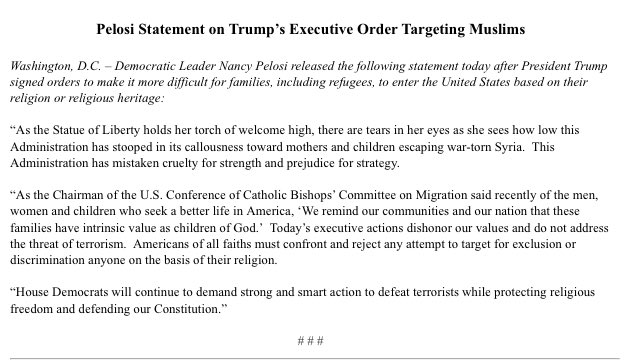
If you thought only Senator Schumer saw tears in Lady Liberty’s eyes, think again. Here’s Nancy Pelosi:

CNN, doing its best Huffington Post impersonation, ran a headline declaring “Trump bans 134,000,000 from the U.S.” The Huffington Post, outdoing itself, just put the Statue of Liberty upside down on its front page.

So, what did Trump do? Did he implement his promised Muslim ban? No, far from it. He backed down dramatically from his campaign promises and instead signed an executive order dominated mainly by moderate refugee restrictions and temporary provisions aimed directly at limiting immigration from jihadist conflict zones.

Let’s analyze the key provisions, separate the fact from the hysteria, and introduce just a bit of historical perspective.

First, the order temporarily halts refugee admissions for 120 days to improve the vetting process, then caps refugee admissions at 50,000 per year. Outrageous, right? Not so fast. 
Before 2016, when Obama dramatically ramped up refugee admissions, Trump’s 50,000 stands roughly in between a typical year of refugee admissions in George W. Bush’s two terms and a typical year in Obama’s two terms. The chart below, from the Migration Policy Institute, is instructive:


In 2002, the United States admitted only 27,131 refugees. It admitted fewer than 50,000 in 2003, 2006, and 2007. As for President Obama, he was slightly more generous than President Bush, but his refugee cap from 2013 to 2015 was a mere 70,000, and in 2011 and 2012 he admitted barely more than 50,000 refugees himself.

The bottom line is that Trump is improving security screening and intends to admit refugees at close to the average rate of the 15 years before Obama’s dramatic expansion in 2016. 
Obama’s expansion was a departure from recent norms, not Trump’s contraction.
Second, the order imposes a temporary, 90-day ban on people entering the U.S. from Iraq, Syria, Iran, Libya, Somalia, Sudan, and Yemen. These are countries either torn apart by jihadist violence or under the control of hostile, jihadist governments.

The ban is in place while the Department of Homeland Security determines the “information needed from any country to adjudicate any visa, admission, or other benefit under the INA (adjudications) in order to determine that the individual seeking the benefit is who the individual claims to be and is not a security or public-safety threat.” It could, however, be extended or expanded depending on whether countries are capable of providing the requested information.

The ban, however, contains an important exception: “Secretaries of State and Homeland Security may, on a case-by-case basis, and when in the national interest, issue visas or other immigration benefits to nationals of countries for which visas and benefits are otherwise blocked.” In other words, the secretaries can make exceptions — a provision that would, one hopes, fully allow interpreters and other proven allies to enter the U.S. during the 90-day period.

To the extent this ban applies to new immigrant and non-immigrant entry, this temporary halt (with exceptions) is wise. We know that terrorists are trying to infiltrate the ranks of refugees and other visitors. We know that immigrants from Somalia, for example, have launched jihadist attacks here at home and have sought to leave the U.S. to join ISIS.

Indeed, given the terrible recent track record of completed and attempted terror attacks by Muslim immigrants, it’s clear that our current approach is inadequate to control the threat. Unless we want to simply accept Muslim immigrant terror as a fact of American life, a short-term ban on entry from problematic countries combined with a systematic review of our security procedures is both reasonable and prudent.

However, there are reports that the ban is being applied even to green-card holders. This is madness. The plain language of the order doesn’t apply to legal permanent residents of the U.S., and green-card holders have been through round after round of vetting and security checks. The administration should intervene, immediately, to stop misapplication. If, however, the Trump administration continues to apply the order to legal permanent residents, it should indeed be condemned.

Third, Trump’s order also puts an indefinite hold on admission of Syrian refugees to the United States “until such time as I have determined that sufficient changes have been made to the USRAP to ensure that admission of Syrian refugees is consistent with the national interest.” This is perhaps the least consequential aspect of his order — and is largely a return to the Obama administration’s practices from 2011 to 2014. For all the Democrats’ wailing and gnashing of teeth, until 2016 the Obama administration had already largely slammed the door on Syrian-refugee admissions.
The Syrian Civil War touched off in 2011. Here are the Syrian-refugee admissions to the U.S. until Obama decided to admit more than 13,000 in 2016:

Fiscal Year 2011: 29
Fiscal Year 2012: 31
Fiscal Year 2013: 36
Fiscal Year 2014: 105
Fiscal Year 2015: 1,682

To recap: While the Syrian Civil War was raging, ISIS was rising, and refugees were swamping Syria’s neighbors and surging into Europe, the Obama administration let in less than a trickle of refugees. Only in the closing days of his administration did President Obama reverse course — in numbers insufficient to make a dent in the overall crisis, by the way — and now the Democrats have the audacity to tweet out pictures of bleeding Syrian children?

It’s particularly gross to see this display when the Obama administration’s deliberate decision to leave a yawning power vacuum — in part through its Iraq withdrawal and in part through its dithering throughout the Syrian Civil War — exacerbated the refugee crisis in the first place. There was a genocide on Obama’s watch, and his tiny trickle of Syrian refugees hardly makes up for the grotesque negligence of abandoning Iraq and his years-long mishandling of the emerging Syrian crisis.

When we know our enemy is seeking to strike America and its allies through the refugee population, when we know they’ve succeeded in Europe, and when the administration has doubts about our ability to adequately vet the refugees we admit into this nation, a pause is again not just prudent but arguably necessary. It is important that we provide sufficient aid and protection to keep refugees safe and healthy in place, but it is not necessary to bring Syrians to the United States to fulfill our vital moral obligations.

Fourth, there is a puzzling amount of outrage over Trump’s directive to “prioritize refugee claims made by individuals on the basis of religious-based persecution, provided that the religion of the individual is a minority religion in the individual’s country of nationality.” In other words, once refugee admissions resume, members of minority religions may well go to the front of the line. In some countries, this means Christians and Yazidis. In others, it can well mean Muslims.

Sadly, during the Obama administration it seems that Christians and other minorities may well have ended up in the back of the line. For example, when Obama dramatically expanded Syrian refugee admissions in 2016,few Christians made the cut:
The Obama administration has resettled 13,210 Syrian refugees into the United States since the beginning of 2016 — an increase of 675 percent over the same 10-month period in 2015.
Of those, 13,100 (99.1 percent) are Muslims — 12,966 Sunnis, 24 Shi’a, and 110 other Muslims — and 77 (0.5 percent) are Christians. Another 24 (0.18 percent) are Yazidis.
As a point of reference, in 2015 Christians represented roughly 10 percent of Syria’s population. Perhaps there’s an innocent explanation for the disparity. Perhaps not. But one thing is clear — federal asylum and refugee law already require a religious test. As my colleague Andy McCarthy has repeatedly pointed out, an alien seeking asylum “must establish that . . . religion [among other things] . . . was or will be at least one central reason for persecuting the applicant.”

Similarly, the term “refugee” means “(A) any person who is outside any country of such person’s nationality . . . and who is unable or unwilling to return to . . . that country because of persecution or a well-founded fear of persecution on account of . . . religion [among other things] . . . [.]”

But don’t tell CNN’s chief national security correspondent, who last night tweeted this:
False. False. False. Religious considerations are by law part of refugee policy. And it is entirely reasonable to give preference (though not exclusivity) to members of minority religions.

Finally, you can read the entire executive order from start to finish, reread it, then read it again, and you will not find a Muslim ban. It’s not there. Nowhere. At its most draconian, it temporarily halts entry from jihadist regions. In other words, Trump’s executive order is a dramatic climb-down from his worst campaign rhetoric.

To be sure, however, the ban is deeply problematic as applied to legal residents of the U.S. and to interpreters and other allies seeking refuge in the United States after demonstrated (and courageous) service to the United States. Twitter timelines are coming alive with stories of Iraqi interpreters who’ve saved American lives. Few have bled more in alliance with America than Iraq’s Kurds, but the order itself provides for the necessary case-by-case exemptions to the temporary blanket bans. It is vital that General John Kelly, the newly confirmed secretary of the Department of Homeland Security, move expeditiously to protect those who’ve laid down their lives in the war against ISIS, al-Qaeda, and the Taliban. Given his own wartime experience, I believe and hope that he will.

Trump’s order was not signed in a vacuum. Look at the Heritage Foundation’s interactive timeline of Islamist terror plots since 9/11. Note the dramatic increase in planned and executed attacks since 2015. Now is not the time for complacency. Now is the time to take a fresh look at our border-control and immigration policies. Trump’s order isn’t a betrayal of American values. Applied correctly and competently, it can represent a promising fresh start and a prelude to new policies that protect our nation while still maintaining American compassion and preserving American friendships.

— David French is a staff writer for National Review, a senior fellow at the National Review Institute, and an attorney.

LEFTISTS DETERMINED TO STOP TRUMP FROM DEFENDING AMERICA


For the Left, it’s national suicide, or else.


January 30, 2017

Image result for trump executive order immigration
Protesters gather at San Francisco International Airport on Saturday, Jan. 28, 2017 to denounce an executive order issued by President Donald Trump. (AP Photo/Marcio Jose Sanchez)
President Trump’s executive orders on the Mexican border and the temporary ban on immigration from seven countries that are hotbeds of jihad terror have the Left in an uproar that increases in hysteria by the minute, proving once again that the Left will be satisfied with national suicide and national suicide only – not anything less.
What has the Left so enraged is a simple declaration of an intention to protect and defend the United States.Trump’s executive order states that it is designed “to protect the American people from terrorist attacks by foreign nationals admitted to the United States.” How dare he! It adds: “The United States must be vigilant during the visa-issuance process to ensure that those approved for admission do not intend to harm Americans and that they have no ties to terrorism.” 
It’s racism! The Nation published an article entitled, “How to Fight Trump’s Racist Immigration Policies.” Bigotry! The Detroit Free Press editorialized: “Immigrant, refugee ban reflects fear, bigotry.” Islamophobia! Vox informed us that “Trump says his refugee ban is about protecting America. It’s really about Islamophobia.”
Here is the substance of that racism, bigotry and Islamophobia, straight from the executive order:
The United States cannot, and should not, admit those who do not support the Constitution, or those who would place violent ideologies over American law. In addition, the United States should not admit those who engage in acts of bigotry or hatred (including “honor” killings, other forms of violence against women, or the persecution of those who practice religions different from their own) or those who would oppress Americans of any race, gender, or sexual orientation.
So acting to prevent people who have no intention of obeying American law and approve of honor killings, other violence against women, and the persecution of non-Muslims and gays is such an outrage that Leftists have begun nationwide protests. Meanwhile, in response to a lawsuit from the American Civil Liberties Union (ACLU), federal judge Ann Donnelly on Saturday night issued an emergency stay, barring U.S. officials from deporting people who were being detained at airports. According to CBS News, “the order barred U.S. border agents from removing anyone who arrived in the U.S. with a valid visa from Iraq, Syria, Iran, Sudan, Libya, Somalia and Yemen. It also covered anyone with an approved refugee application.”
However, it didn’t cover those who had not yet made the trip. The Department of Homeland Security announced on Sunday morning that it would “continue to enforce all of President Trump’s Executive Orders in a manner that ensures the safety and security of the American people. President Trump’s Executive Orders remain in place—prohibited travel will remain prohibited, and the U.S. government retains its right to revoke visas at any time if required for national security or public safety. President Trump’s Executive Order affects a minor portion of international travelers, and is a first step towards reestablishing control over America’s borders and national security.”
Trump wasn’t backing down, either, despite the Left’s treating this executive order as if it were the second coming of Auschwitz and Dachau. White House chief of staff Reince Priebus defended the executive order on Sunday on “Face the Nation”: “This is not a Muslim ban. All this is is identifying the seven countries -- and the reason we chose those seven countries is those were the seven countries that both the Congress and the Obama administration identified as being the seven countries that were most identifiable with dangerous terrorism taking place in their country. You can point to other countries that have similar problems like Pakistan and others -- perhaps we need to take it further. But for now, immediate steps, pulling the Band-Aid off, is to do further vetting for people traveling in and out of those countries.”
Priebus added: “This was a promise that President Trump had made and it’s a promise that he’s going to keep. And he’s not willing to be wrong on this subject -- we need to do our best to be vigilant and protect Americans.”
That is what makes President Trump, after just over a week in office, the recipient of even more hatred from the Left than George W. Bush and Ronald Reagan. And they’re just getting started.

Friday, January 27, 2017

Trump's radical immigration plan: Enforce the law


January 26, 2017
President Donald Trump takes the cap off a pen before signing executive order for immigration actions to build border wall as Vice President Mike Pence, left, and Homeland Security Secretary John F. Kelly, right, and others watch during Trump's a visit to the Homeland Security Department headquarters in Washington, Wednesday, Jan. 25, 2017.
President Donald Trump takes the cap off a pen before signing executive order for immigration actions to build border wall as Vice President Mike Pence, left, and Homeland Security Secretary John F. Kelly, right, and others watch during Trump's a visit to the Homeland Security Department headquarters in Washington, Wednesday, Jan. 25, 2017. (Pablo Martinez Monsivais/AP)

Read more here: http://www.mcclatchydc.com/news/politics-government/article128690104.html#storylink=cpy
There's one fundamental difference between the new White House and the old when it comes to immigrationBarack Obama ordered his administration not to enforce a number of immigration laws. Donald Trump has ordered his administration to enforce them.
Trump's two immigration executive orders, issued Wednesday, are long, far-reaching, and complicated. But perhaps the most consequential passage in the two combined orders is a single sentence: "The purpose of this order is to direct executive departments and agencies to employ all lawful means to enforce the immigration laws of the United States."
That is the heart of Trump's immigration strategy. "We do not need new laws," the president said at the Department of Homeland Security Wednesday. "We will work within the existing system and framework."

Trump's proposal to build a wall on the Mexican border dominated coverage of the two executive orders. But the orders do much, much more than that — or at least they start the process of doing much, much more. For those who follow immigration closely, the Trump orders contain several critical provisions. Among them:
1) End "catch and release." In the Obama years, as thousands of people, mostly from Central America, crossed the Mexican border illegally — and made no effort to escape apprehension, asking for a "permiso" to stay — the border authorities would briefly detain them, give them a date to show up in court, and let them go. The practice was known as "catch and release."
It did not take a rocket scientist to predict that most, now safely inside the U.S., would not show up for court. With family units who arrived in that fashion, immigration court statistics gathered by the Center for Immigration Studies (a group which favors tighter immigration restrictions), reveal that 84 percent do not show up in court.
Under Trump's new directive, the Department of Homeland Security will now detain those illegal crossers and handle their cases on the spot. "The Secretary [of DHS] shall immediately take all appropriate actions to ensure the detention of aliens apprehended for violations ofimmigration law," the order on border enforcement says, "pending the outcome of their removal proceedings or their removal from the country to the extent permitted by law."
"They will be setting up detention facilities and have asylum officers and immigration judges on hand to deal with these cases right away, instead of releasing them into the country to disappear, or claim a work permit," notes the Center for Immigration Studies's Jessica Vaughan.
2) Put pressure on "sanctuary cities." Trump spoke often during the campaign about cities and counties that openly defy federal immigrationlaw. He frequently cited the case of Kate Steinle, the young woman murdered in San Francisco in 2015 by a criminal illegal immigrant who had been convicted of multiple felonies and deported multiple times, yet was still protected from another deportation by local officials enforcing San Francisco's sanctuary policy.
"Sanctuary jurisdictions across the United States willfully violate Federal law in an attempt to shield aliens from removal from the United States," the Trump order on interior enforcement says. The order would give the Attorney General and Secretary of Homeland Security the authority to determine "that jurisdictions that willfully refuse to comply with [federal law] are not eligible to receive federal grants, except as deemed necessary for law enforcement purposes by the Attorney General or the [DHS] Secretary."
Some leaders of sanctuary cities are already promising to fight the federal government. But some will likely yield to federal pressure — a remarkable change from the Obama years.
3) Speed deportations. Both the Obama administration and now Trump said they want to remove illegal immigrants who have committed serious crimes. But Obama waited until the immigrant in question had been convicted before even beginning what could be a lengthy removal process. The Trump interior enforcement order allows removal paperwork to begin at the time an illegal immigrant is charged, on the reasonable assumption that a person who is in the United States illegally to begin with, and is then charged with at least one additional crime, does not have a right to stay in the country indefinitely.
4) Follow the law in deporting "removable" illegal immigrants. "We cannot faithfully execute the immigration laws of the United States if we exempt classes or categories of removable aliens from potential enforcement," the order on interior enforcement says, referring to illegal immigrants who have been convicted of crimes, and in some cases deported multiple times, only to return to commit more crimes and endanger local communities. "I hereby direct agencies to employ all lawful means to ensure the faithful execution of the immigration laws of the United States against all removable aliens."
"I think it's very important that he is telling DHS officers in all three enforcement agencies that they will again have the discretion to enforce the law as written," says Vaughan, "and not be limited by arbitrary prioritization policies that have been so disastrous for public safety and that have encouraged more illegal immigration."