Tuesday, April 03, 2012

Carbon Emissions Are Good

It is erroneous to think that humans cannot change the environment for good.

By Robert Zubrin
http://www.nationalreview.com
April 3, 2012

Coal power plant in Datteln (Germany) at the Dortmund-Ems-Kanal
Image by Arnold Paul cropped by Gralo

Last week, the Environmental Protection Agency (EPA) announced its intention to enforce regulations that would effectively ban new coal-fired power plants in the United States. As coal is by far America’s cheapest and most plentiful fossil fuel, and coal-fired power stations account for 45 percent of all electricity generated in the U.S., the destructive economic effects of this edict can hardly be overstated. It is therefore imperative to subject the EPA’s logic to a searching examination.

According to the EPA, despite their disastrous economic effects, regulations to prevent the U.S. from making use of its coal resources are necessary, because coal combustion produces carbon dioxide, which allegedly will cause global warming, which would allegedly be harmful to the Earth’s biosphere and human society. Others, wishing to avoid an environmentalist-created economic catastrophe, have challenged this argument’s first premise, to wit, that global warming is really occurring. Since there is no actual global temperature, but only an average of many different constantly changing local temperatures, this approach has led to convoluted debates revolving around data sets that can easily be based upon an unrepresentative mix of measurements.

This has left the EPA’s second premise — that global warming would be a harmful development — largely unchallenged. This is unfortunate, because while it is entirely possible that the earth may be warming — as it has done so many times in the past — there is no rational basis whatsoever to support the contention that carbon-dioxide-driven global warming would be on the whole harmful to life and civilization. Quite the contrary: All available evidence supports the contention that human CO2 emissions offer great benefits to the earth’s community of life.

Putting aside for the moment the question of whether human industrial CO2 emissions are having an effect on climate, it is quite clear that they are raising atmospheric CO2 levels. As a result, they are having a strong and markedly positive effect on plant growth worldwide. There is no doubt about this. NASA satellite observations taken from orbit since 1958 show that, concurrent with the 19 percent increase in atmospheric CO2 over the past half century, the rate of plant growth in the continental United States has increased by 14 percent. Studies done at Oak Ridge National Lab on forest trees have shown that increasing the carbon dioxide level 50 percent, to the 550 parts per million level projected to prevail at the end of the 21 century, will likely increase photosynthetic productivity by a further 24 percent. This is readily reproducible laboratory science. If CO2 levels are increased, the rate of plant growth will accelerate.

Now let us consider the question of warming: If it is occurring — and I believe it is, based not on disputable temperature measurements but on sea levels, which have risen two inches in two decades — is it a good thing or a bad thing? Answer: It is a very good thing. Global warming would increase the rate of evaporation from the oceans. This would increase rainfall worldwide. In addition, global warming would lengthen the growing season, thereby increasing still further the bounty of both agriculture and nature.

In other words, from any rational point of view, global warming would be a very good thing. By enriching the carbon-dioxide content of the atmosphere from its impoverished pre-industrial levels, human beings have increased the productivity of the entire biosphere — so much so that roughly one out of every seven living things on the planet owes its existence to the marvelous improvement in nature that humans have effected. Through our CO2 emissions we are making the earth a more fertile world.

There is no reason to fear a more clement climate. A thousand years ago, the world was significantly warmer than it is today. A thousand years ago, the snow line in the Rockies was a thousand feet higher than it is now, and Canadian forests flourished tens of kilometers farther north. A thousand years ago, oats and barley were grown in Iceland, wheat in Norway, hay in Greenland, and the vineyards of England produced fine wines as far north as York. These warm temperatures were no disaster. On the contrary, persisting through the twelfth century, they are believed by historians to have contributed materially to the significant growth of population and prosperity in Europe during the High Middle Ages (roughly the years 1000 to 1300).

If we wish to look at a longer span of the earth’s history, average global temperatures can be estimated by examining sea-floor material. Looking at the data, we see significant global cooling since the time of the Paleocene-Eocene Thermal Maximum (PETM), which occurred 55 million years ago. The atmosphere contained 2,000 parts per million carbon dioxide, more than five times the 380 parts per million that is does today. New species of plants evolved that were capable of using carbon dioxide more efficiently. The most important of these were the grasses, which, originating at the end of the Paleocene about 58 million years ago, drove temperatures sharply down. Things then stabilized in the Oligocene, until the mid-Miocene, about 15 million years ago, when additional types of grasses appeared. These more advanced grasses were much more efficient at carbon-dioxide utilization, and as they replaced their predecessors, they drove atmospheric carbon-dioxide levels below 300 parts per million for the first time in the earth’s history. In the process, they sent the planet’s climate plunging into a glacial age that has continued to the present day.

Twenty million years ago, vast regions of what are today frozen polar deserts in the Arctic and Antarctic were forests, inhabited by vibrant communities of animal life. Today these regions are close to dead, made uninhabitable by the failure of the wild biosphere to maintain sufficient levels of atmospheric CO2.

The fact that the earth’s atmospheric carbon-dioxide concentration was about 280 parts per million shortly before the industrial revolution implies that this value is close to the minimum acceptable equilibrium level for the modern biosphere. As human industrial activity pushes carbon-dioxide levels above this impoverished state, we increase plant productivity, causing the biosphere to push back like a spring, with the force of its push becoming ever stronger the further the system is displaced from equilibrium. The more fossil fuels we burn, the more carbon resources we make available for plant growth, and the more productive the biosphere becomes.

During the 1970s, the earth experienced a short-term cooling trend, and as a result many of the current cast of global-warming alarmists then predicted an icy doom unless human industrial and population expansion (which they blamed for the phenomenon) could be brought under strict control. This history has exposed them to some mockery, but in fact their previous stand was more to their credit. The global-cooling doomsayers of the 1970s may have been wrong, but at least they were yelling about something that, had it been real, would have been bad. Global cooling would indeed have been a disaster, leading to a drier, more sterile planet. Had the threat of another ice age actually been valid, a forceful government effort to avert such a catastrophe might well have been justified. But as the blame for global cooling could not be conclusively assigned to humanity, the case held little of enduring interest to humanity’s prosecutors.

In contrast, the role of humanity in raising global CO2 levels is relatively clear, and power allegedly needed to suppress it is enormous. The problem may be the direct opposite of what was previously alleged, but the solution is the same — more control. The fact that increased CO2 is constructive and highly beneficial to both mankind and the natural world is ignored.

This is deeply irrational. Indeed, consider for a moment what the situation would be if not only temperatures, but atmospheric CO2 levels, were to resume falling. That would truly be a cause for alarm, as it would imperil all life on earth.

But for those seeking the power to oppress humanity, any change in nature effected by humans, no matter how beneficial, is criminal by assumption. Thus all anthropogenic CO2 releases must be harmful to nature, by definition. Furthermore, since all human activity must, perforce, release CO2, all human existence partakes of crime against nature. Therefore nothing we can do is right, and controllers must be empowered to make sure we do as little as possible. Such is the case for the EPA.

— Robert Zubrin is president of Pioneer Astronautics, a member of the steering committee of Americans for Energy, and the author of Energy Victory. His next book, Merchants of Despair: Radical Environmentalists, Criminal Pseudo-Scientists, and the Fatal Cult of Antihumanism, has just been published by Encounter Books.

Monday, April 02, 2012

Today's Tune: Emmylou Harris - Sweet Chariot

Statism Goes to Court

Health care should not be a federal concern at all.


By Andrew C. McCarthy
http://www.nationalreview.com
March 30, 2012

Well, I can’t imagine that that — that the Commerce Clause would — would forbid Congress from taking into account this deeply embedded social norm.”

This was Solicitor General Donald Verrilli on Day Two of the great Obamacare case. At issue was Affordable Care Act’s most controversial aspect: the “individual mandate” — the requirement that Americans purchase health insurance as a condition of living in their country. The SG was being pummeled by Justice Antonin Scalia.

Pummeling was the order of the day for Verrilli. From the moment he rose to deliver the most important argument of his professional life, he seemed tongue-tied; he could barely get through “May it please the Court” without sputtering. It is hard, even for a lawyer as fine as Verrilli, to defend the indefensible. Yet, as he argued with Scalia, the SG grabbed on to a hidden truth: He and his fellow progressives are already way, way ahead. They may not win this skirmish over the individual mandate. But there is the battle, and then there is the war. For statism, the war is still going very well.

The “deeply embedded social norm” to which the SG referred was another government mandate: The 1986 law demanding that hospitals, without compensation, treat emergency patients who lack insurance or the capacity to pay. It was a telling moment: The hullaballoo over the individual mandate is a case of noticing the barn door open about a quarter-century after the horse has galloped away.

So who are “the uninsured”? They sort into two categories, alternatively emphasized, depending on what the Left is trying to accomplish that day. If the aim is to achieve “social justice” (i.e., the redistribution of wealth from the producers to the takers), they are “the poor.” If the aim is to manufacture social injustice, they are the “free riders” — “free,” once our coveted condition, is now an epithet. The “free riders” rationally choose not to insure themselves, figuring that they are young, healthy, not likely to need much medical attention, and able to get treatment in the event of an emergency.

There are no free lunches, though. The central planners want to co-opt the aged and the poor, but they cannot afford to seduce them with “free” health care unless they soak the free riders. Meantime, hospitals cannot afford to treat and bear the malpractice risks of non-paying patients unless they recoup by over-charging the paying customers. Since people generally pay by insurance, this drives up the private insurers’ costs. That, in turn, drives up the costs of premiums, which responsible people choose to pay in order to insure themselves against the skyrocketing prices bred by this vicious cycle of coercion.

Thus, Verrilli contended, Congress can force free riders either to buy government-approved insurance or to pony up a government-dictated fine. As he put it, you must “pay for what you get” because you are “getting the health care service anyway as a result of the social norms . . . to which we’ve obligated ourselves so that people get health care.”

Well, no, Justice Scalia countered. There’s a much easier answer: “Don’t obligate yourself” in the first place. After all, if you didn’t coerce the hospitals and the insurers, you wouldn’t need to coerce the citizens.

Heaven forefend! Why, government coercion is the beating heart of our “free” society. It is — all together now — a “deeply embedded social norm.”

In the abstract, Verrilli’s case on the individual mandate is specious. The Commerce Clause empowers Congress to regulate interstate commerce that free people choose to engage in. It does not authorize Congress to create commerce by compulsion, to coerce Americans into engaging in individual commercial transactions that — thanks to New Deal alchemy — are feverishly imagined to jolt interstate markets, activating the hair-trigger of federal regulation. This is why the SG labored mightily to claim that the mandate does not so much fabricate new commerce as regulate ongoing commerce. Bootstrapping mandates to mandates, Verrilli theorized that we are all in the health-care market already, whether we realize it or not, because accident or disease could strike at any moment — and when it does the “free” emergency room is here for us.

Still, we don’t live in abstractions. Ours is a landscape of statist excess, enabled by 80 years of Supreme Court jurisprudence. Verrilli was thus at his strongest talking not about the Commerce Clause per se but about its unrecognizable remains. Just look at the “reforms” already enacted, the SG urged: not just the mandate that hospitals must treat ER patients but mandates that force insurers to cover people despite “preexisting conditions” and mandates that “require ‘guaranteed issue’ and ‘community rating’” — euphemisms for prohibitions that bar insurers, when setting premiums, from accounting for factors, such as age, sex, and health status, that common sense says are highly significant to the risk being assumed.

Then Verrilli dropped the hammer: For all their caterwauling about the individual mandate, the states that brought the Obamacare suit did not, and do not, dispute Congress’s Commerce Clause power to impose these other long-established health-care “reforms.”

The premise of the states’ challenge to Obamacare is that, in taking direct aim on the whole citizenry, the individual mandate crosses a new threshold. The claim is not without merit, and it seemed to resonate with several of the justices. Addressing Verrilli, Justice Anthony Kennedy, the presumptive swing vote, admonished, “You are changing the relation of the individual to the government in . . . a unique way.”

But how unique, really, is the Obamacare mandate? Assuming we are still a free society, of course it is offensive for government to coerce citizens into buying health insurance. But is it not equally offensive for government to coerce private hospitals to treat patients for free? For government to coerce private insurers regarding whom they must cover and what they must cover them for? To dictate that, in making these determinations and calculating their risks, insurers must ignore palpably pertinent information? In the law, a contract is a voluntary bargain. What we’ve tolerated for a very long time, however, are adhesive arrangements of involuntary servitude. The law’s usual word for that is extortion.

And health-care extortion, by the way, is not Obama’s doing. It is our longstanding, bipartisan, Big Government condition. To take just one example, here is an excerpt from the vaunted “Pledge to America” that House Republican leaders touted during the 2010 campaign:
Ensure Access For Patients With Pre-Existing Conditions: Health care should be accessible for all, regardless of pre-existing conditions or past illnesses. We will expand state high-risk pools, reinsurance programs and reduce the cost of coverage. We will make it illegal for an insurance company to deny coverage to someone with prior coverage on the basis of a pre-existing condition, eliminate annual and lifetime spending caps, and prevent insurers from dropping your coverage just because you get sick. We will incentivize states to develop innovative programs that lower premiums and reduce the number of uninsured Americans.
No, President Obama did not invent this stuff. He is simply fast-forwarding to the next logical steps.
Health care, like most things, should not be a federal concern at all. If people at the state or local level think everyone should be entitled to emergency medical care, that’s fine — they ought to raise taxes and pay the hospitals to provide it. If they think sick or high-risk patients who can’t get affordable private medical insurance ought to have their treatment paid for nonetheless, they ought to raise taxes to pay for that, too. It is great to be noble, but it’s not noble to throw around other people’s money. Your choices ought to be your costs. And that goes for insurance-company executives, too: If they take premium payments, then fraudulently wriggle out of the consequent obligations, they ought to be prosecuted, sued for damages, and put out of business. The state’s legitimate role is limited, but it is essential.

That is how a sensible, private, cost-effective system would work. To the contrary, the ruling class of both parties embraces a central planning scheme of “deeply imbedded social norms”: Politician A and lobbyist B get together to decide what service-provider C is going to be forced to do for interest group D. Adam Smith, Frederick von Hayek, and Milton Friedman told us why this never works, but by now we should know from our own experience. Coercion begets coercion: If you’re going to force the hospitals, then you have to force the insurers; if you’re going to force the insurers, then you have to force the citizens.

Donald Verrilli had a tough go of it at the high court this week. The individual mandate may be on the ropes, as, perhaps, is the whole 2,700-page Obamacare monstrosity — although I wouldn’t bet on it. But if we were in the wagering business, what do you figure is more likely: The statists regroup and put us on a surer legal path to a “single-payer” system of socialized medicine; or Republicans seize the moment, roll back more noxious federal mandates, and forge a path back to free-market health care? I’m not sure how solicitor general Verrilli will grade out come Judgment Day in early July, but, alas, I like his team’s chances over the long haul.

Andrew C. McCarthy is the author, most recently, of The Grand Jihad: How Islam and the Left Sabotage America.

Just reading Obamacare cruel and unusual punishment

It’s not just that the legislators who legislate it don’t know what’s in it, nor that citizens can ever hope to understand it, but that even the nation’s most eminent judges acknowledge that it is beyond individual human comprehension.


By Mark Steyn
The Orange County Register
http://www.ocregister.com/
March 29, 2012


Since the retirement of Sandra Day O'Connor, Swingin' Anthony Kennedy has been the swingingest swinger on the Supreme Court, the big Numero Cinco on all those 5-4 white-knuckle nail-biting final scores. So naturally court observers have been paying close attention to his interventions in the ObamaCare oral arguments. So far he doesn't sound terribly persuaded by the administration's line:

"The government is saying that the federal government has a duty to tell the individual citizen that it must act, and that is different from what we have in previous cases, and that changes the relationship of the federal government to the individual in a very fundamental way."

As John Hinderaker wrote at the Powerline blog, "In that last observation, Kennedy seems to be channeling Mark Steyn." Which is true. As I wrote in National Review only two or three issues back, "I've argued for years in these pages that governmentalized health care fundamentally transforms the relationship between citizen and state in ways that" – and here's the bit Justice Kennedy isn't quite on board with yet – "make it all but impossible to have genuinely conservative government ever again." So I'm naturally heartened to hear him meeting me halfway. This was one of the highlights of a week that a shellshocked Jeffrey Toobin, crawling out from under the rubble of the solicitor general's presentation, told CNN viewers was "a train wreck" for the government's case.

And yet, and yet... If you incline to the view that Obamacare is a transformative act, isn't there something slightly pitiful about the fact that the liberties of more than 300 million people hinge on the somewhat whimsical leanings of just one man? I mean, Kennedy seems a cheery enough cove, but who died and made him the all-powerful Sultan of Swing? "It is a decision of the Supreme Court," explained Nancy Pelosi a few years back in more congenial times for the Democrats. "So this is almost as if God has spoken."

That's not how earlier Americans saw it: "If the policy of the government upon vital questions affecting the whole people is to be irrevocably fixed by decisions of the Supreme Court," wrote Abraham Lincoln, "the people will have ceased to be their own rulers."

Which they have. Or it would not have come to this.

In February, George Jonas wrote up north that Canadians enjoyed more rights and freedoms in the days before all their rights and freedoms got written down in a big ol' "Charter of Rights and Freedoms" (1982). At this point, many readers will object that the constitutional documents of some effete pansy ninny monarchy like Canada are entirely irrelevant to a strapping butch manly self-reliant republic like America. Three words:

Ruth Bader Ginsburg. Finding herself with a bit of time on her hands, Justice Ginsburg swung by Cairo last month to help out the lads from the Muslim Brotherhood building the new Egypt: "I would not look to the United States Constitution if I were drafting a constitution in the year 2012," she advised them. Instead, she recommended the Canadian Charter of Rights and Freedoms and the European Convention on Human Rights. That's why the fate of the republic will come down to a 5-4 vote. Because four-ninths of the constitutional court think the American constitutional order is as déclassé as a 2006 BlackBerry.

"There seems to be an inverse relationship between written instruments of freedom, such as a Charter, and freedom itself," mused George Jonas. "It's as if freedom were too fragile to be put into words: If you write down your rights and freedoms, you lose them." That was generally the view of the Britannic part of the English-speaking world until the late 20th century: What's unwritten is as important, if not more so, than what is.

The Constitution of Australia, for example, makes no mention of the office of Prime Minister. The job exists only through custom and convention understood from the United Kingdom, where, likewise, it existed only through custom and convention: "statutory recognition" in London didn't come till 1937 – or over two centuries after dozens of blokes had been doing the job.

By contrast, on the Continent, where many constitutions date all the way back to the disco era (Greece, 1975; Portugal, 1976; Spain, 1978), if the establishment wants to invent a new "right" – i.e., yet another intrusion by government – it goes ahead and does so. If it happens to conflict with this year's constitution, they rewrite it. The United States is the only Western nation in which our rulers invoke the Constitution for the purpose of overriding it – or, at any rate, torturing its language beyond repair.

Thus, in this week's debate on whether Obamacare is merely the latest harmless evolution of the interstate commerce clause, the most learned and highly remunerated jurists in the land chewed over the matter of whether a person, simply by virtue of being born, was participating in a "market."

Had George III shown up at the Constitutional Convention to advance that argument with a straight face, the framers would have tossed aside the quill feathers and reached for their muskets.

A land of laws decays almost imperceptibly into a land of legalisms, which is why America has 50 percent of the world's lawyers. Like most of his colleagues, lifetime legislator John Conyers (a congressman for 47 years) didn't bother reading the 2,700-page health care bill he voted for. As he said with disarming honesty, he wouldn't understand it even if he did:

"They get up and say, 'Read the bill.' What good is reading the bill if it's a thousand pages and you don't have two days and two lawyers to find out what it means after you read the bill?"

It would be churlish to direct readers to the video posted on the Internet of Rep. Conyers finding time to peruse a copy of Playboy while on a commuter flight to Detroit. So let's take him at his word that it would be unreasonable to expect a legislator to know what it is he's actually legislating into law. Who does read the thing? "What happened to the Eighth Amendment?" sighed Justice Scalia the other day. That's the bit about cruel and unusual punishment. "You really want us to go through these 2,700 pages? Or do you expect us to give this function to our law clerks?"

He was making a narrow argument about "severability" – about whether the court could junk the "individual mandate" but pick and choose what bits of Obamacare to keep. Yet he was unintentionally making a far more basic point: A 2,700-page law is not a "law" by any civilized understanding of the term. Law rests on the principle of equality before it. When a bill is 2,700 pages, there's no equality: Instead, there's a hierarchy of privilege microregulated by an unelected, unaccountable, unconstrained, unknown and unnumbered bureaucracy. It's not just that the legislators who legislate it don't know what's in it, nor that the citizens on the receiving end can ever hope to understand it, but that even the nation's most eminent judges acknowledge that it is beyond individual human comprehension. A 2,700-page law is, by definition, an affront to self-government.

If the Supreme Court really wished to perform a service, it would declare that henceforth no law can be longer than, say, 27 pages – or, at any rate, longer than the copy of Playboy Congressman Conyers was reading on that commuter flight.

C'mon, Justice Kennedy. Obamacare vs. Playboy: It would be a decision for the ages – and an act of bracing constitutional hygiene.

©MARK STEYN

The ‘flexibility’ doctrine

By
The Washington Post
http://www.washingtonpost.com
March 29, 2012


Presidents Obama and Medvedev of Russia shake hands in Seoul, S. Korea


“On all these issues, but particularly missile defense, this can be solved, but it’s important for him [Vladimir Putin] to give me space. . . . This is my last election. After my election, I have more flexibility.”

— Barack Obama to Dmitry Medvedev, open mike, March 26


You don’t often hear an American president secretly (he thinks) assuring foreign leaders that concessions are coming their way, but they must wait because he’s seeking reelection and he dares not tell his own people.

Not at all, spun a White House aide in major gaffe-control mode. The president was merely explaining that arms control is too complicated to be dealt with in a year in which both Russia and the United States hold presidential elections.

Rubbish. First of all, to speak of Russian elections in the same breath as ours is a travesty. Theirs was a rigged, predetermined farce. Putin ruled before. Putin rules after.

Obama spoke of the difficulties of the Russian presidential “transition.” What transition? It’s a joke. It had no effect on Putin’s ability to negotiate anything.

As for the U.S. election, the problem is not that the issue is too complicated but that if people knew Obama’s intentions of flexibly caving on missile defense, they might think twice about giving him a second term.

After all, what is Obama doing negotiating on missile defense in the first place? We have no obligation to do so. The Anti-Ballistic Missile Treaty, a relic of the Cold War, died in 2002.

We have an unmatched technological lead in this area. It’s a priceless strategic advantage that for three decades Russia has been trying to get us to yield. Why give any of it away?

To placate Putin, Obama had already in 2009 abruptly canceled the missile-defense system the Poles and Czechs had agreed to host in defiance of Russian threats. Why give away more?

It’s unfathomable. In trying to clean up the gaffe, Obama emphasized his intent to “reduce nuclear stockpiles” and “reduce reliance on nuclear weapons.” In which case, he should want to augment missile defenses, not weaken, dismantle or bargain them away. The fewer nukes you have for deterrence, the more you need nuclear defenses. If your professed goal is nuclear disarmament, as is Obama’s, eliminating defenses is completely illogical.

Nonetheless, Obama is telling the Russians not to worry, that once past “my last election” and no longer subject to any electoral accountability, he’ll show “more flexibility” on missile defense. It’s yet another accommodation to advance his cherished Russia “reset” policy.

Why? Hasn’t reset been failure enough?

Let’s do the accounting. In addition to canceling the Polish/Czech missile-defense system, Obama gave the Russians accession to the World Trade Organization, signed a START Treaty that they need and we don’t (their weapons are obsolete and deteriorating rapidly), and turned a scandalously blind eye to their violations of human rights and dismantling of democracy. Obama even gave Putin a congratulatory call for winning his phony election.

In return? Russia consistently watered down or obstructed sanctions on Iran, completed Iran’s nuclear reactor at Bushehr, provides to this day Bashar al-Assad with huge arms shipments used to massacre his own people (while rebuilding the Soviet-era naval base in the Syrian port of Tartus), conducted a virulently anti-American presidential campaign on behalf of Putin, pressured Eastern Europe and threatened Georgia.

On which of “all these issues” — Syria, Iran, Eastern Europe, Georgia, human rights — is Obama ready to offer Putin yet more flexibility as soon as he gets past his last election? Where else will he show U.S. adversaries more flexibility? Yet more aid to North Korea? More weakening of tough Senate sanctions against Iran?

Can you imagine the kind of pressure a reelected Obama will put on Israel, the kind of anxiety he will induce from Georgia to the Persian Gulf, the nervousness among our most loyal East European friends who, having been left out on a limb by Obama once before, are now wondering what new flexibility Obama will show Putin — the man who famously proclaimed that the “greatest geopolitical catastrophe” of the 20th century was Russia’s loss of its Soviet empire?

They don’t know. We don’t know. We didn’t even know this was coming — until the mike was left open. Only Putin was to know. “I will transmit this information to Vladimir,” Medvedev assured Obama.

Added Medvedev: “I stand with you.” A nice endorsement from Putin’s puppet, enough to chill friends and allies, democrats and dissidents, all over the world.

letters@charleskrauthammer.com

Thursday, March 29, 2012

Earl Scruggs, Bluegrass Pioneer, Dies at 88

By
The New York Times
http://www.nytimes.com
March 29, 2012


In this June 10, 2005 file photo, Earl Scruggs, performs at the Bonnaroo Music & Arts Festival in Manchester, Tenn. (AP2005)

Earl Scruggs, the bluegrass banjo player whose hard-driving picking style influenced a generation of players and helped shape the sound of 20th-century country music, died on Wednesday in Nashville. He was 88.

His son Gary said his father died at a hospital of natural causes.

Mr. Scruggs was probably best known for performing alongside the guitar-playing Lester Flatt with the Foggy Mountain Boys. Among their signature songs were “Foggy Mountain Breakdown,” which was used as the getaway music in the 1967 film “Bonnie and Clyde,” and “The Ballad of Jed Clampett,” the theme song of the 1960s television sitcom “The Beverly Hillbillies.”

Mr. Scruggs began developing his picking style at an early age. Born on a North Carolina farm to a large family of musicians, he took up the banjo at age 4, about the time his father, who also played the banjo, died. He also learned to play guitar, modeling his style after Mother Maybelle Carter of the Carter Family.

With little else to do but chores on a Depression-era farm, he became obsessed with the banjo. He depended mainly on a two-fingered picking style until he was about 10. Then one day, alone in his bedroom and brooding about an argument he had just had with an older brother, he found himself picking a song called “Lonesome Reuben” (or “Reuben’s Train”) using three fingers instead of two — the thumb, index and middle finger. It was a style, indigenous to North Carolina, that he had been trying to learn.

By tuning his banjo in different keys, he found he could play any tune, but the notes sounded undifferentiated at first. “I can’t hear the melody,” his mother would tell him, he said. So he learned to emphasize melody by plucking it with his strong thumb in syncopation with harmonic notes picked with his first two fingers. The sound was like thumbtacks plinking rhythmically on a tin roof.

The technique lent a harder edge to the bluegrass sound — named after Bill Monroe’s band, the Blue Grass Boys — which Jon Pareles, writing in The New York Times, characterized as “a fusion of American music: gospel harmony and Celtic fiddling, blues and folk songs, Tin Pan Alley pop and jazz-tinged improvisations.”

Earl Eugene Scruggs was born on Jan. 6, 1924, in Flint Hill, near Shelby, N.C., to George Elam Scruggs, a farmer and bookkeeper, and the former Georgia Lula Ruppe, who played the pump organ in church. He attended high school in Boiling Springs, N.C.

As Earl’s mastery of the banjo grew, the demands for his performance increased, and he soon found himself playing at dances and on radio shows in the Carolinas with various bands, among them Lost John Miller and His Allied Kentuckians.

In December 1945, after Mr. Miller’s group disbanded, Mr. Scruggs quit school and took the first major step of his career by joining the Blue Grass Boys for $50 a week plus $10 extra if he worked on Sundays. Besides Mr. Scruggs, the band came to include Mr. Monroe on the mandolin and singing; Mr. Flatt playing guitar and singing duets with Monroe; Howard Watts (a k a Cedric Rainwater) on bass, and Chubby Wise on fiddle.

With them Mr. Scruggs helped the group achieve the hard-driving “high, lonesome sound” that Monroe, called by many “the father of bluegrass,” was striving to achieve. When Mr. Scruggs stepped up to the microphone to play an instrumental break, “listeners would physically come out of their seats in excitement,” Richard Smith wrote in “Can’t You Hear Me Calling: The Life of Bill Monroe.”

Mr. Scruggs stayed with the Blue Grass Boys for two years as they starred on the “Grand Ole Opry” radio show and recorded classics like “Blue Moon of Kentucky,” “Blue Grass Breakdown” and “Molly and Tenbrooks (The Race Horse Song)” for Columbia Records. He also sang baritone in the group’s gospel quartet.

Early in 1948, he and Mr. Flatt, weary of the low pay and exhausting travel, decided to strike out on their own, despite Monroe’s pleas to stay. In a famous feud, he did not speak to them for 20 years.

Although the two said they hadn’t planned to get together when they quit, they ended up forming a band called the Foggy Mountain Boys, after the Carter Family song “Foggy Mountain Top,” which they took as their theme song. With other musicians joining them, they moved bluegrass away from Monroe’s stronghold in Kentucky and central Tennessee to North Carolina, eastern Tennessee and Virginia.

Aided by the former Louise Certain, whom Earl had married in 1948 and who acted as the group’s manager and booking agent, and by the corporate sponsorship of Martha White Mills, they not only survived the onset of Elvis Presley and rock ’n’ roll but also surpassed Monroe in popularity. In 1954 they traveled to New York to appear in a Broadway show, “Hayride,” and Mr. Scruggs’s banjo-picking style began to spread among young folk musicians.

In 1955 they finally joined the “Grand Ole Opry,” thanks to pressure from Martha White Mills. In 1959 the group appeared at the first Newport Folk Festival, an offshoot of the Newport Jazz Festival. The Foggy Mountain Boys entered the folk-music revival, and the band began to play the college folk-festival circuit. As Mr. Scruggs broadened his musical interests he began to work with his growing sons, Gary Eugene, Randy Lynn and, during school vacations, Steve Earl, and to record material by Bob Dylan and other folk-rockers.

Mr. Flatt, by contrast, disliked the new music and felt it was alienating the band’s grass-roots fans. In 1969 the two broke up. Mr. Scruggs formed the Earl Scruggs Revue, a mostly acoustic group with drums and electric bass, which further broadened its repertory to include rock and touches of modern jazz, sometimes combining genres in a single number. The group stayed together for the remainder of Mr. Scruggs’s career, during which he performed at Carnegie Hall and at the Wembley Festival in London as well as in films and on television specials.

Mr. Flatt died in 1979. Mr. Scruggs’ wife, Louise, died in 2006; his son, Steve, died in 1992. Besides his sons Gary and Randy, his survivors include five grandchildren and five great-grandchildren.


Bluegrass banjo great Earl Scruggs dies at 88


By Thomas Goldsmith - tgoldsmith@newsobserver.com
The News & Observer
http://www.newsobserver.com/
March 29, 2012


Earl Scruggs, the quiet farm boy from North Carolina who grew up to transform acoustic music with his fiery five-string banjo style, died Wednesday at 88 at a Nashville hospital, his family said.

A native of Shelby, Scruggs won international fame initially as the duet partner of guitarist Lester Flatt between 1948 and 1969. The duet and their band, the Foggy Mountain Boys, lived briefly in Raleigh in 1952 while playing on radio station WPTF.

Scruggs was known nationally and internationally for intricate tunes such as “Foggy Mountain Breakdown,” made famous in the 1967 film “Bonnie and Clyde,” and “The Beverly Hillbillies” theme. He attracted fans all over the world and admirers as diverse as comedian Steve Martin, actress Angelina Jolie and pop-rocker Elton John.

At the time Scruggs achieved stardom, the banjo was an instrument most closely associated with the cornball humor and rowdy songs of traveling medicine shows. In later years, the New York Times famously dubbed him the Paganini of the banjo, a reference to the famed violinist.

Triangle resident and award-winning banjo man Jim Mills spoke for acoustic music fans everywhere Wednesday night when he lauded Scruggs as the man most responsible for the creation of the blues-tinged, quicksilver bluegrass style.

“His contribution to bluegrass music cannot be overstated,” said Mills, for years a sideman to fellow Scruggs acolyte and country star Ricky Skaggs. “There would be no bluegrass music without the playing of Earl Scruggs.

“He’s known the world over and in all types of music. He was very happy to be with anyone playing good music.”

Scruggs had been in poor health for months; his family said his death came as a result of “natural causes.” In January, likely aware of Scruggs’ fragile state, Martin wrote a eulogistic piece for The New Yorker praising the performer who heavily influenced Martin’s own banjo style.

Genius with a quick style

“In 1945, when he first stood on the stage at the Ryman Auditorium in Nashville and played banjo the way no one had ever heard before, the audience responded with shouts, whoops, and ovations,” Martin wrote. “He performed tunes he wrote as well as songs they knew, with clarity and speed like no one could imagine, except him.”

Scruggs, a soft-spoken, modest person who generally found time to give an ear to the fans who wanted just a word with the legendary figure, won virtually every award that popular music could present. From membership in the Country Music Hall of Fame to three Grammy awards to performances at the White House, he was recognized widely as a genius of folk music.

Born Jan. 6, 1924, Scruggs worked around the family farm and in area mills as he developed a more sophisticated, revved-up version of the area’s three-finger banjo style. While in his early 20s, he earned a place, along with Flatt, in the band of Kentucky singer and mandolin master Bill Monroe, another giant figure in the formation of bluegrass.

With Flatt and Scruggs to spur him to new musical heights, Monroe created tremendous musical excitement as the band played regular engagements on the Grand Ole Opry and crisscrossed the South playing auditoriums, country churches and schoolhouses.

In 1948, Flatt and Scruggs went on their own to create a band that would surpass Monroe’s in popularity, both with their original songs and their blazing-fast, intricate picking.

“He was so far ahead of his time, that so many players today are still trying to figure out the little things he did 60 years ago,” Mills said.

Scruggs was the behind-the-scenes business force of the act, working in concert with his business-savvy wife, Louise, who died in 2006. The group toured constantly, moving around the South to bases such as Bristol, Tenn., and Raleigh, where son Randy was born in 1952.

Adventurous music

With such famed sidemen as North Carolinian Curly Seckler, singer Mac Wiseman, fiddler Johnny Warren and Dobro man Josh Graves, Flatt and Scruggs achieved greater peaks of popularity when moving to the far-reaching radio show the Grand Ole Opry in 1955. The folk boom of the 1960s brought even greater rewards to the act, as they started performing songs by Bob Dylan and other rock artists, a direction that Scruggs approved and Flatt disliked.

Always a more adventurous musician than Flatt, Scruggs parted ways with the guitarist in 1969 and started a band with sons Randy, Gary and Steve. They perfected a country-rock sound that brought them widespread acceptance in the burgeoning youth culture of the day.

Scruggs was plagued by injuries and left the Earl Scruggs Revue to issue solo records beginning in the 1980s. He and Louise were famous as hosts of picking parties where bold-face names such Chet Atkins and Vince Gill rubbed elbows with new pickers in town and hosts of family members.

Scruggs always remembered North Carolina fondly. His home area is repaying the favor with the development of the Earl Scruggs Center in Shelby as a monument to the farm boy who brought fame to the banjo, even as it brought fame to him.

Goldsmith: 919-829-8929


Today's Tune: Bruce Sprinsgteen - Talk To Me (Live 2012)

The Hunger Games: A Prophecy?


When I was a junior in high school, I read Shirley Jackson’s great short story “The Lottery,” and I will confess that her narrative still haunts me. You might remember the plot. The townspeople of a village in the American heartland are gathering on a beautiful summer day in late June for a festival. There is good food, lively conversation, and upbeat music. It becomes clear that the focus for this celebration is the annual lottery, and the reader naturally assumes that the winner of the lottery will receive a prize of some kind. But when the choice is made, the “winner” shrinks away in fear, protesting the injustice of it all, while her fellow citizens close in on her, rocks and stones in hand. As the story ends, they are upon her.
In medieval Mexico, the Aztecs would choose a particularly handsome and brave warrior from a rival tribe. For a year, they would wine and dine him, provide entertainment for him, and treat him like a celebrity. Then, at the close of the year, they would lead him to the top of a tall pyramid and rip his still-beating heart from his chest, and offer it to the gods.

In the arenas of ancient Rome — most famously in the Colosseum — young gladiators would engage in mortal combat for the entertainment of blood-thirsty mobs, and emperors would use these spectacles for cynical political purposes.

In the mythological story of Theseus and the Minotaur, we hear that the king of Crete obligated the king of Athens every year to send seven young men and seven young women to battle the Minotaur, who was hidden in a devilishly complex maze. No one survived the ordeal, until Theseus managed to outwit the monster and escape from the maze.

All of these examples of human sacrifice — both fictional and non-fictional — swirled through my head as I watched the much-anticipated film The Hunger Games, based on the wildly popular series of novels. As in Jackson’s story, a lottery results in the choice of sacrificial victims from each “district” of a post-apocalyptic North American nation state. These youngsters — they must be teenagers — are then taken to the capital city and, like the Aztecs’ prisoners, they are pampered, made-up, and treated as celebrities for an extended period. Next, they are compelled to engage in mortal combat, so that, of the 24 participants, only one will survive. Like the Roman crowds of old, the people of the nation watch this process unfold and find it deeply entertaining, while the leadership manipulates the games (and the people’s feelings) for their own political ends. Finally, two of the participants in the Hunger Games (they changed the rules a bit) play the role of Theseus and manage to survive their ordeal and thus call into question the games themselves.

The really interesting question is this: Why has this motif of the sacrificial victim played such a large role in the human imagination for so long? Why do we keep acting out this scenario, both in reality and in our literature? The contemporary literary theorist Rene Girard has speculated that practically every human community is grounded in what he calls “the scapegoating mechanism.” This is the process by which we discharge our societal tensions onto a victim whom we have decided, collectively, to punish. In this, we effectively (at least for a time) manage to bring some peace and stability to our always volatile communities — which goes a long way toward explaining why the scapegoat dynamic is so popular with governments and why it is usually given a quasi-religious sanction.

If you doubt Girard on this score, I would invite you to take a good, long look at what Hitler accomplished through his scapegoating of Jews — and at what most of us accomplish through gossip and back-stabbing. As a wag once put it: “wherever two or three are gathered, look for victims.”
Girard discovered something else, which, despite his Catholic up-bringing, took him quite by surprise. He found that Christianity was the one religion, philosophy, or ideology that both unmasked this scapegoat mechanism and showed a way out. For at the heart of Christian revelation is God’s utter identification, not with the perpetrators of violence, but with the scapegoated victim. The crucified Jesus is hence the undermining of the dynamic that has undergirded most civilizations and that continues to beguile the human imagination to this day. If we find stories like The Lottery and The Hunger Games disturbing, it is due to our at least implicitly Christian formation. Human sacrifice flourished in the midst of some of the most sophisticated and intellectually advanced civilizations in history. It is demonstrably the case, and not just a matter of speculation, that what brought it to an end in both the Roman and Aztec contexts was nothing other than the influence of Christianity, the religion centered on a crucified Lord.

What haunted me as I watched The Hunger Games was that the instinct for human sacrifice is never far from the surface and that it could easily exist alongside of tremendous cultural and technological sophistication. I suspect that this film is disturbingly prophetic. We might comfort ourselves with the thought that such things could never happen here, but as we in the West enter increasingly into a secular, post-Christian cultural space, we place ourselves in danger of reverting to wicked forms of behavior and social organization.

— Father Robert Barron is the founder of the global ministry, Word on Fire, and the Francis Cardinal George Professor of Faith and Culture at University of St. Mary of the Lake in Mundelein. He is the creator of a ten-episode documentary series called Catholicism.

Wednesday, March 28, 2012

Anderson Cooper 360: Bounty put on Trayvon Martin shooter

His Worst Mistake: Obama Surrenders to Vladimir

Aiding the rebirth of the USSR.


By Kim Zigfel
http://pjmedia.com
March 27, 2012


President Obama spoke with President Dmitri A. Medvedev of Russia in Seoul on Monday. (Pool photo by Ekaterina Shtukina)

Barack Obama went to South Korea and met with Russian President Dmitri Medvedev. Huddled tête-à-tête with Medvedev, when he thought nobody was listening [1] he told Medvedev the he would be able to sell out U.S. security interests and allies in Europe on the missile defense issue once he had his reelection in the bag. The purpose: he’d like the Russians to shut up and stop criticizing him because he needs his Russian “reset” to appear valid until then.

“I understand,” Medvedev whispered. “I transmit this information to Vladimir.”

Fortunately for American voters, Obama was oblivious to the active microphone that recorded and broadcast his every word.

Even more fortunately, the Republicans were not asleep at the switch on Russia, as they usually are. Mitt Romney pounced [2]. The Republican presumptive nominee for president stated of Russia [3]:
This is without question our number one geopolitical foe, they fight for every cause for the world’s worst actors. The idea that he has more flexibility in mind for Russia is very, very troubling indeed.
Romney got it exactly right. Now, he must make sure to finish what he has started.

He should remind U.S. voters that one important reason [4] their gasoline prices are soaring is Russia’s determined effort to support dictatorship in the Middle East. Every time Russia speaks out in support of rogue regimes, it makes the oil markets think protracted war rather than peaceful democratic transition is likely. That makes them nervous, and prices skyrocket.

And if the “world’s worst actors” happen to kill a few Americans with terrorism, so much the better as far as Vladimir Putin is concerned.

Romney should remind U.S. voters that, though Obama may not know it even though Medvedev told him so in so many words, Russia isn’t ruled by its “president” and never has been. Ever since the late 1990s, it’s been ruled by a proud KGB spy who spent his entire life learning how to hate and destroy America. A man who believes the collapse of the USSR was a tragedy, who has brought back the Soviet national anthem, who rigs elections and murders or jails political opponents.

You know how right Romney was from the ferocity of the Kremlin’s response. Medvedev fired back [5]:
I would recommend all U.S. presidential candidates to do two things. First, when phrasing their position one needs to use one’s head, one’s good reason, which would not do harm to a presidential candidate. Also, [one needs to] look at his watch: we are in 2012 and not the mid-1970s.
It’s hard to know what Medvedev bases his opinion on. Opposition parties and local government authority have been liquidated, history texts are politicized and controlled by the Kremlin, and the denizens of the Kremlin are firing off vicious personal attacks which seem oblivious of the facts — just like they did in the 1970s.

And there’s more. The House Foreign Affairs Committee recently heard testimony [6] documenting chapter and verse the horrific rise of a neo-Soviet state in Russia under Putin. The president of Freedom House told the Committee:
Putin oversees a regime that shows utter disregard for the human rights of its own people or for those in other countries, as evidenced most recently by its continued arms sales to the murderous Assad regime in Syria.
The Kremlin is arresting anyone [7] who appears on Red Square wearing a white protest ribbon, supporting democracy. Welcome back to the USSR.

Obama isn’t listening to such facts, of course, but Romney is, and he should make sure American voters are doing so as well. Instead of standing up for American values where Russia is concerned — in the manner of Ronald Reagan (who defeated one-term incumbent Jimmy Carter) — Obama is acting like Neville Chamberlain.

Obama is, just for instance, aggressively seeking to repeal the Jackson-Vanik amendment’s demand that Russia act like a civilized state before being treated like one. He doesn’t know history, so he likely doesn’t know Natan Sharansky warned [8]: “You can only talk with the Kremlin in the language of sanctions.” A Russian blogger wrote of Jackson-Vanik:
As long as it is not repealed, it hangs like Damocles’ sword over the heads of the crooks in power, since the moratorium might be lifted at any moment if the human rights situation in Russia gets worse.
In contrast, once it is repealed Putin can proclaim to the world that his government has been officially vindicated by the West. This will give him all the cover he needs to pursue a vicious crackdown, already well underway, as he consolidates his position as president for life.

Obama’s claims about trying to support American business by repealing Jackson-Vanik so as to promote market access in Russia are pure fabrications. Russia has had a waiver from Jackson-Vanik every year Obama has been president, and every year our trade deficit with Russia has become larger.
Romney should call Obama out on this lie: Obama wants to repeal it simply to make the Kremlin happy. His “plan” for Russia: give the Kremlin whatever it wants and hope that Russia, out of the goodness of its heart, will not stand in the way if Iran goes postal. This type of “plan” didn’t work with Hitler, it didn’t work with Stalin, and it won’t work with Putin.

But Obama doesn’t care what happens to Russian civil society, nor does he care what happens to Syrian women and children butchered by Russian weapons and diplomatic cover. All Obama cares about is pretending before American voters that he has made Russia into a reliable friend, just long enough to get himself reelected. As Obama told Medvedev: once he is back in office he can do whatever he likes, with nothing more to lose.

Just look into the faces of the Kremlin’s “little girl soldiers [9].” Romney should challenge U.S. voters, and ask us if this is a country Obama should be pursuing a partnership with, a nation with whose leader he should be whispering in corners.

Obama is right that nothing will get better where Russia is concerned until the next U.S. presidential election is over. Romney should make sure American voters understand why.

Article printed from PJ Media: http://pjmedia.com

URL to article: http://pjmedia.com/blog/his-worst-mistake-obama-surrenders-to-vladimir/

URLs in this post:

[5] fired back: http://ht.ly/9U7FZ


The war on Wisconsin

By Michelle Malkin
http://michellemalkin.com/
March 28, 2012


Now is the time for all good tea partiers to come to the aid of Wisconsin. Fiscally conservative leaders in the Badger State are under coordinated siege from Big Labor, the White House, the liberal media and the judiciary. The yearlong campaign of union thuggery, family harassment and intimidation of Republican donors and businesses is about to escalate even further. This is the price the Right pays for doing the right thing.

The most visible target is Gov. Scott Walker, who faces recall on June 5 over his tough package of state budget and public employee union reforms. Three state GOP legislators — Senate Majority Leader Scott Fitzgerald, Sen. Van Wanggaard and Sen. Terry Moulton — also face recall. A fourth target, staunch union reformer and Second Amendment advocate Sen. Pam Galloway, announced she was stepping down last week — leaving the legislature deadlocked and Democratic strategists salivating.

Walker and the GOP majority ended the union compulsory dues racket, allowed workers to choose whether to join a union, curtailed costly bargaining rights and enacted pension and health contribution requirements to bring the government in line with private-sector practices. The Walker reform law helped prevent massive layoffs in public education by saving tens of millions of dollars in bloated benefits bills. Ending the state union monopoly on teachers’ health insurance plans allowed dozens of school districts to switch their coverage to more competitive bidders.

The free-market MacIver Institute reports that at least 25 school districts did so, saving the districts more than $200 per student. Hundreds of millions more in savings are in the works as school districts and local governments turn deficits to surpluses. And Walker’s actions have nearly wiped out the nearly $3.6 billion deficit he inherited from his free-spending predecessors.

New poll data released on Tuesday show two potential Democratic rivals neck and neck with Walker. Wisconsin politicos tell me his national name recognition has bolstered public awareness and fundraising efforts. He’s currently sitting on a $5 million war chest. Walker supporters believe the Big Labor-fueled fight will be dirty, but with vigilant backing, he’ll survive.

The outlook for the unhinged Left’s secondary targets, however, is not so bright. Lt. Gov. Rebecca Kleefisch, a tea party candidate who is not part of the GOP establishment, is being treated as collateral damage by the party. Outside of Wisconsin, most conservative activists are not even aware that she may be booted from office for simply doing her job. Kleefisch told me that on a recent fundraising swing in D.C., national GOP leaders were shocked to learn of her plight.

While Democratic femme-a-gogues continue their plaintive wailing about a “war on women,” Kleefisch has battled vile misogyny from liberal detractors. When lefty Wisconsin radio host John “Sly” Sylvester accused Kleefisch of performing “fellatio on all the talk-show hosts in Milwaukee” and sneered that she had “pulled a train” (a crude phrase for gang sex), feminists remained silent. A former television anchor, small businesswoman and mother of two, Kleefisch’s quiet work on economic development has reaped untold dividends for the state. But if conservatives who preach the gospel of fiscal conservatism do not act, the profligate progressives’ vendetta against Wisconsin may result in the first-ever recall of a lieutenant governor in American history.

Kleefisch, a 36-year-old colon cancer survivor, is a fighter who points to her two young daughters when I ask why she’s in the political arena. What message would it send to young tea party moms across the country if Walker survived but Kleefisch was hung out to dry? Will Beltway Republican strategists and donors who constantly harp about the need to diversify the party step up to the plate? [Donate to Kleefisch's defense here.]

President Obama, the AFL-CIO, SEIU, AFSCME and left-wing operatives know that Wisconsin is Ground Zero in their battle against limited-government activists. Their demagogic propaganda war against Wisconsin GOP Rep. Paul Ryan, who is leading entitlement reform and budget discipline efforts in Washington, is of a piece with the campaign to overturn the popular elections that put Walker, Kleefisch and the GOP majority in place. If they can chill fiscal responsibility and free market-based reforms in Wisconsin, they can chill it everywhere. Will movement conservatives let them?

~ For the latest breaking news, be sure to join Michelle's e-mail list ~

The Left Resumes Its War on History

Among the Intellectualoids

Did you know Che Guevara was at heart an Irish freedom fighter?

By
The American Spectator
http://spectator.org/
March 28, 2012


An artist's impression of the Che Guevara monument on Salthill Promenade.

What does an Argentine-born Cuban Communist revolutionary executed in the Bolivian jungle 45 years ago have in common with a small town on Ireland's west coast? Apart from tenuous ancestral connections, the answer is nothing. Recent attempts, however, to manufacture such an association have provided yet another illustration of the left's on-going determination to whitewash history.

In February this year, Galway City Council announced plans to build a statute of Che Guevara to "honor one of its own" (one of Che 's grandmothers was born in Galway). It wasn't long, however, before several Irish business leaders, journalists, and eventually theChairman of the House Foreign Relations Committee vented their outrage about the council's decision. Why, they asked, would Galway erect a monument to someone who had personally killed several people without even the pretense of trials? Why would they honor a man who oversaw one of the Castro regime's most brutal periods of oppression -- including arbitrary imprisonments and summary executions?

The Irish left's initial reaction was to deny these facts and launch ad hominem attacks. When that failed, they produced extraordinary rationalizations which bordered on the absurd. One columnist, for example, wrote: "Yes, Che was ruthless and fanatical and sometimes murderous. But was he a murderer? No, not in the sense of a serial killer or gangland assassin. He was one of those rare people who are prepared to push past ethical constraints, even their own conscience, and bring about a greater good by doing terrible things."

Apparently murder isn't really murder if it's justified by "a greater good."

We shouldn't, however, be surprised by such responses. They reflect a pattern. Getting contemporary French left-wing intellectuals, for example, to acknowledge the ideological genocide unleashed in the Vendée by the French Revolution in the 1790s is almost impossible. In present-day America, any mention of Planned Parenthood's early association with the eugenics movement invariably results in stone-walling and, eventually, lame explanations that its founder Margaret Sanger was a "child of her time." The same approach shows up in most American liberals' studied refusal to discuss slurs employed by the likes of Bill Maher to describe conservative women.

But it's when the left is confronted with the history of Communism that the denials, ad hominem vitriol, sullen silences, and feeble excuses really get going. Back in 1997, several French intellectuals, many with left-wing backgrounds, published The Black Book of Communism. This text exhaustively detailed how Communist movements and regimes had imprisoned, tortured, starved, experimented upon, enslaved, and exterminated millions across the globe throughout the 20th century.

Though a few brave lefty souls conceded the book's damning evidence, the left's general response followed the usual playbook: attacks on the authors' credibility; arcane disputation of precise numbers killed (as if a million-less here-or-there made any meaningful difference to the overall thesis); claims that Stalin represented a "distortion" of Marxism; and even bizarre suggestions that such crimes shouldn't distract us from Communism's "genuine achievements."

Overall, the left has been remarkably successful in distorting people's knowledge of Communism's track-record. Everyone today knows about the Nazis' unspeakable crimes. Yet does anyone doubt that far fewer know much about the atrocities ordered by the likes of Lenin, Castro, Mao, and Pol Pot? Do those Occupy Wall Street protesters waving red hammer-and-sickle flags actually understand what such symbols mean for those who endured Communism?

But while the left's response to such awkward queries won't likely change, the unanswered question is why so many left-inclined politicians and intellectuals play these games.

Part of the answer is the very human reluctance of anyone to acknowledge the dark side of movements with which they have some empathy. Even today, for example, there are Latin Americans inclined to make excuses for the right-wing death-squads -- the infamous Escuadrón de la Muerte -- that wrought havoc in Central America throughout the 1970s and '80s.

The sheer scale of denial among progressivists, however, suggests something else is going on. I think it owes much to the left's claim to a monopoly of moral high-mindedness.

Anyone who reads progressivists' writings soon discovers they usually assert to be working to liberate the rest of us from all sorts of oppression. Normally, the end-goal is to usher some secular utopia. Karl Marx, for instance, described his particular end of history as a world in which it would be possible for everyone "to do one thing today and another tomorrow; to hunt in the morning, fish in the afternoon, breed cattle in the evening and criticize after dinner, just as I please."

Claiming the moral high-ground, of course, allows the left to dismiss its critics as unethical, disingenuous, or dangerous. In many instances, the same self-righteousness has been invoked to justify the left's use of ferocious measures against its opponents, real and imaginary.

Seeking, for example, to legitimize the Reign of Terror during the French Revolution, its architect Maximilian Robespierre claimed: "The spring of… government during a revolution is virtue combined with terror.… Terror is only justice prompt, severe and inflexible; it is then an emanation of virtue."

Unfortunately for progressivists, the lengths to which some leftists have gone to realize their objectives cast into extreme doubt their claims to moral authority. After all, who in their right mind would associate virtue with the guillotine in thePlace de la Révolution? Isn't it supposed to be reactionaries who do such appalling things? Could it really be that Saint Che himself once actually said: "To send men to the firing squad, judicial proof is unnecessary. These procedures are an archaic bourgeois detail.… a revolutionary must become a cold killing machine motivated by pure hate."

As a rule, conservatives generally aren't into utopias. Since Edmund Burke's time, they've underscored human fallibility and the folly -- not to mention hubris -- of trying to create heaven-on-earth.

For the left, however, any recognition of such hum-drum truths about the human condition severely compromises theirraison d'être. That same self-understanding also means they must wage a war of rejection and rationalization against whatever contradicts their mythologies, such as some very unromantic facts about not-so-angelic figures like Che .

Ultimately, historical truth usually triumphs over mere ideology. Lies have a way of disintegrating from within. But as Alexis de Tocqueville once wrote, "When the past no longer illuminates the future, the spirit walks in darkness." Conservatives forget that advice at their peril.

- Samuel Gregg is Research Director at the Acton Institute. He has authored several books including On Ordered Liberty, his prize-winning The Commercial Society, and Wilhelm Röpke's Political Economy.

It’s Not About "Stand Your Ground"

We should reserve judgment, but it seems that Zimmerman acted lawfully.

By John R. Lott Jr.
http://www.nationalreview.com
March 28, 2012

President Obama, Jesse Jackson, and others have chosen to personalize the shooting of Trayvon Martin in Sanford, Fla., highlighting the racial issues by expressing concern for people who look like they do or live where “blacks are under attack.” Many conservatives and liberals have also already concluded that the shooter committed a crime. All of these reactions are premature.

In response to the shooting, Florida governor Rick Scott has set up a commission to review the state’s “Stand Your Ground” law. Gun-control organizations, including the Brady Campaign, have gone beyond this and even more drastically called for the end of right-to-carry laws.

But such outrage should be restrained until we have all of the facts. Zimmerman’s call to the police, which has been heard over and over again, does not appear to tell the whole story. There is other information that appears to back up the shooter’s account. That evidence, rather than racism, might well be the reason that police chose not to arrest the shooter. Fox 35 in Orlando spoke to one eyewitness, identified as “John,” the day after the shooting. He explained: “The guy on the bottom who had a red sweater on was yelling to me: ‘Help, help’ . . . and I told him to stop and I was calling 9-1-1.”

The witness further indicated that it was the guy on top who was doing the hitting, and that the shot occurred while that attack was taking place. The man who shot Martin, George Zimmerman, was the man in the red jacket. The police report corroborates the witness’s account: “While I was in such close contact with Zimmerman, I could observe that his back appeared to be wet and was covered in grass, as if he had been laying on his back on the ground. Zimmerman was also bleeding from the nose and back of his head.” Zimmerman told the police, “I was yelling for someone to help me, but no one would help me.”

Zimmerman and his neighbors seem to have had reason for forming a neighborhood-watch group: During the past year, the Miami Herald reports, eight burglaries, nine thefts, and one shooting occurred in their gated community. And Zimmerman had even caught at least one thief himself.

Prior to the spread of “Stand Your Ground” and “Castle Doctrine” laws, citizens who wanted to defend themselves from a criminal had to retreat as far as possible and then announce to the criminal that they were going to shoot. But obvious problems arise: Forcing a victim to take time to retreat can put their life in jeopardy, and a prosecutor might argue that a victim didn’t retreat sufficiently. There have been many cases where victims have been chased and knocked down a couple of times before firing in self-defense, and yet prosecutors claimed that the victim still could have done more to retreat before firing their gun.

The Stand Your Ground and Castle Doctrine laws replaced the original requirement to retreat to a “reasonable person’s” standard, instead stating that lethal force is justified when a reasonable person would believe that a criminal intends to inflict serious bodily harm or death. These laws do not protect those who shoot fleeing criminals in the back, provoke attacks, or use lethal force in the absence of a threat to life or limb.

The difference between the Castle Doctrine and Stand Your Ground laws is where they apply: The Castle Doctrine applies in a person’s home, and Stand Your Ground extends the right to any place the defender has a right to have a gun. Forty-one states now have these laws in some form, though most have adopted them in the last decade, and the statutes haven’t caused any problems at all. By case law, six other states protect victims from having to retreat before using deadly force.

Allowing victims to defend themselves not only protects the lives of victims who come under attack, but deters criminals from attacking to begin with. I have myself conducted the only published refereed academic study on these laws, and I found that states adopting Castle Doctrine laws reduced murder rates by 9 percent and overall violent crime by 8 percent.

But Martin’s shooting has raised a lot of confusion over what the Florida law would allow. Irrespective of the Stand Your Ground law, Zimmerman did indeed have the right to investigate a strange person in his neighborhood. And when, before any confrontation, Zimmerman informed the police operator that he was following Martin, the operator’s advice that “we don’t need you to do that” was suggestive, not compulsory. By itself, investigating someone who is a stranger in the neighborhood does not imply a provocation. In addition, Zimmerman claims that Martin attacked him from behind.

If it turns out that the police report and witness are wrong, and Zimmerman was the aggressor, he certainly deserves to be punished. But if Zimmerman was attacked, pummeled, and bloodied by Trayvon Martin, Zimmerman had justification to shoot in self-defense. So far it looks as if the police made the right decision.

John R. Lott Jr. is the author of the third edition of More Guns, Less Crime (University of Chicago Press, 2010). He previously served as the chief economist at the United States Sentencing Commission. He is also a co-author of the newly released book Debacle: Obama’s War on Jobs and Growth and What We Can Do Now to Regain Our Future (John Wiley & Sons, 2012).

Magic Johnson is perfect fit for Dodgers

Former Lakers great is the perfect guy to help reestablish bond between the fans and the franchise.


By Bill Plaschke
Los Angeles Times
http://www.latimes.com
March 28, 2012

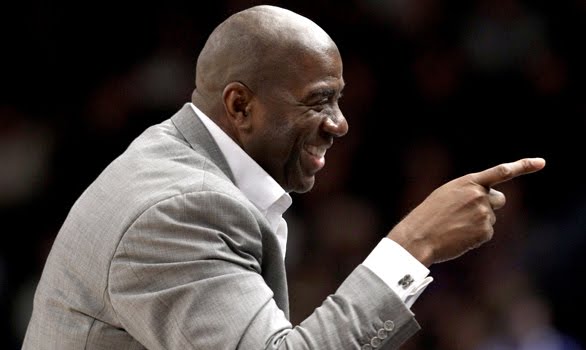
A group led by Lakers great Magic Johnson has been selected as the next owners of the Dodgers. (Kathy Willens / Associated Press / March 28, 2012)


Just like that, the Dodgers are credible again, promising again, connected to their city again.

Just like that, it's Magic.

Go ahead, Los Angeles, dig out that dusty Dodgers cap and unwrinkle that Dodger Stadium seating chart and shout yourself blue again. Go ahead, it's safe now, after two years in hell your city's most enduring sports team has just been placed in the giant hands of its most enduring sports star.

A group headed by Magic Johnson has just purchased the Dodgers from Frank McCourt for $2 billion, ending a prolonged nightmare with a soaring slam dunk.

Mark Walter, chief executive of the $126-billion Guggenheim Partners financial company based in Chicago, will be the controlling owner of a group that will be led by Johnson and directed by longtime respected baseball executive Stan Kasten.

McCourt sold the Dodgers to Johnson's group Tuesday just five hours after Major League Baseball approved three finalists for an auction. As I wrote in a column that appeared on the Internet an hour before the news broke, Johnson's group was the obvious and best choice over out-of-town billionaires Steve Cohen and Stan Kroenke.

After successfully boycotting Dodger Stadium enough to convince MLB to run McCourt out of town, Dodgers fans are distrusting and disillusioned, and Johnson's group is the only one with the credibility to quickly bring them back.

Johnson, whose business acumen equals his former Lakers court sense, will become a full-time team executive with an office in Dodger Stadium and a giant welcoming reach that will stretch to every corner of the disaffected Dodgers nation. Kasten, a traditional baseball guy who built the perennially contending Atlanta Braves from scratch and help shape the surging Washington Nationals, was interested in the Dodgers before McCourt bought the team in 2004 and has long held a dream of restoring them to greatness.

When I interviewed Johnson in December when The Times broke the news of his decision to pursue the team, he said, "The Dodgers are my next big thing. This is not just millions of my money, this is dear to my heart. This is bringing back the brand for the people of Los Angeles."

At the time, Johnson said his goal would be to bring the Dodgers back to the popularity level currently enjoyed by his former team.

"When I first got to town [in 1979], the Dodgers were on Page 1 of the L.A. Times and the Lakers were on Page 3," Johnson said. "I've seen how the Dodgers can be as big as the Lakers, and I want that to happen again."

We know little about Walter and the Guggenheim folks, who will fund their majority contribution from out-of-state insurance companes, but we know that they have convinced Johnson and Kasten that it's not about real estate or television, but baseball.

In that same December interview, Johnson said he auditioned six prospective bidders before deciding on the Guggenheim group for winning reasons.

"The first thing I asked Walter was, 'Do you want to win, and do you want to put money in?" Johnson said at the time. "He said, 'Absolutely.'"

Johnson said the future Dodgers owner says the things you hear from championship owners.

"Listening to Walter talk about winning, it was like listening to Jerry Buss," Johnson said. "He told me three times, 'All I want to do is get to the World Series.' I know great owners, and this guy can be a great owner."

Of course, once the initial love fest ends, the tough stuff begins.

The new owners know that Dodgers fans are not a bunch of poor saps on a deserted beach standing around an "SOS" rock formation and waiting desperately for the first ship to save them. They know that Dodgers fans are, instead, huddled and hidden in a clump of trees in the middle of the island, defiant, distrustful, and willing to remain out of sight until somebody shows up with enough smarts and savvy and charm to coax them back home.

Two billion dollars will buy the new owners no love or respect or even 30,000 folks on a school night in September. Two billion dollars will only buy them two billion questions from the toughest crowd they've ever faced.

Those hundreds of thousands of Dodgers fans who abandoned Chavez Ravine will need more than simple answers. They will need action, they will need explanation, they will need a group that can proactively reestablish the bonds of this city's most enduring yet most abused connection with a sports franchise.

In my opinion, they needed Magic.

On Tuesday night, they got him, and the fastbreak is on.

bill.plaschke@latimes.com

twitter.com/billplaschke