By Brigitte Gabriel
http://www.FrontPageMag.com
October 30, 2006
The Truth About Muhammad
by Robert Spencer
Regnery Publishing
256 pp.
ISBN- 1596980281
“Freedom of inquiry and speech, the quest for truth, should not be cowed into silence by violent intimidation or the acceptance of half-truths and propaganda meant to appease freedom’s enemies. One thing is certain: if no one is willing to take such risks, freedom of speech will swiftly become a relic of history.”
These are the words of author Robert Spencer, who is risking his life to educate Westerners about the life of the founder of Islam. He has just come out with a new book, The Truth About Muhammad: Founder of the World's Most Intolerant Religion. In this biography, Spencer tells the story of the founder of Islam -- a story that many Muslims themselves apparently either do not know about or do not want non-Muslims to hear.
Yet it's strange that any Muslim would react with anger to Spencer's book, since he bases it strictly on Islamic sources, all written by pious and serious Muslims. No critic can rightly say that anything Spencer has said about Muhammad in this book is inaccurate. But the problem Muslims find with it is that Spencer doesn't treat Muhammad as if he were the highest moral standard.
Within the Islamic world, by contrast, Muhammad is considered untouchable. Spencer demonstrates that the Qur’an and Islamic tradition are clear that the Prophet is the supreme example of behavior for Muslims to follow. And today, no hint of criticism of any of his acts or teachings is tolerated.
This stifling of speech is now beginning to affect the West, within which non-Muslims are becoming increasingly frightened to say anything critical about Islam and its founder. Indeed, at even the mildest criticism, either by the Pope or in lightly satirical newspaper cartoons, Islamic nations erupt in a frenzy of blind anger. Furious Muslims take to the streets, burn churches and temples, kill innocent civilians, and threaten violence against the non-Muslim world.
Spencer warns that for the West to be intimidated into silence by this behavior is dangerous. He writes, “to place Muhammad and Islam beyond criticism and even beyond lampooning would be just as dangerous for a free society as the idea that the “Beloved Leader” of North Korea and dialectical materialism is above criticism. Indeed it would be death for a free society.”
Spencer accordingly presents the truth about Islam’s founder clearly. His story is backed up by solid scholarship and research. So the key question becomes: who is the man whom the Qur’an states is “an excellent model of conduct” (33:21)?
Spencer begins by introducing the historical Muhammad as well as the books and writings that make up the religion of Islam. This is crucial for all to understand, because it is not only the Qur’an that influences Muslim opinion, but also accompanying religious literature, including the hadith (traditions of Muhammad recorded by his followers) and the Sira (the biography of Muhammad).
Spencer goes on to explain how Muhammad became a prophet, and how he tried at first to spread his message by peaceful means -- including attempts to convince Jews and Christians that he was a prophet in the line of the Old Testament prophets and Jesus (whom he considered a prophet, not the Son of God). When his efforts failed to bring them, along with the pagan Arabs of his native tribe, into his new religion, he became a warlord -- killing, slaughtering and beheading in order to convert others or to force them to submit to him and to the religion given to him by Allah.
Spencer shows how the Prophet Muhammad, the perfect model for human behavior according to Islam and any professing Muslim, perfected the arts of assassination, deceit and taking booty. Chapters 7, 8 and 9 detail the warrior Muhammad’s battles with pagans, Jews and Christians. He told them that their lives and property would be safe only if they became Muslims. In many places, we can see clearly how he serves today as an example for Muslim behavior: at one point Spencer writes,
“Muhammad addressed them (the Jews) in terms that have become familiar usage for Islamic Jihadists when speaking of Jews today …. ‘You brothers of monkeys, has God disgraced you and brought His vengeance upon you?’ The Qur'an in three places (2:62-65; 5:59-60; and 7:166) says that Allah transformed the Sabbath-breaking Jews into pigs and monkeys.
Jihadists today routinely refer to Jews as "pigs and monkeys" -- not just a term of abuse, but an imitation of the holy prophet's example.
The author also sheds a light on the Treaty of Hudaybiyya, the ten-year truce (Hudna) Muhammad signed with the pagan Quraysh tribe. By breaking this treaty, Muhammad again set a precedent: Muslims can sign a treaty but can break it at anytime, when doing so is to their advantage. The purpose of Hudna is to allow weakened Muslim forces to gather strength to fight again later more effectively. This is an extremely important principle for the West to understand today, since it shows the difference between what we perceive as a cease-fire and what believing Muslims think it is.
Chapter 10 explores in a carefully balanced and restrained manner the personal life of Muhammad, allowing the reader to make his own informed decision based on the facts. Spencer presents frightening facts that call into serious question the wisdom behind the Islamic tradition that has dubbed Muhammad “al-insan al-kamil,” or the Perfect Man: his marriage to a child (which is widely imitated in the Islamic world today), his polygamy, his calls to subjugate Jews and Christians, and more.
Throughout the book, we learn how Muhammad treated women and how his words and actions have inspired generation after generation of Muslim men to look at women as nothing more than property. As Spencer notes,
“The Qur’an likens a woman to a field (tilth), to be used by a man as he wills: ‘Your women are a tilth for you (to cultivate) so go to your tilth as ye will’ ” (2:223).
That's bad enough, but there is much more. Spencer’s work details example after example of Muhammad’s teaching about women and how to treat them: beat them if they are disobedient, deny them the right to testify in cases involving sexual crimes, deny their inheritance rights, and deny their rights in numerous ways. And as the historical record has shown, his teachings have sentenced millions of women into a life of oppression, misery and depression.
Readers will learn a great deal from this book, as I did. Spencer also offers constructive suggestions and solutions if we ever want to win this war on Islamofascism. Some of them include:
* Stop insisting that Islam is a religion of peace.
* Initiate a full-scale Manhattan Project to find new energy sources.
* Make Western aid contingent upon renunciation of the Jihad ideology.
* Call upon American Muslim advocacy groups to work against the Jihad ideology.
* Revise immigration policies with the Jihad ideology in view.
This book is a must read for all to understand the roots of radical Islam. It arms non-Muslims and Muslims alike by illuminating what needs to be targeted in order to weaken Islamic extremism and the oxygen which they need to breathe.
Get it and be informed.
Click Here to support Frontpagemag.com.
Brigitte Gabriel is the author of Because They Hate: A Survivor of Islamic Terror Warns America and the founder of American Congress for Truth.org. She is an expert on the Middle East and lectures nationally and internationally on the subject
Monday, October 30, 2006


Sunday, October 29, 2006
Dan Shaughnessy- Red Auerbach: An Appreciation
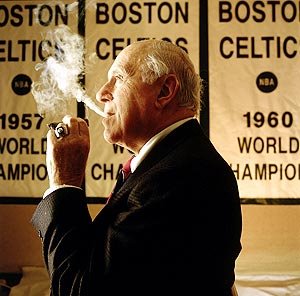
For decades, he lit up our lives
The Boston Globe
October 29, 2006
We were so lucky. We had Red Auerbach for nearly 57 NBA seasons. We had his genius, his rough, old-school charm, and his Brooklyn-learned street smarts. And we lost him yesterday. At the age of 89. Just four days before the start of another Celtics season.
Red was the Celtics. Sure, we had Bill Russell, Bob Cousy, John Havlicek, Larry Bird, and the rest. But Red was the Celtics. He delivered 16 championships to our town. We never could pay back all the pride and glory he brought to Boston.
We tried. We dedicated a statue to Red a full 21 years before he died. We wrote books about him. We created a scholarship in his honor. We made documentaries about him and held a $500 per plate "Red-fest" at the Bayside Exposition Center.
"Most guys have to die to get a tribute like that," Red said, with a chuckle.
We were hoping he never would die. As long as Red lived, there was still Celtic tradition, Celtic pride. We were looking forward to seeing him for one more opening night Wednesday at the Garden. It would have been his 57th opener with the Celts. It would have been his 61st opening night with the NBA, a magnificent career that spanned the entire history of the league. But he just missed. In the end, he never lived to see the first Celtic cheerleader. Probably the way he wanted it.
Where do we start now that Red is officially finished? Do we tell you that he made more great deals than any executive in the history of sports? Do we tell you that he was the best coach, then the best general manager? Do we tell you that he invented the end zone dance?
That's right, boys and girls. You may think that opponent-baiting started with NFL wide receivers preening in end zones, but it all goes back to the 1950s and a short fellow in a jacket and tie with a rolled-up game program in his hand -- lighting up a Hoyo de Monterrey -- as he sat at the end of the bench watching his Celtics bring home another win. Red's victory cigar was the original in-your-face taunt. Celtic rivals despised the gesture and even Red's players dreaded the ceremonial stogie: It just made the other team mad. It made them play harder.
Red didn't care. He was enjoying victory, already thinking about the next game.
Red was decades ahead of his time. The old saying was that Red was playing chess while the rest of the coaches and GMs were still playing checkers. He outsmarted all of them. When confronted, he punched first and asked questions later. He dared his rivals to beat him. And none ever could. Drove them crazy.
Being Jewish helped. It taught him discrimination at a young age. This knowledge was handy when Red came into a fledgling league that was initially all white, but one day would be more than 70 percent black. Red was the first NBA executive to draft a black player, the first coach to start five black players, and he hired the first black coach (Russell) in the history of American sports. Russell, we all know, was more sensitive to frauds than any athlete on the planet. Russell went through walls for Red. And no one else.
Red was sometimes crude and ever vengeful. Ask Cedric Maxwell. When Max took too long to recover from knee surgery in 1985, Red shipped him out of town (for Bill Walton), then had all positive Maxwell references deleted from an Auerbach book that was still in production. Downright Kremlinesque. It took two decades for Red to agree to let the Celtics retire Max's number.
He was well past 65 when he stormed across the parquet floor and challenged Moses Malone to a fight. A couple of years later, the death of Len Bias almost killed Red and sent the Celtics into a tailspin from which they still have not recovered.
What else can we tell you? Red was a sore loser and a gloating winner. Referees hated him. He got into beefs with the officials at old-timers' games. Seriously. And he always hated Madison Square Garden, dating to the 1930s, when he felt his George Washington team was snubbed by the NIT.
Red loved "Hawaii Five-O." He loved Chinese food and would order for the entire table. He was a historically bad driver, rarely getting into accidents, but leaving a trail of fenders and furious drivers in his exhaust. He collected letter openers from around the world and delighted in telling stories of deal-making with trinket merchants on other continents.
Red was constitutionally incapable of participating in small talk. He could be particularly ham-handed when dealing with women. In 1982, he barred Lesley Visser from the Celtic locker room just two years after attending her wedding in Boston.
In 1984, I brought my young wife and infant daughter to the NBA meetings in Salt Lake City. Red had given me a box of cigars when our daughter was born (probably a company violation to accept them, but hopefully the statute of limitations on graft has expired) and I was anxious to have him take a look at our 6-week-old baby. Red took one look at little Sarah, blew some smoke past my wife's head, and said, "Lady, you got a lot of balls bringing that baby all the way out here. Yes, sir, a lot of balls."
It took a while to explain to my wife that this was Red's highest form of praise.
For all that bluster, there was a sweetness about him and you saw it when he was in the presence of his late wife, Dorothy, and his two daughters. In all the years he worked for the Celtics, Red never bought a house in Boston. Dorothy liked her native Washington and dutiful Red went along with the plan. Case closed.
Modern laws be damned, the Celtics should hand out cigars at the Garden opening night. After the anthem, before the opening tap, turn out the lights and let everybody light up a Hoyo de Monterrey. It'll smell like victory.
Murray Chass: Series is Over; Let the Bidding Begin
MURRAY CHASS
The New York Times
Published: October 29, 2006
In the early days of free agency, one of its fiercest opponents was a veteran baseball executive named Jim Campbell. He was the general manager of the Detroit Tigers, and he refused to sign free agents. They weren’t part of the baseball he knew and loved. Campbell epitomized the old guard who inspired the players union to fight for free agency.
The 2006 Tigers did not win the World Series; no team that played as poorly as they did could win the World Series. But the Tigers have at least entered the modern baseball world. Three players they signed as free agents in the past three years served as their foundation: Iván Rodríguez, Magglio Ordóñez and Kenny Rogers. Jim Campbell is in agony, wherever he is.
“That’s a long time ago,” Dave Dombrowski, the Tigers’ chief executive and general manager, said Friday in the hour after the St. Louis Cardinals beat the Tigers, eating a chocolate sundae as he talked about Campbell. “The game has changed so much since then. I understand there was a whole different mind-set from some people, but it’s a tool that’s helped us win, and we’ve gotten some good players that way.”
Nearly 200 players are eligible to become free agents in the next two weeks, and 59 filed yesterday, the first day of the 15-day filing period. Among those filing were Barry Bonds, Orlando Hernández and Steve Trachsel. Only a player’s 2006 club may sign him during this 15-day period, but beginning Nov. 12, all clubs are permitted to sign any free agent.
Starting pitchers will be in demand because they always are. Everybody needs starting pitchers, including the biggest spenders, a k a the Yankees and the Red Sox.
Barry Zito is the brightest name on the pitching list, and his record this season — 16-10 for a 102-63 career mark — did nothing to tarnish his stature. Kerry Wood, Mark Buehrle, Randy Wolf and Jason Schmidt can also be free agents, with Wood raising the most questions among the elite group.
A 29-year-old right-hander, Wood has had an injury-plagued career, making a full complement of 32 starts only twice in eight seasons. He started only four games this year and 14 the last two years.
But if you want to ask questions, ask if Roger Clemens will play another season. He hasn’t said, but at 44 years old, he looks as if he can still pitch effectively. This season he had only a 7-6 record, but his 2.30 earned run average sure looked good after a 1.87 in 32 starts the year before.
Mike Mussina will most likely be a free agent because the Yankees aren’t expected to exercise his $17 million option, but they could negotiate a contract at a lower salary by adding a year to the deal.
The Yankees, who had pitching problems the past season, will be one of the teams most actively pursuing pitchers. The Mets will be right there with them, and the competition for Zito could serve as the off-season’s Subway Series.
The free-agent list will have hitters, too, including outfielders Alfonso Soriano, Jermaine Dye, Carlos Lee, Gary Matthews, Torii Hunter and Juan Pierre. Among the top infielders who are expected to file are third baseman Aramis Ramírez and second baseman Mark Loretta.
And don’t forget Bonds. Clubs that would consider signing him, including the Giants, have to decide how much his 22nd home run will be worth to them. They can sell only a certain number of seats for the few games in which he may break Henry Aaron’s record of 755.
The recently negotiated labor contract has changed some of the rules for free agency. A player’s former club will no longer face deadlines for signing him, meaning their talks can go beyond the previous deadlines of Dec. 7 (if a club didn’t offer salary arbitration) and Jan. 8 (if it did).
The clubs proposed eliminating the deadlines, and the union agreed.
Parsing Girardi
Joe Girardi’s experience as a rookie manager in Florida was weird enough. Now he has made it more so.
Girardi did more than anyone could have expected with a rookie-laden team and a $15 million payroll. But it was the makeup of the team’s roster that was at the crux of Girardi’s conflicting comments.
Last week Girardi, who was fired at the end of the season, told The New York Times, “I believe the landscape changed from what it was originally going to be and I was misled a bit.”
But 11 months ago, when the Marlins were trading their best and most expensive players — Carlos Delgado, Josh Beckett and Mike Lowell, for starters — Girardi told The Times: “I knew they were going to make trades. We talked about that when I first met with them. They said they had to do some things they felt would make their club better for a long time.” And he added: “I knew when I signed the contract that the team was different than what it would be when we took the field in February. I’m excited.”
That doesn’t sound as if he was misled at all.
Who’s in Charge?
A Major League Baseball all-star team goes to Japan this week for a five-game series, but the players can’t be blamed if they don’t know who their manager is.
Initially, it was supposed to be Ken Macha of Oakland. But on the day Macha was announced as the manager, the Athletics fired him. Terry Francona of Boston was the next manager named, but Francona withdrew when he developed a foot infection and was hospitalized.
Then Bruce Bochy of San Diego replaced Francona, but when he manages the team, he will be Bruce Bochy of San Francisco. The Giants named Bochy as their manager Friday.
Easy Come, Easy Go
Like student, like teacher.
Why would the Padres give the Giants permission to talk to Bruce Bochy even though he had a year left on his contract, he had been their manager for a dozen years and he had directed the team to division titles the last two seasons? The belief in baseball circles is that Sandy Alderson, the Padres’ chief executive, wanted to make a change.
Alderson once upon a time was general manager, then president of the Oakland Athletics. He was Billy Beane’s boss and mentor.
Four years ago, Beane, the Athletics’ general manager, gave the Mets permission to talk with Art Howe even though he had managed the Athletics to three consecutive playoff appearances. The belief at the time was that Beane wanted to get rid of Howe.
Asked to explain the Padres’ decision to let Bochy leave, General Manager Kevin Towers said he and Alderson believed that if a team sought permission to talk to one of their employees, the employee “should have the right to talk to them.”
Alderson, Towers said, gave him permission a year ago to talk to the Arizona Diamondbacks about their general manager’s job. “I almost left, but it didn’t work out,” Towers said.
Bochy had one year left on his Padres contract, and they were not prepared to extend it now, if ever. Bochy opted for the security of a three-year contract with the Giants.
A Rule Meant to Be Broken
With his help, teams have made a mockery of Commissioner Bud Selig’s ban on major announcements during the postseason, particularly the World Series. The Chicago Cubs (Lou Piniella) and the Giants (Bruce Bochy) didn’t violate Selig’s ban because they received his permission to announce their new managers.
But what’s the point of having a rule if every time someone wants to make an announcement, Selig says go ahead?
In the Giants’ case, they asked to be allowed to announce Bochy’s appointment because he is leaving for Japan tomorrow. Selig could have told them to wait until after the World Series to make the announcement, then have a news conference when Bochy returned. As it turned out, the Giants could have held their news conference yesterday or today, after the World Series was over and before Bochy left for Japan.
The New York Times
Published: October 29, 2006
In the early days of free agency, one of its fiercest opponents was a veteran baseball executive named Jim Campbell. He was the general manager of the Detroit Tigers, and he refused to sign free agents. They weren’t part of the baseball he knew and loved. Campbell epitomized the old guard who inspired the players union to fight for free agency.
The 2006 Tigers did not win the World Series; no team that played as poorly as they did could win the World Series. But the Tigers have at least entered the modern baseball world. Three players they signed as free agents in the past three years served as their foundation: Iván Rodríguez, Magglio Ordóñez and Kenny Rogers. Jim Campbell is in agony, wherever he is.
“That’s a long time ago,” Dave Dombrowski, the Tigers’ chief executive and general manager, said Friday in the hour after the St. Louis Cardinals beat the Tigers, eating a chocolate sundae as he talked about Campbell. “The game has changed so much since then. I understand there was a whole different mind-set from some people, but it’s a tool that’s helped us win, and we’ve gotten some good players that way.”
Nearly 200 players are eligible to become free agents in the next two weeks, and 59 filed yesterday, the first day of the 15-day filing period. Among those filing were Barry Bonds, Orlando Hernández and Steve Trachsel. Only a player’s 2006 club may sign him during this 15-day period, but beginning Nov. 12, all clubs are permitted to sign any free agent.
Starting pitchers will be in demand because they always are. Everybody needs starting pitchers, including the biggest spenders, a k a the Yankees and the Red Sox.
Barry Zito is the brightest name on the pitching list, and his record this season — 16-10 for a 102-63 career mark — did nothing to tarnish his stature. Kerry Wood, Mark Buehrle, Randy Wolf and Jason Schmidt can also be free agents, with Wood raising the most questions among the elite group.
A 29-year-old right-hander, Wood has had an injury-plagued career, making a full complement of 32 starts only twice in eight seasons. He started only four games this year and 14 the last two years.
But if you want to ask questions, ask if Roger Clemens will play another season. He hasn’t said, but at 44 years old, he looks as if he can still pitch effectively. This season he had only a 7-6 record, but his 2.30 earned run average sure looked good after a 1.87 in 32 starts the year before.
Mike Mussina will most likely be a free agent because the Yankees aren’t expected to exercise his $17 million option, but they could negotiate a contract at a lower salary by adding a year to the deal.
The Yankees, who had pitching problems the past season, will be one of the teams most actively pursuing pitchers. The Mets will be right there with them, and the competition for Zito could serve as the off-season’s Subway Series.
The free-agent list will have hitters, too, including outfielders Alfonso Soriano, Jermaine Dye, Carlos Lee, Gary Matthews, Torii Hunter and Juan Pierre. Among the top infielders who are expected to file are third baseman Aramis Ramírez and second baseman Mark Loretta.
And don’t forget Bonds. Clubs that would consider signing him, including the Giants, have to decide how much his 22nd home run will be worth to them. They can sell only a certain number of seats for the few games in which he may break Henry Aaron’s record of 755.
The recently negotiated labor contract has changed some of the rules for free agency. A player’s former club will no longer face deadlines for signing him, meaning their talks can go beyond the previous deadlines of Dec. 7 (if a club didn’t offer salary arbitration) and Jan. 8 (if it did).
The clubs proposed eliminating the deadlines, and the union agreed.
Parsing Girardi
Joe Girardi’s experience as a rookie manager in Florida was weird enough. Now he has made it more so.
Girardi did more than anyone could have expected with a rookie-laden team and a $15 million payroll. But it was the makeup of the team’s roster that was at the crux of Girardi’s conflicting comments.
Last week Girardi, who was fired at the end of the season, told The New York Times, “I believe the landscape changed from what it was originally going to be and I was misled a bit.”
But 11 months ago, when the Marlins were trading their best and most expensive players — Carlos Delgado, Josh Beckett and Mike Lowell, for starters — Girardi told The Times: “I knew they were going to make trades. We talked about that when I first met with them. They said they had to do some things they felt would make their club better for a long time.” And he added: “I knew when I signed the contract that the team was different than what it would be when we took the field in February. I’m excited.”
That doesn’t sound as if he was misled at all.
Who’s in Charge?
A Major League Baseball all-star team goes to Japan this week for a five-game series, but the players can’t be blamed if they don’t know who their manager is.
Initially, it was supposed to be Ken Macha of Oakland. But on the day Macha was announced as the manager, the Athletics fired him. Terry Francona of Boston was the next manager named, but Francona withdrew when he developed a foot infection and was hospitalized.
Then Bruce Bochy of San Diego replaced Francona, but when he manages the team, he will be Bruce Bochy of San Francisco. The Giants named Bochy as their manager Friday.
Easy Come, Easy Go
Like student, like teacher.
Why would the Padres give the Giants permission to talk to Bruce Bochy even though he had a year left on his contract, he had been their manager for a dozen years and he had directed the team to division titles the last two seasons? The belief in baseball circles is that Sandy Alderson, the Padres’ chief executive, wanted to make a change.
Alderson once upon a time was general manager, then president of the Oakland Athletics. He was Billy Beane’s boss and mentor.
Four years ago, Beane, the Athletics’ general manager, gave the Mets permission to talk with Art Howe even though he had managed the Athletics to three consecutive playoff appearances. The belief at the time was that Beane wanted to get rid of Howe.
Asked to explain the Padres’ decision to let Bochy leave, General Manager Kevin Towers said he and Alderson believed that if a team sought permission to talk to one of their employees, the employee “should have the right to talk to them.”
Alderson, Towers said, gave him permission a year ago to talk to the Arizona Diamondbacks about their general manager’s job. “I almost left, but it didn’t work out,” Towers said.
Bochy had one year left on his Padres contract, and they were not prepared to extend it now, if ever. Bochy opted for the security of a three-year contract with the Giants.
A Rule Meant to Be Broken
With his help, teams have made a mockery of Commissioner Bud Selig’s ban on major announcements during the postseason, particularly the World Series. The Chicago Cubs (Lou Piniella) and the Giants (Bruce Bochy) didn’t violate Selig’s ban because they received his permission to announce their new managers.
But what’s the point of having a rule if every time someone wants to make an announcement, Selig says go ahead?
In the Giants’ case, they asked to be allowed to announce Bochy’s appointment because he is leaving for Japan tomorrow. Selig could have told them to wait until after the World Series to make the announcement, then have a news conference when Bochy returned. As it turned out, the Giants could have held their news conference yesterday or today, after the World Series was over and before Bochy left for Japan.
Mark Steyn: Only choice on war is to win or lose it
October 29, 2006
Chicago Sun-Times
I was on C-SPAN the other morning, and a lady called in to complain that ''you are making my blood pressure rise.'' Usual reason. The host, Paul Orgel, had asked me what I thought of President Bush and I replied that, whatever my differences with him on this or that, I thought he was one of the most farsighted politicians in Washington. That's to say, he's looking down the line to a world in which a radicalized Islam has exported its pathologies to every corner on Earth, Iran and like-minded states have applied nuclear blackmail to any parties within range, and a dozen or more nutcake basket-case jurisdictions have joined Pyongyang and Tehran as a Nukes R Us one-stop shop for all your terrorist needs.
In 2020, no one's going to be worrying about which Congressional page Mark Foley is coming on to. Except Mark Foley, who'll be getting a bit long in the tooth by then. But if it really is, as Democrats say, ''all about the future of our children,'' then our children will want to know why our generation saw what was happening and didn't do anything about it. They will despise us as we despise the political class of the 1930s. And the fact that we passed a great prescription drug plan will be poor consolation when the entire planet is one almighty headache.
My caller at C-SPAN thought this Bush farsightedness shtick was ridiculous. And, though I did my best to lower her blood pressure, I can't honestly say I succeeded. But suppose the ''Anyone But Bush'' bumper-sticker set got their way; suppose he and Cheney and Rummy and all the minor supporting warmongers down to yours truly were suddenly vaporized in 20 seconds' time. What then?
Nothing, that's what. The jihad's still there. Kim Jong Il's still there. The Iranian nukes are still there. The slyer Islamist subversion from south-east Asia to the Balkans to northern England goes on, day after day after day. And one morning we'll switch on the TV and the smoke and flames will be on this side of the Atlantic, much to President Rodham's surprise. Bush hatred is silly and parochial and reductive: History is on the march and the anti-Bush crowd is holding the telescope the wrong way round.
"We're in this grand ideological struggle," said the president two days later. "I am in disbelief that people don't take these people seriously." He was sitting in the Oval Office with a handful of columnists including yours truly. At the risk of making that C-SPAN caller's head explode, it was a great honor. I wasn't the only foreigner in the room: There was a bust of Winston Churchill, along with those of Lincoln and Eisenhower. A war president, a war prime minister, a war general.
Bush was forceful and informed, and it seems to me he performs better in small groups of one-night-only White House correspondents than in the leaden electronic vaudeville with Helen Thomas, David Gregory and the other regulars. (You can judge for yourself: Michael Barone has posted the entire audio at U.S. News & World Report's Web site.) He dismissed the idea that going into Iraq had only served to "recruit" more terrorists to the cause. (General Pace told me last week that, if anything, the evidence is that Iraq has tied up a big chunk of senior jihadists who'd otherwise be blowing up Afghanistan and elsewhere.) The president's view is that before it was Iraq it was Israel; with these guys, it's always something. Sometimes it's East Timor -- which used to be the leftie cause du jour. And, riffing on the endless list of Islamist grievances, Bush concluded with an exasperated: "If it's not the Crusades, it's the cartoons." That'd make a great slogan: it encapsulates simultaneously the Islamists' inability to move on millennium-in millennium-out, plus their propensity for instant new "root causes," and their utter lack of proportion.
"We need to be on the offense all the time," said the president. I pointed out that, when the military are obviously on offense -- liberating Afghanistan, toppling Saddam -- the American people are behind them. But that it's hard to see where the offense is in what to most TV viewers has dwindled down to a thankless semi-colonial policing operation with no end in sight. How about a bit more offense? Syria's been subverting Iraq for three years. Why not return the favor?
"We are on the offense," he insisted, sounding sometimes as frustrated as us columnists that so much of the wider momentum had become (in Charles Krauthammer's words) "mired in diplomacy." Still, it was a different conversation than most Bush encounters with the media-political class. I happened to be plugging my book on a local radio show this week just as a Minnesota "conservative" (ish) Democrat joined the herd of stampeding donkeys explaining why they were now disowning their vote in favor of the Iraq war. What a sorry sight. It's not a question of whether you're "for" or "against" a war. Once you're in it, the choice is to win it or lose it. And, if you're arguing for what will look to most of the world like the latter option, you better understand what the consequences are. In this case, it would, in effect, end the American moment.
Does that bother people? Bush said something, en passant, that I brooded on all the way home. Asked about poll numbers, he said that 25 percent of the population are always against the war -- any war.
That sounds about right. And it's a bit disturbing. To be sure, if Canadian storm troopers were swarming across the 49th Parallel or Bahamian warships were firing off the coast of Florida, some of that 25 percent might change their mind, though it might be a bit late by then. But, as America's highly unlikely to be facing that kind of war in the foreseeable future, that 25 percent's objection to the only wars on offer is rather unnerving.
The invaluable Brussels Journal recently translated an interview with the writer Oscar van den Boogaard from the Belgian paper De Standaard. A Dutch gay "humanist" (which is pretty much the trifecta of Eurocool), van den Boogaard was reflecting on the accelerating Islamification of the Continent and concluding that the jig was up for the Europe he loved. "I am not a warrior, but who is?" he shrugged. "I have never learned to fight for my freedom. I was only good at enjoying it."
Too many of us are only good at enjoying freedom. That war-is-never-the-answer 25 percent are in essence saying that there's nothing about America worth fighting for, and that, ultimately, the continuation of their society is a bet on the kindness of strangers -- on the goodnaturedness of Kim Jong Il and the mullahs and al-Qaida and what the president called "al-Qaida lookalikes and al-Qaida wannabes" and whatever nuclear combination thereof comes down the pike. Some of us don't reckon that's a good bet, and think America's arms-are-for-hugging crowd need to get real. Van den Boogaard's arms are likely to be doing rather less of their preferred form of hugging in the European twilight.
©Mark Steyn 2006
Chicago Sun-Times
I was on C-SPAN the other morning, and a lady called in to complain that ''you are making my blood pressure rise.'' Usual reason. The host, Paul Orgel, had asked me what I thought of President Bush and I replied that, whatever my differences with him on this or that, I thought he was one of the most farsighted politicians in Washington. That's to say, he's looking down the line to a world in which a radicalized Islam has exported its pathologies to every corner on Earth, Iran and like-minded states have applied nuclear blackmail to any parties within range, and a dozen or more nutcake basket-case jurisdictions have joined Pyongyang and Tehran as a Nukes R Us one-stop shop for all your terrorist needs.
In 2020, no one's going to be worrying about which Congressional page Mark Foley is coming on to. Except Mark Foley, who'll be getting a bit long in the tooth by then. But if it really is, as Democrats say, ''all about the future of our children,'' then our children will want to know why our generation saw what was happening and didn't do anything about it. They will despise us as we despise the political class of the 1930s. And the fact that we passed a great prescription drug plan will be poor consolation when the entire planet is one almighty headache.
My caller at C-SPAN thought this Bush farsightedness shtick was ridiculous. And, though I did my best to lower her blood pressure, I can't honestly say I succeeded. But suppose the ''Anyone But Bush'' bumper-sticker set got their way; suppose he and Cheney and Rummy and all the minor supporting warmongers down to yours truly were suddenly vaporized in 20 seconds' time. What then?
Nothing, that's what. The jihad's still there. Kim Jong Il's still there. The Iranian nukes are still there. The slyer Islamist subversion from south-east Asia to the Balkans to northern England goes on, day after day after day. And one morning we'll switch on the TV and the smoke and flames will be on this side of the Atlantic, much to President Rodham's surprise. Bush hatred is silly and parochial and reductive: History is on the march and the anti-Bush crowd is holding the telescope the wrong way round.
"We're in this grand ideological struggle," said the president two days later. "I am in disbelief that people don't take these people seriously." He was sitting in the Oval Office with a handful of columnists including yours truly. At the risk of making that C-SPAN caller's head explode, it was a great honor. I wasn't the only foreigner in the room: There was a bust of Winston Churchill, along with those of Lincoln and Eisenhower. A war president, a war prime minister, a war general.
Bush was forceful and informed, and it seems to me he performs better in small groups of one-night-only White House correspondents than in the leaden electronic vaudeville with Helen Thomas, David Gregory and the other regulars. (You can judge for yourself: Michael Barone has posted the entire audio at U.S. News & World Report's Web site.) He dismissed the idea that going into Iraq had only served to "recruit" more terrorists to the cause. (General Pace told me last week that, if anything, the evidence is that Iraq has tied up a big chunk of senior jihadists who'd otherwise be blowing up Afghanistan and elsewhere.) The president's view is that before it was Iraq it was Israel; with these guys, it's always something. Sometimes it's East Timor -- which used to be the leftie cause du jour. And, riffing on the endless list of Islamist grievances, Bush concluded with an exasperated: "If it's not the Crusades, it's the cartoons." That'd make a great slogan: it encapsulates simultaneously the Islamists' inability to move on millennium-in millennium-out, plus their propensity for instant new "root causes," and their utter lack of proportion.
"We need to be on the offense all the time," said the president. I pointed out that, when the military are obviously on offense -- liberating Afghanistan, toppling Saddam -- the American people are behind them. But that it's hard to see where the offense is in what to most TV viewers has dwindled down to a thankless semi-colonial policing operation with no end in sight. How about a bit more offense? Syria's been subverting Iraq for three years. Why not return the favor?
"We are on the offense," he insisted, sounding sometimes as frustrated as us columnists that so much of the wider momentum had become (in Charles Krauthammer's words) "mired in diplomacy." Still, it was a different conversation than most Bush encounters with the media-political class. I happened to be plugging my book on a local radio show this week just as a Minnesota "conservative" (ish) Democrat joined the herd of stampeding donkeys explaining why they were now disowning their vote in favor of the Iraq war. What a sorry sight. It's not a question of whether you're "for" or "against" a war. Once you're in it, the choice is to win it or lose it. And, if you're arguing for what will look to most of the world like the latter option, you better understand what the consequences are. In this case, it would, in effect, end the American moment.
Does that bother people? Bush said something, en passant, that I brooded on all the way home. Asked about poll numbers, he said that 25 percent of the population are always against the war -- any war.
That sounds about right. And it's a bit disturbing. To be sure, if Canadian storm troopers were swarming across the 49th Parallel or Bahamian warships were firing off the coast of Florida, some of that 25 percent might change their mind, though it might be a bit late by then. But, as America's highly unlikely to be facing that kind of war in the foreseeable future, that 25 percent's objection to the only wars on offer is rather unnerving.
The invaluable Brussels Journal recently translated an interview with the writer Oscar van den Boogaard from the Belgian paper De Standaard. A Dutch gay "humanist" (which is pretty much the trifecta of Eurocool), van den Boogaard was reflecting on the accelerating Islamification of the Continent and concluding that the jig was up for the Europe he loved. "I am not a warrior, but who is?" he shrugged. "I have never learned to fight for my freedom. I was only good at enjoying it."
Too many of us are only good at enjoying freedom. That war-is-never-the-answer 25 percent are in essence saying that there's nothing about America worth fighting for, and that, ultimately, the continuation of their society is a bet on the kindness of strangers -- on the goodnaturedness of Kim Jong Il and the mullahs and al-Qaida and what the president called "al-Qaida lookalikes and al-Qaida wannabes" and whatever nuclear combination thereof comes down the pike. Some of us don't reckon that's a good bet, and think America's arms-are-for-hugging crowd need to get real. Van den Boogaard's arms are likely to be doing rather less of their preferred form of hugging in the European twilight.
©Mark Steyn 2006
Saturday, October 28, 2006
Muslim leader blames women for sex attacks
Richard Kerbaj
The Australian
October 26, 2006
THE nation's most senior Muslim cleric has blamed immodestly dressed women who don't wear Islamic headdress for being preyed on by men and likened them to abandoned "meat" that attracts voracious animals.
In a Ramadan sermon that has outraged Muslim women leaders, Sydney-based Sheik Taj Din al-Hilali also alluded to the infamous Sydney gang rapes, suggesting the attackers were not entirely to blame.
While not specifically referring to the rapes, brutal attacks on four women for which a group of young Lebanese men received long jail sentences, Sheik Hilali said there were women who "sway suggestively" and wore make-up and immodest dress ... "and then you get a judge without mercy (rahma) and gives you 65 years".
"But the problem, but the problem all began with who?" he asked.
The leader of the 2000 rapes in Sydney's southwest, Bilal Skaf, a Muslim, was initially sentenced to 55 years' jail, but later had the sentence reduced on appeal.
In the religious address on adultery to about 500 worshippers in Sydney last month, Sheik Hilali said: "If you take out uncovered meat and place it outside on the street, or in the garden or in the park, or in the backyard without a cover, and the cats come and eat it ... whose fault is it, the cats or the uncovered meat?
"The uncovered meat is the problem."
The sheik then said: "If she was in her room, in her home, in her hijab, no problem would have occurred."
He said women were "weapons" used by "Satan" to control men.
"It is said in the state of zina (adultery), the responsibility falls 90 per cent of the time on the woman. Why? Because she possesses the weapon of enticement (igraa)."
Muslim community leaders were yesterday outraged and offended by Sheik Hilali's remarks, insisting the cleric was no longer worthy of his title as Australia's mufti.
Young Muslim adviser Iktimal Hage-Ali - who does not wear a hijab - said the Islamic headdress was not a "tool" worn to prevent rape and sexual harassment. "It's a symbol that readily identifies you as being Muslim, but just because you don't wear the headscarf doesn't mean that you're considered fresh meat for sale," the former member of John Howard's Muslim advisory board told The Australian. "The onus should not be on the female to not attract attention, it should be on males to learn how to control themselves."
Australia's most prominent female Muslim leader, Aziza Abdel-Halim, said the hijab did not "detract or add to a person's moral standards", while Islamic Council of Victoria spokesman Waleed Ali said it was "ignorant and naive" for anyone to believe that a hijab could stop sexual assault.
"Anyone who is foolish enough to believe that there is a relationship between rape or unwelcome sexual interference and the failure to wear a hijab, clearly has no understanding of the nature of sexual crime," he said.
Ms Hage-Ali said she was "disgusted and offended" by Shiek Hilali's comments. "I find it very offensive that a man who considers himself as a mufti, a leader of Australia's Muslims, can give comment that lacks intelligence and common sense."
Yesterday, the mufti defended the sermon about "adultery and theft", a recorded copy of which has been obtained and translated by The Australian.
Sheik Hilali said he only meant to refer to prostitutes as "meat" and not any scantily dressed woman with no hijab, despite him not mentioning the word prostitute during the 17-minute talk.
He told The Australian the message he intended to convey was: "If a woman who shows herself off, she is to blame ... but a man should be able to control himself". He said if a woman is "covered and respectful" she "demands respect from a man". "But when she is cheap, she throws herself at the man and cheapens herself."
Sheik Hilali also insisted his references to the Sydney gang rapes were to illustrate that Skaf was guilty and worthy of receiving such a harsh sentence.
Waleed Ali said Sheik Hilali was "normalising immoral sexual behaviour" by comparing women to meat and men to animals and entirely blaming women for being victims.
"It's basically saying that the immoral response of men to women who are not fully covered is as natural and as inevitable as the response of an animal tempted by food," he said.
"But (unlike animals) men are people who have moral responsibilities and the capability in engaging in moral action."
Revelation of the mufti's comments comes after he criticised Mr Howard last month in The Australian for saying a minority of migrant men mistreated their women. Sheik Hilali said such a minority was found in all faiths. "Those who don't respect their women are not true Muslims."
"There's a small percentage found among all religions, but we don't recognise ours as Muslims."
Aziza Abdel-Halim said Sheik Hilali's remarks during Ramadan were inaccurate and upsetting to the Muslim community.
"They are below and beyond any comment (and) do not deserve any consideration."
The Australian
October 26, 2006
THE nation's most senior Muslim cleric has blamed immodestly dressed women who don't wear Islamic headdress for being preyed on by men and likened them to abandoned "meat" that attracts voracious animals.
In a Ramadan sermon that has outraged Muslim women leaders, Sydney-based Sheik Taj Din al-Hilali also alluded to the infamous Sydney gang rapes, suggesting the attackers were not entirely to blame.
While not specifically referring to the rapes, brutal attacks on four women for which a group of young Lebanese men received long jail sentences, Sheik Hilali said there were women who "sway suggestively" and wore make-up and immodest dress ... "and then you get a judge without mercy (rahma) and gives you 65 years".
"But the problem, but the problem all began with who?" he asked.
The leader of the 2000 rapes in Sydney's southwest, Bilal Skaf, a Muslim, was initially sentenced to 55 years' jail, but later had the sentence reduced on appeal.
In the religious address on adultery to about 500 worshippers in Sydney last month, Sheik Hilali said: "If you take out uncovered meat and place it outside on the street, or in the garden or in the park, or in the backyard without a cover, and the cats come and eat it ... whose fault is it, the cats or the uncovered meat?
"The uncovered meat is the problem."
The sheik then said: "If she was in her room, in her home, in her hijab, no problem would have occurred."
He said women were "weapons" used by "Satan" to control men.
"It is said in the state of zina (adultery), the responsibility falls 90 per cent of the time on the woman. Why? Because she possesses the weapon of enticement (igraa)."
Muslim community leaders were yesterday outraged and offended by Sheik Hilali's remarks, insisting the cleric was no longer worthy of his title as Australia's mufti.
Young Muslim adviser Iktimal Hage-Ali - who does not wear a hijab - said the Islamic headdress was not a "tool" worn to prevent rape and sexual harassment. "It's a symbol that readily identifies you as being Muslim, but just because you don't wear the headscarf doesn't mean that you're considered fresh meat for sale," the former member of John Howard's Muslim advisory board told The Australian. "The onus should not be on the female to not attract attention, it should be on males to learn how to control themselves."
Australia's most prominent female Muslim leader, Aziza Abdel-Halim, said the hijab did not "detract or add to a person's moral standards", while Islamic Council of Victoria spokesman Waleed Ali said it was "ignorant and naive" for anyone to believe that a hijab could stop sexual assault.
"Anyone who is foolish enough to believe that there is a relationship between rape or unwelcome sexual interference and the failure to wear a hijab, clearly has no understanding of the nature of sexual crime," he said.
Ms Hage-Ali said she was "disgusted and offended" by Shiek Hilali's comments. "I find it very offensive that a man who considers himself as a mufti, a leader of Australia's Muslims, can give comment that lacks intelligence and common sense."
Yesterday, the mufti defended the sermon about "adultery and theft", a recorded copy of which has been obtained and translated by The Australian.
Sheik Hilali said he only meant to refer to prostitutes as "meat" and not any scantily dressed woman with no hijab, despite him not mentioning the word prostitute during the 17-minute talk.
He told The Australian the message he intended to convey was: "If a woman who shows herself off, she is to blame ... but a man should be able to control himself". He said if a woman is "covered and respectful" she "demands respect from a man". "But when she is cheap, she throws herself at the man and cheapens herself."
Sheik Hilali also insisted his references to the Sydney gang rapes were to illustrate that Skaf was guilty and worthy of receiving such a harsh sentence.
Waleed Ali said Sheik Hilali was "normalising immoral sexual behaviour" by comparing women to meat and men to animals and entirely blaming women for being victims.
"It's basically saying that the immoral response of men to women who are not fully covered is as natural and as inevitable as the response of an animal tempted by food," he said.
"But (unlike animals) men are people who have moral responsibilities and the capability in engaging in moral action."
Revelation of the mufti's comments comes after he criticised Mr Howard last month in The Australian for saying a minority of migrant men mistreated their women. Sheik Hilali said such a minority was found in all faiths. "Those who don't respect their women are not true Muslims."
"There's a small percentage found among all religions, but we don't recognise ours as Muslims."
Aziza Abdel-Halim said Sheik Hilali's remarks during Ramadan were inaccurate and upsetting to the Muslim community.
"They are below and beyond any comment (and) do not deserve any consideration."
Ed Driscoll: Teddy's War
October 20, 2006 11:02 PM · Bobos In Paradise · War And Anti-War
http://www.eddriscoll.com
In his 2002 book titled Reagan's War, Peter Schweizer wrote:
On repeated occasions, according to numerous Soviet accounts, [Jimmy] Carter encouraged Moscow to influence American politics for his benefit or for the detriment of his enemies. Soviet Ambassador Anatoly Dobrynin recounts in his memoirs how, in the waning days of the 1980 campaign, the Carter White House dispatched Armand Hammer to the Soviet embassy. Explaining to the Soviet Ambassador that Carter was "clearly alarmed" at the prospect of losing to Reagan, Hammer asked for help: Could the Kremlin expand Jewish emigration to bolster Carter's standing in the polls? "Carter won't forget that service if he is elected," Hammer told Dobrynin.
According to Georgii Kornienko, first deputy foreign minister at the time, something similar took place in 1976, when Carter sent Averell Harriman to Moscow. Harriman sought to assure the Soviets that Carter would be easier to deal with than Ford, clearly inviting Moscow to do what it could through public diplomacy to help his campaign.
Even when he was out of office, Carter still tried bitterly to encourage Moscow to do damage to his enemies during an election. As Dobrynin recounts, in January 1984 the former president dropped by his residence for a private meeting. Carter was concerned about Reagan's defense build-up and went on to explain that Moscow would be better off with someone else in the White House. If Reagan won, he warned, "There would not be a single agreement on arms control, especially on nuclear arms, as long as Reagan remained in power."
Did Ted Kennedy also try to throw a presidential election involving Reagan by going to the Soviets? Bryan of Hot Air writes:
There’s a new book on Ronald Reagan making the rounds, The Crusader: Ronald Reagan and the Fall of Communism. Its author, Paul Kengor, unearthed a sensational document from the Soviet archives. That document is a memo regarding an offer made by Sen. Ted Kennedy of Massachusetts via former Senator John Tunney, both Democrats, to the General Secretary of the Communist Party, USSR, Yuri Andropov, in 1983. The offer was to help the Soviet leadership, military and civilian, conduct a PR campaign in the United States as President Ronald Reagan sought re-election. The goal of the PR campaign would be to cast President Reagan as a warmonger, the Soviets as willing to peacefully co-exist, and thereby turn the electorate away from Reagan. It was a plan to enlist Soviet help, and use the American press, in unseating an American president.
Think about that.
It certainly rings a bell. (In addition to Carter, it's also reminiscent of his fellow senator from Massachusetts' Winter Soldier moment. But that shouldn't be too surprising.)
TrackBack (1)
http://www.eddriscoll.com
In his 2002 book titled Reagan's War, Peter Schweizer wrote:
On repeated occasions, according to numerous Soviet accounts, [Jimmy] Carter encouraged Moscow to influence American politics for his benefit or for the detriment of his enemies. Soviet Ambassador Anatoly Dobrynin recounts in his memoirs how, in the waning days of the 1980 campaign, the Carter White House dispatched Armand Hammer to the Soviet embassy. Explaining to the Soviet Ambassador that Carter was "clearly alarmed" at the prospect of losing to Reagan, Hammer asked for help: Could the Kremlin expand Jewish emigration to bolster Carter's standing in the polls? "Carter won't forget that service if he is elected," Hammer told Dobrynin.
According to Georgii Kornienko, first deputy foreign minister at the time, something similar took place in 1976, when Carter sent Averell Harriman to Moscow. Harriman sought to assure the Soviets that Carter would be easier to deal with than Ford, clearly inviting Moscow to do what it could through public diplomacy to help his campaign.
Even when he was out of office, Carter still tried bitterly to encourage Moscow to do damage to his enemies during an election. As Dobrynin recounts, in January 1984 the former president dropped by his residence for a private meeting. Carter was concerned about Reagan's defense build-up and went on to explain that Moscow would be better off with someone else in the White House. If Reagan won, he warned, "There would not be a single agreement on arms control, especially on nuclear arms, as long as Reagan remained in power."
Did Ted Kennedy also try to throw a presidential election involving Reagan by going to the Soviets? Bryan of Hot Air writes:
There’s a new book on Ronald Reagan making the rounds, The Crusader: Ronald Reagan and the Fall of Communism. Its author, Paul Kengor, unearthed a sensational document from the Soviet archives. That document is a memo regarding an offer made by Sen. Ted Kennedy of Massachusetts via former Senator John Tunney, both Democrats, to the General Secretary of the Communist Party, USSR, Yuri Andropov, in 1983. The offer was to help the Soviet leadership, military and civilian, conduct a PR campaign in the United States as President Ronald Reagan sought re-election. The goal of the PR campaign would be to cast President Reagan as a warmonger, the Soviets as willing to peacefully co-exist, and thereby turn the electorate away from Reagan. It was a plan to enlist Soviet help, and use the American press, in unseating an American president.
Think about that.
It certainly rings a bell. (In addition to Carter, it's also reminiscent of his fellow senator from Massachusetts' Winter Soldier moment. But that shouldn't be too surprising.)

TrackBack (1)
Borat: America's Funniest Movie or Most Offensive?

Beyond the Cringe
As bumbling documentarian Borat, British comedian Sacha Baron Cohen provokes, offends, and embarrasses -- all in the name of good clean satire. But will American moviegoers get the joke?
by Josh Rottenberg
Entertainment Weekly
October 12, 2006
One evening this summer, a number of Hollywood's finest comedic minds gathered in a Los Angeles screening room to watch an early rough cut of a new comedy, awkwardly titled Borat: Cultural Learnings of America for Make Benefit Glorious Nation of Kazakhstan. The audience, which included legendary stand-up comic Garry Shandling, Simpsons writer George Meyer, 40 Year-Old Virgin director Judd Apatow, and Curb Your Enthusiasm star-creator Larry David, thought they were just there to offer the filmmakers a little helpful feedback. When the movie ended and the lights came up, everyone realized they'd just seen something totally original, perhaps even revolutionary. Capturing the sense of collective astonishment, Meyer turned to Apatow and said, ''I feel like someone just played me Sgt. Pepper's for the first time.''
At first glance, Borat, which opens in theaters on Nov. 3, looks like some weird foreign public-access TV show that has inexplicably found its way onto the big screen. Shot in deliberately crummy-looking video, it's a faux documentary about a TV reporter from Kazakhstan named Borat Sagdiyev, who embarks on a journey across America for the supposed edification of his audience back home. In his travels, Borat encounters a wide range of real-life Americans: Wall Street power brokers, political leaders, Pentecostal churchgoers, genteel Southern ladies, Pamela Anderson. Oblivious to American notions of decorum and political correctness, he cheerfully says appallingly inappropriate and offensive things at every turn in his unique brand of broken English, punctuating them with overeager exclamations: ''I like!'' ''Hi-five!'' ''Very nice!'' ''Sexytime!'' He mangles the national anthem at a Virginia rodeo. He releases a chicken on a crowded New York subway car. He brings a prostitute to a posh Southern society dinner.
Some people are charmed by the seemingly innocent Kazakh bumpkin. Others are simply baffled. Some are outraged to the point of calling the cops. None seem to have the slightest idea that it's all a complete and total put-on: Smile, you're on Kazakh Kamera!
For the uninitiated, the Borat character is the creation of 34-year-old British comedian Sacha Baron Cohen, first introduced to a wide American audience in 2003 on the cult HBO comedy series Da Ali G Show. In each Ali G episode, Baron Cohen interviewed unsuspecting subjects in the guise of one of his three alter egos: Ali G, a dim-witted wannabe gangsta rapper/TV journalist; Brüno, a flamboyant Austrian fashion reporter; and the bigoted, horny, anti-Semitic, and yet strangely likable, Borat. Now, with the Borat movie, Baron Cohen has exploded the clueless-foreigner shtick into a wild, mostly improvised 89-minute road movie, creating one of the most elaborate and audacious pranks ever put on film.
In the past few months, the buzz around Borat has been steadily building. Reports from test screenings make them sound like tent revivals, with audiences convulsing with laughter, covering their eyes, and screaming out loud at the blend of merciless satire and over-the-top slapstick comedy, which includes a truly eyeball-searing scene of Borat wrestling in the nude with his obese sidekick, Azamat (character actor Ken Davitian). Following the film's debut at Cannes — which featured the spectacle of Baron Cohen, as Borat, strolling along the Croisette in a neon green thong — the fervor reached a climax at this year's Toronto film festival, where, despite a projector malfunction 12 minutes into its screening, Borat earned a rapturous reception, overshadowing more sober-minded Oscar bait.
Of course, not everyone shares a fondness for this kind of cringe-inducing humor.
The government of Kazakhstan, for one, has denounced Baron Cohen's work as ''a concoction of bad taste and ill manners…completely incompatible with the ethics and civilized behavior of Kazakhstan's people.'' The Kazakh Foreign Ministry last year threatened legal action against the comedian and booted the official Borat website off its Kazakhstan-based domain. The country has launched its own damage-control PR campaign; a recent four-page advertorial touting Kazakhstan's wonders appeared in The New York Times, with unintentionally funny come-ons to potential tourists and investors (''The country is home to the world's largest population of wolves''). All of this has played into Baron Cohen's hands. Last month, when Kazakh president Nursultan Nazarbayev went to Washington to meet with President Bush, Baron Cohen — in a piece of dadaist performance art worthy of Andy Kaufman — showed up as Borat outside the gates of the White House to invite ''Premier George Walter Bush,'' along with O.J. Simpson, Mel Gibson, and ''other American dignitaries,'' to a screening of his movie.
Yet the man at the center of all this hubbub remains shrouded in mystery. Though the highlights of his biography are well established — educated at Cambridge, the comedian, who is Jewish, rose to fame doing the Ali G character on British TV, then crossed over to America in 2000 with an appearance in Madonna's ''Music'' video — Baron Cohen has rarely agreed to be interviewed as himself. In advance of Borat's release, he will only conduct interviews in character, via e-mail. His commitment to his concept is nothing short of extreme. For example, not only is Baron Cohen's Borat mustache real (it takes six weeks to grow), but the drab gray suit he wears is left unwashed to make him smell more ''foreign'' to people he meets. At a time when the line between the real and the unreal in popular culture seems ever more blurred — fake reality TV, fake news, fake Internet celebrities, fake memoirs — Baron Cohen has taken our sense of uncertainty about what can be believed to its logical cinematic conclusion.
Baron Cohen has said that the character of Borat was inspired by a Russian doctor he once met, but one of the undeniable masterstrokes in bringing him to life was having him hail from Kazakhstan. Though Kazakhstan is the ninth-largest country in the world — look at a map, the sucker is big — the former Soviet republic represents one of many gaping holes in the average American's shaky knowledge of geography. According to a recent survey, 63 percent of Americans between ages 18 and 24 can't locate either Iraq or Saudi Arabia on a map, let alone the country above Uzbekistan and to the right of the Caspian Sea. Even in a time of supposedly heightened awareness about our nation's place in the wider world, Baron Cohen exploits the fact that Americans can be made to believe the most absurd things about life in other countries: say, that women in Kazakhstan are kept in cages, or that Kazakh wine is made from fermented horse urine. The truth is, when playing Borat, Baron Cohen is not even actually speaking Kazakh but mainly pure gibberish with a sprinkling of some Hebrew and Polish.
But even more remarkable than what Baron Cohen gets people to accept about Kazakhstan is what he gets them to reveal about themselves.
Armed with only his smelly suit, cheap microphone, and wide, naive grin, he turns Borat into a cross-cultural Trojan horse, sneaking past his subjects' defenses and giving them license to bare hidden prejudices — to confess, on cable TV, a wish that it were legal to hunt Jews, for example, or to keep slaves. One only hopes the CIA employs people with such skills.
Borat is actually not the first time Baron Cohen has brought his Ali G Show creations onto the big screen. In 2002, he starred in the movie Ali G Indahouse, in which the hip-hop poser was elected to the British Parliament. The film was a hit in England, where Baron Cohen has long been a household name, but was dumped straight to video in the States. By placing Ali G in scripted scenarios with other actors, the comedy lost much of the spontaneity and high-wire riskiness that made Da Ali G Show unique.
Baron Cohen had no intention of making that mistake again. In spring 2003, he brought the idea for a Borat movie to Jay Roach, director of Austin Powers and Meet the Parents. (They were introduced by their manager Jimmy Miller.) Roach agreed to co-produce the movie, and together they pitched the idea to studios, ultimately going with Twentieth Century Fox, which greenlit it immediately. A longtime admirer of South Park, Baron Cohen sought out its creators, Trey Parker and Matt Stone (whose South Park: Bigger, Longer & Uncut grossed $52 million in 1999), to bounce around story ideas. When Parker and Stone went off to make 2004's Team America:World Police, he brought in Todd Phillips (Old School) to direct.
The film's initial concept had shades of This Is Spinal Tap, with an American film crew making a documentary about Borat as he traveled across America. After around three weeks of shooting in 2004, though, it was clear that the approach wasn't working — it created too much of a buffer between Borat and his subjects — and Phillips dropped out. ''Ultimately, the creative core of Borat is Sacha,'' says Fox Filmed Entertainment co-chairman Jim Gianopulos. ''If there were reasons certain elements didn't work out, that was really Sacha's choice.''
Baron Cohen recognized that, for all his debts to past satirists, from Jonathan Swift to Mark Twain and beyond, what sets his work apart is its total demolition of the boundary between the wildly surreal and the all-too-real. South Park, The Onion, and The Daily Show all offer their critiques from a self-consciously wry, above-the-fray perspective. Even Stephen Colbert does his Bill O'Reilly-ish shtick with a twinkle in his eye, and both guests and viewers are in on the gag. Baron Cohen, by contrast, allows his subjects and his audience no comforting recourse to ironic detachment, giving his social commentary a unique gut-punching immediacy. ''You can't top reality,'' says South Park's Parker. ''We're basically still just in the business of making cartoons.''
After a period of creative retooling, Baron Cohen hired Seinfeld writer and Curb Your Enthusiasm director Larry Charles, whom he'd met at a boxing match, to take the directing reins. In the summer of 2005, with only the barest sense of a narrative in mind, Baron Cohen, Charles, and a tiny crew of about 20 people set off by van to create Borat's American odyssey.
Budgeted at between $15 million and $20 million, the film involved unprecedented guerrilla tactics for a major studio. On the road, there were none of the usual accoutrements: no sets, no trailers, no craft service, and, of course, no real script. Crew members had to essentially double as off-camera actors, often using false names and keeping stonefaced, no matter how insane the situations turned.
The unwitting subjects, whom Baron Cohen and his team carefully selected for their potential comedic value, were handed release forms that were, if not technically bogus, at least ambiguous as to the filmmakers' true intent. ''I don't want to get into the whole process,'' says Gianopulos. ''But people knew in advance they were being taped, so they signed the appropriate documents.'' Asked if the releases said ''Twentieth Century Fox'' on them, he answers, ''I don't know.''
Says Charles: ''I'd tell people, 'Right now this movie is only scheduled to be shown in Kazakhstan. I don't know what they're going to do with it. I'm just here to shoot it.' We were like the Merry Pranksters in a way. These people got dosed.''
One unsuspecting target, Ron Miller, took part in a formal dinner party arranged for Borat in Natchez, Miss. ''We signed the releases without even reading them,'' he admits. ''We have no idea what we signed.'' After suffering through a long and excruciatingly awkward meal, during which Baron Cohen repeatedly attempted to bait his hosts with racist, homophobic, and anti-Semitic comments, Miller says he and his fellow victims felt ''emotionally raped.'' To his relief, the scene didn't make the final cut, and he has no intention to sue anyone over the prank: ''Why be made a fool of twice?'' he says. Others may feel differently. Fox lawyers are no doubt standing by the phones.
Occasionally, when Borat would ask a wildly inappropriate question or offer a discourse on some bizarre aspect of life in Kazakhstan, people would wonder if it was all some strange stunt. ''Sometimes people would say, 'Is this real?''' says Charles. ''I'd say, 'Yes, it's totally real.' And in my mind I'm thinking, It may not be the reality you think it is, but trust me, it's real. There's film in the camera.''
Numerous times, especially in the South, Baron Cohen and the Borat crew found themselves in very real physical and legal jeopardy. ''We walked into extremely hostile situations that we then exacerbated into incredibly hostile situations. We got pulled over by the Secret Service in Washington, by the police in Dallas, all sorts of places,'' says Charles. ''Sacha never once broke character. He was fearless.... To maintain the integrity of the character and accomplish what needed to be accomplished in the scene with no second takes or anything — it was an incredibly breathtaking performance.''
Some have expressed concern that Borat's bigotry, particularly his virulent anti-Semitism, goes too far. The Anti-Defamation League recently issued a statement saying that, while it understands Baron Cohen's intentions, it fears that ''the audience may not always be sophisticated enough to get the joke.''
Roach doesn't share the concern: ''If you want the anti-Semitism to be clearly anti-anti-Semitism, you have to exaggerate it. You have to take it so far that there's no ambiguity about how ridiculous it is.''
Charles, who is also Jewish, insists that revealing hidden prejudices has not just comedic payoff but redeeming social value: ''At one point, we went into a gun store and Borat asks, 'What kind of gun would you recommend to kill a Jew?' This gunstore guy doesn't hesitate: 'I'd recommend a 9mm or a Glock automatic.' That's one of those moments when you're going, Holy s---, that just really happened. This anti-Semitism is real and it comes from ignorance. You understand it better, and maybe in some way that will ultimately defuse it.''
So what else do we know about the real Sacha Baron Cohen? A few things: He wrote a thesis on the black-Jewish alliance in the American civil rights movement. He is engaged to actress Isla Fisher (Wedding Crashers). And by all accounts, despite his mercenary and misanthropic comedy and one alleged confrontation with a photographer at a party last year, he is a thoroughly decent and courteous person. ''When you interact with him, there's nothing that would lead you to believe that he would make the Borat movie,'' says Apatow.
In a way, hunting for these sorts of biographical details is beside the point; it's like trying to get to the bottom of who Woody Allen's Zelig really is. The more interesting question is, Once Borat has had its way with our cultural sensitivities, what will Baron Cohen do next? His recent performance as a gay French race-car driver in Talladega Nights proved he can hold his own with the likes of Will Ferrell in conventional scripted comedy. Now, having likely burned up the chance to keep fooling people with the Ali G and Borat characters, can he find a new avenue for his brand of confidence-game comedy, mining humor in the gap between the real and the fabricated, the serious and the absurd?
Matt Stone, for one, thinks he can. ''The day after I saw the movie, I told Sacha, 'Forget about Borat, you've f---ed that character every way you can — now go do a Brüno movie,' '' Stone says, referring to the final remaining Ali G Show character. ''He can't do a Borat sequel, but people will want to see a Sacha Baron Cohen sequel. People are going to want to see another movie like this, and he's really the only person in the world who can do it.''
Posted:10/12/06)
Friday, October 27, 2006
The Many Faces of Sacha Baron Cohen

Updated 10/27/2006 7:58 AM ET
By Donna Freydkin, USA TODAY
Britney. Barbra. Bono.
There are a handful of stars in the pop-culture pantheon who sail by on just one name. Prepare to add one more: Borat.
Borat Sagdiyev, the sex-crazed, thong-wearing, moustache-sporting, obscenity-spouting Kazakhstani reporter hurtling into a theater near you in one of the year's most anticipated comedies.
He's not real. Neither are his "reportings."
Yet his movie, which has the unwieldy title of Borat: Cultural Learnings of America for Make Benefit Glorious Nation of Kazakhstan, has generated the kind of pre-release hype that blue-chip Oscar contenders can only dream of.
"I haven't ever gotten this same kind of response from such a broad range of people, like parents at my kids' school," says producer Jay Roach, who helmed the Austin Powers and Meet the Parents flicks. "I was just sitting with Jack Valenti (the 85-year-old former head of the MPAA) at something, and he'd heard about Borat. The weirdest people come out of the woodwork."
The movie, which starts rolling out Nov. 3, killed at early screenings in Cannes, where Borat showed up on the beach in a neon man-kini, and Toronto, with Borat arriving at the premiere in a cart pulled by burly women. "You probably won't laugh as hard all year," raved the Hollywood Reporter, while Variety called it "uproariously funny."
The credit for all that hoopla goes to British comedian Sacha Baron Cohen, 35, a Cambridge-educated fellow best known as faux gangsta rapper Ali G on Da Ali G Show, which made its debut in England before having a two-season run on HBO. The show featured Baron Cohen as Ali G, who interviewed unsuspecting public figures such as Andy Rooney and Pat Buchanan, and secondary characters Bruno (a catty gay Austrian fashion reporter who accosted stylists and designers) and Borat, who came to America to report on the great land by going to wine tastings, self-defense classes and dating services.
Borat simply moves Borat to a larger screen: The star Kazakh reporter comes to America to learn about it and to take his "reportings" back to his homeland. While here, he catches a rerun of Baywatch and falls head over heels for Pamela Anderson, deciding to make her his bride.
Because he's afraid of flying and believes the Jews were responsible for 9/11, he drives cross-country from New York to L.A. to find her. Along the way, he sings at a rodeo, learns to rap, hits a yard sale and engages in a wrestling match.
"Borat wants to come to the greatest country in the world and take back what he's learned," says Roach. "It just so happens that he reveals things about our culture to ourselves by getting people to say what they're privately thinking." For example: Drunken college boys lament the end of slavery and a rodeo hand slams homosexuals.
The goal was "to make a hysterically funny movie," says director Larry Charles. "The idea of exposing hypocrisy? Those were secondary agendas."
Some bits shoot barbs straight at Kazakhstan. Borat says the central Asian country is a backwater that holds an annual event called "the running of the Jew," bans women from driving because "to let a woman drive a car is like to let a monkey drive a plane" and serves fermented horse urine as wine. He professes amazement that in the "U.S. and A.," people flush their excrement down the toilet and wash themselves in a shower, not a river.
Some are not amused
The humor hasn't gone over well with officials in Kazakhstan. Earlier reports had Kazakhstan threatening to sue, but embassy spokesman Roman Vassilenko dismisses those accounts.
"We're concerned that the joke may be lost on somebody, that it's just a British comedian playing a prank on Americans," Vassilenko says. "We never did threaten to sue, and we're not going to. The movie is an opportunity for Kazakhstan to present its side of the story, and we hope the movie will draw attention to the real Kazakhstan."
Although Baron Cohen is devoutly Jewish, his bumbling alter ego fears Jews. On the Ali G show Borat sings a song called Throw the Jew Down the Well; in the film he refuses to stay in a B&B run by Jews. When Kazakhstan first protested Baron Cohen's shtick, Borat sided with the angry country by saying in a video posted on his official website that he supports the decision to "sue this Jew."
Baron Cohen wasn't available to comment. Not exactly, anyway. He responded to questions by e-mail — as Borat. On the movie, he writes: "My government was concern about amounts of anti-semism in my moviefilm. But eventually our censor decide there was just enough and allow its release. However it do have most strict certificate of Kazakh Censor, which mean it cannot be looked on by anyone below age of 3."
And on the biggest perk of fame: "Since I change from be gypsy catcher and icemaker to occupation make reportings I have much better life and great success, especial with opposite sex ... Hi 5! Ladies like Borat!"
Such oddities as doing interviews only by e-mail and in character are the mild side of the Borat universe. To promote the film, Borat has gone to Washington, D.C., to meet with "Premiere George Walter Bush." On his MySpace page, Borat posts videos that have Kazakhstan endorsing Mel Gibson's anti-Semitic tirade and calling him a "warrior" and asking his "lady-friends" to send him erotic photos.
In comedy circles, such dedication is something to celebrate.
"Borat is fantastic," says British comic Ricky Gervais, creator of The Office. "He absolutely goes all out. If he can justify something, he doesn't compromise."
"He's courageous," says Stephen Colbert, host of Comedy Central's The Colbert Report. "It's hard to know how much someone knows what he's doing is real and how much is a creation. I have a great admiration for him. It takes a tremendous amount of guts to stick to your character."
Whenever Baron Cohen is Borat, he never breaks away from the character's wide-eyed stare, gleeful grin, choppy accent and garbled English. While shooting, Charles says he noticed Baron Cohen's mouth twinge a few times, perhaps inching toward a smile, but that's as far as it went.
"He is doing four-hour single-take scenes, and he is in character at all times," marvels Charles. "He's in character when he and I talk between scenes. From the moment he comes out of the hotel in the morning, you're talking to Borat. He was completely immersed in the character. He is an incredibly intense, focused individual."
While Baron Cohen takes his comedy seriously, he's not afraid to mock himself. Hence his penchant, as Borat, for wearing thongs and shiny suits.
"He has no inhibitions with his physical self. None whatsoever," says Roach. "When you think of the green thong to the little gym shorts, there's very little concern for the risk of looking uncool."
He's nothing like Borat
Those who know Baron Cohen say he's nothing like any of his outrageous, in-your-face characters. He also voiced King Julian in Madagascar and played the Camus-reading French race car driver in Talladega Nights: The Ballad of Ricky Bobby.
His Talladega co-star Molly Shannon calls Baron Cohen "hilarious. Such an original talent. I was so star-struck. But he seems very normal. He's funny but kind of quiet. And he's pretty religious."
Bring up his name to anyone and the word you often hear is "nice."
Paul Rudd calls him "the greatest comedic performer on earth. There's really funny people, there's incredibly funny people, and there's him. He's got more guts and is more inventive than anyone except Peter Sellers. I actually, as a diehard Peter Sellers fan, think he might actually be better, because he's a very nice guy, too."
There's that word again. Nice.
"He's not like what you'd expect," says Gervais, who has known Baron Cohen for years. "He's very scholarly and quiet, and serious."
Adds Tina Fey, who is writing a movie for him to star in at Paramount: "He's really smart. Just a lovely, genteel, educated British gentleman."
And while comedians can be sour in person, Roach says Baron Cohen is the exception. "You don't have to have a dark upbringing or dark approach to life to be funny. I don't think his comedy comes from that at all. His personas often come from the physical. That walk he has, that looks almost like a wooden puppet, as Borat."
Roach calls Baron Cohen "very respectful, deferential. He will get up and pull a chair out for anybody who walks into the room and make sure they're comfortable and (make sure) they have something to drink. He's tremendously chivalrous. I find him to be incredibly intelligent, articulate, charming, super-polite by American standards."
A life more ordinary
The London-born Baron Cohen lives in Los Angeles and is engaged to Aussie actress Isla Fisher, of Wedding Crashers fame.
He has a solidly middle-class background. His first cousin, psychologist Simon Baron-Cohen, is an autism expert in London, his brother Erran Baron Cohen is a composer and a trumpet player, while dad Gerald is an accountant and mom Daniella an aerobics instructor.
At Cambridge, he studied history and wrote his thesis on the Jewish involvement in the U.S. civil rights movement in the 1960s. While in college, he performed in scores of plays, including Cyrano de Bergerac and Fiddler on the Roof, and became involved with the Cambridge Footlights acting troupe. After graduation, he worked the London comedy club circuit, where he developed the characters he later brought to British TV.
Because he inhabited his Da Ali G Show characters thoroughly, he told Jimmy Kimmel in 2004, viewers had no idea what Baron Cohen looked like.
"When the first DVD came out in England, I'd be at the stands, and the people would be buying them and have no idea that I was standing next (to them)."
Despite the buzz surrounding Borat, which cost less than $20 million to shoot, it remains to be seen whether an R-rated comedy based on a character from a premium cable channel will have wide appeal.
But if the movie does reach mass audiences, Baron Cohen's anonymity could be endangered.
To a certain extent, a hit movie is the comedian's Kryptonite. The more identifiable he is and the more people are aware of his ambush antics, the less he can con people into chatting with him.
"His art depends a certain amount on being able to go incognito," Roach says. "He's conflicted about it. On the one hand, he very much wants people to enjoy the film. But every exposure makes him that much more recognizable. It's a conundrum."
Apparently, Baron Cohen is willing to take it as far as he can; according to Variety, he's shooting another reality-based movie next summer with a new character.
And Borat himself has no qualms about being rich and famous. Will success spoil him?
"No, I excite!" he writes. "I hope my fame outside Kazakhstan will make come true my dreams to be friend of bald homosexual Eltonjohn. If you are read this, Eltonjohn, you must call me for chitchat! My telephones number is Almaty 74. I would also like very much to have meet ladies man Frederick Mercury. It was shame he die in that car crash. Many peoples say I looks like him, infacts, last month I come 7th in Almaty's annual 'who look most like Freddy Mercury' competition. This out of over 843,000 entrant!"
Posted 10/26/2006 10:16 PM ET
Updated 10/27/2006 7:58 AM ET
Wednesday, October 25, 2006
John Tierney: Iraq- One Nation, Divisible
JOHN TIERNEY
Published: October 24, 2006
The New York Times
An American in Iraq has finally gotten it almost right.
J. D. Thurman, the major general who is the senior commander of U.S. forces in Baghdad, has figured out the obstacle to America’s dream for Iraq.
“Part of our problem is that we want this more than they do,” General Thurman told The Times’s Michael Gordon, alluding to American efforts to unify Iraqis. “We need to get people to stop worrying about self and start worrying about Iraq.”
That’s a refreshingly candid alternative to the usual lines we hear about the Iraqi people’s patriotism and resolve. General Thurman predicted that Americans will keep struggling unless Iraqis put aside their differences. Quite right — and quite depressing, because they’re not about to do it, no matter what timetable the U.S. tries to impose.
But what’s stopping them is not selfishness. When General Thurman talked about the conflict between serving oneself and serving one’s country, he was applying an American template to a different culture. Rampant individualism is not the problem in Iraq.
The problem is that they have so many social obligations more important to them than national unity. Iraqis bravely went to the polls and waved their purple fingers, but they voted along sectarian lines. Appeals to their religion trumped appeals to the national interest. And as the beleaguered police in Amara saw last week, religion gets trumped by the most important obligation of all: the clan.
The deadly battle in Amara wasn’t between Sunnis and Shiites, but between two Shiite clans that have feuded for generations. After one clan’s militia destroyed police stations and took over half the city, the Iraqi Army did not ride to the rescue. Authorities regained control only after the clan leaders negotiated a truce.
When the U.S. invaded Iraq, American optimists invoked Germany and Japan as models for their democratization project, but Iraq didn’t have the cultural cohesion or national identity of those countries. The shrewdest forecasts I heard came not from foreign policy experts but from anthropologists and sociologists who noted a crucial statistic: nearly half of Iraqis were married to their first or second cousins.
Unlike General Thurman and other Westerners, members of these tightly knit Iraqi clans don’t look on society as a collection of individuals working for the common good of the nation. “In a modern state a citizen’s allegiance is to the state, but theirs is to their clan and their tribe,” Ihsan M. al-Hassan, a sociologist at the University of Baghdad, warned three years ago. “If one person in your clan does something wrong, you favor him anyway, and you expect others to treat their relatives the same way.”
These allegiances explain why Iraqis don’t want to give up their local militias. They know it’s unrealistic to expect protection from a national force of soldiers or police officers from other clans, other regions, other religions. When the Iraqi Army ordered reinforcements to go help Americans keep peace in Baghdad, several Iraqi battalions deserted rather than risk their lives defending strangers.
Instead of trying to transform Iraqis into patriots and build up national security forces, the U.S. should be urging decentralization. The national government should concentrate on defending the borders and equitably distributing oil revenue, ideally by distributing shares of the oil wealth directly to citizens.
Most other duties, including maintaining law and order, should devolve to autonomous local governments: one for the Kurdish north, one for the Sunni Triangle, one for the Shiite south, plus coalition governments in Baghad and the multiethnic region around Kirkuk. The result would hardly be peace. There would still be murderous religious conflicts in Baghdad and fierce interclan battles in towns like Amara.
But the local leaders — elected officials, police officers, sheiks, clerics — would be in a better position to provide security and negotiate truces than would a national government. It’s no accident that the most stable part of Iraq is also the most autonomous: Kurdistan, where two rival clans have negotiated a relatively peaceful coexistence.
It wouldn’t be easy for Iraqis in other regions to work out their differences, but the local leaders would have one crucial advantage over any Iraqis or Americans giving orders from Baghdad.
They would realize their neighbors are not going to suddenly embrace national unity. They would know you make peace with the citizenry you have, not the one you want.
Published: October 24, 2006
The New York Times
An American in Iraq has finally gotten it almost right.
J. D. Thurman, the major general who is the senior commander of U.S. forces in Baghdad, has figured out the obstacle to America’s dream for Iraq.
“Part of our problem is that we want this more than they do,” General Thurman told The Times’s Michael Gordon, alluding to American efforts to unify Iraqis. “We need to get people to stop worrying about self and start worrying about Iraq.”
That’s a refreshingly candid alternative to the usual lines we hear about the Iraqi people’s patriotism and resolve. General Thurman predicted that Americans will keep struggling unless Iraqis put aside their differences. Quite right — and quite depressing, because they’re not about to do it, no matter what timetable the U.S. tries to impose.
But what’s stopping them is not selfishness. When General Thurman talked about the conflict between serving oneself and serving one’s country, he was applying an American template to a different culture. Rampant individualism is not the problem in Iraq.
The problem is that they have so many social obligations more important to them than national unity. Iraqis bravely went to the polls and waved their purple fingers, but they voted along sectarian lines. Appeals to their religion trumped appeals to the national interest. And as the beleaguered police in Amara saw last week, religion gets trumped by the most important obligation of all: the clan.
The deadly battle in Amara wasn’t between Sunnis and Shiites, but between two Shiite clans that have feuded for generations. After one clan’s militia destroyed police stations and took over half the city, the Iraqi Army did not ride to the rescue. Authorities regained control only after the clan leaders negotiated a truce.
When the U.S. invaded Iraq, American optimists invoked Germany and Japan as models for their democratization project, but Iraq didn’t have the cultural cohesion or national identity of those countries. The shrewdest forecasts I heard came not from foreign policy experts but from anthropologists and sociologists who noted a crucial statistic: nearly half of Iraqis were married to their first or second cousins.
Unlike General Thurman and other Westerners, members of these tightly knit Iraqi clans don’t look on society as a collection of individuals working for the common good of the nation. “In a modern state a citizen’s allegiance is to the state, but theirs is to their clan and their tribe,” Ihsan M. al-Hassan, a sociologist at the University of Baghdad, warned three years ago. “If one person in your clan does something wrong, you favor him anyway, and you expect others to treat their relatives the same way.”
These allegiances explain why Iraqis don’t want to give up their local militias. They know it’s unrealistic to expect protection from a national force of soldiers or police officers from other clans, other regions, other religions. When the Iraqi Army ordered reinforcements to go help Americans keep peace in Baghdad, several Iraqi battalions deserted rather than risk their lives defending strangers.
Instead of trying to transform Iraqis into patriots and build up national security forces, the U.S. should be urging decentralization. The national government should concentrate on defending the borders and equitably distributing oil revenue, ideally by distributing shares of the oil wealth directly to citizens.
Most other duties, including maintaining law and order, should devolve to autonomous local governments: one for the Kurdish north, one for the Sunni Triangle, one for the Shiite south, plus coalition governments in Baghad and the multiethnic region around Kirkuk. The result would hardly be peace. There would still be murderous religious conflicts in Baghdad and fierce interclan battles in towns like Amara.
But the local leaders — elected officials, police officers, sheiks, clerics — would be in a better position to provide security and negotiate truces than would a national government. It’s no accident that the most stable part of Iraq is also the most autonomous: Kurdistan, where two rival clans have negotiated a relatively peaceful coexistence.
It wouldn’t be easy for Iraqis in other regions to work out their differences, but the local leaders would have one crucial advantage over any Iraqis or Americans giving orders from Baghdad.
They would realize their neighbors are not going to suddenly embrace national unity. They would know you make peace with the citizenry you have, not the one you want.
Tuesday, October 24, 2006
Robert Spencer: Death to the Apostates
[More fun and frolic from those misunderstood adherents of the "religion of peace"...or maybe it's better stated "religion of pieces"...as in "we'll chop you up into little pieces if you fornicate or apostasize." - jtf]
Robert Spencer
http://www.FrontPageMag.com
October 24, 2006
An Afghan citizen named Abdul Rahman, you may recall, made international news last spring, when his conversion from Islam to Christianity led to his arrest, with the intention of putting him on trial for apostasy. At that time he was spirited away to safety in Italy. Now jihadists in Afghanistan are demanding his return to Afghanistan in exchange for a kidnapped Italian journalist, Gabriele Torsello. “We want this issue resolved before the end of Ramadan,” his captors demanded, but no resolution seemed imminent as the holy month drew to a close.
It is safe to say that if Italian authorities agreed to turn over Abdul Rahman to the kidnappers, the convert would almost certainly be killed for his crime of apostasy from Islam. Yet at the time of Abdul Rahman’s arrest, puzzled Western analysts pointed to what they thought were guarantees of freedom of religion and of conscience in the new Afghan Constitution: after all, didn’t the document pledge “respect” for the Universal Declaration of Human Rights? Didn’t it say, “followers of other religions” were “free to exercise their faith and perform their religious rites within the limits of the provisions of law”?
Indeed it did, but what were the “limits of the provisions of law”? The Constitution itself made the answer abundantly clear: “In Afghanistan,” it stipulated, “no law can be contrary to the beliefs and provisions of the sacred religion of Islam.” It mandated that the President swear an oath to “obey and safeguard the provisions of the sacred religion of Islam,” and only secondarily “to observe the Constitution and other laws of Afghanistan and supervise their implementation.” What’s more, it stated that “the provisions of adherence to the fundamentals of the sacred religion of Islam and the regime of the Islamic Republic cannot be amended.”
Most non-Muslim observers missed the significance of these provisions, and especially the danger they posed to converts like Abdul Rahman and to the freedom of conscience in general. This is understandable, however, since so many Muslims in the West maintained that Islam contained no provision against apostasy. Typical of this was “Leaving Islam is not a capital crime,” a Chicago Tribune article published by M. Cherif Bassiouni, a professor of Law at DePaul University and President of the International Human Rights Law Institute, when Abdul Rahman was arrested. “A Muslim’s conversion to Christianity,” Bassiouni wrote, “is not a crime punishable by death under Islamic law, contrary to the claims in the case of Abdul Rahman in Afghanistan.” Several Muslim spokesmen have insisted the same thing to me in radio debates, excoriating me as “Islamophobic” for pointing out that many Islamic texts do indeed call for apostates to be killed.
Yet the idea that the death penalty for apostasy has always been an element of the “fundamentals of the sacred religion of Islam” is something that some Muslims have made no effort to deny or conceal. IslamOnline, a site manned by a team of Islam scholars headed by the internationally influential Sheikh Yusuf al-Qaradawi, explains, “if a sane person who has reached puberty voluntarily apostatizes from Islam, he deserves to be punished. In such a case, it is obligatory for the caliph (or his representative) to ask him to repent and return to Islam. If he does, it is accepted from him, but if he refuses, he is immediately killed.” And if someone doesn’t wait for a caliph to appear and takes matters into his own hands? Although the killer is to be “disciplined” for “arrogating the caliph’s prerogative and encroaching upon his rights,” there is “no blood money for killing an apostate (or any expiation)” – in other words, no significant punishment for the killer.
These laws are rooted in the words and deeds of Islam’s prophet, as I explain in my new book, The Truth About Muhammad. When he “forced his entry” into Mecca, according to his ninth-century biographer Ibn Sa‘d, “the people embraced Islam willingly or unwillingly” (Ibn Sa‘d, II.168). The Prophet of Islam ordered the Muslims to fight only those individuals or groups who resisted their advance into the city – except for a list of people who were to be killed, even if they had sought sanctuary in the Ka‘bah itself. One of those was Abdullah bin Sa‘d, a former Muslim who at one time had been employed by Muhammad to write down the Qur’anic revelations; but he had subsequently apostatized and returned to the Quraysh. He was found and brought to Muhammad along with his brother, and pleaded with the Prophet of Islam for clemency: “Accept the allegiance of Abdullah, Apostle of Allah!” Abdullah repeated this twice, but Muhammad remained impassive. After Abdullah repeated it a third time, Muhammad accepted.
As soon as Abdullah had left, Muhammad turned to the Muslims who were in the room and asked: “Was not there a wise man among you who would stand up to him when he saw that I had withheld my hand from accepting his allegiance, and kill him?”
The companions, aghast, responded: “We did not know what you had in your heart, Apostle of Allah! Why did you not give us a signal with your eye?”
“It is not advisable,” said the Prophet of Islam, “for a Prophet to play deceptive tricks with the eyes.”
Apostasy from Islam had always been for Muhammad a supreme evil. When he was master of Medina, some livestock herders came to the city and accepted Islam. But they disliked Medina’s climate, so Muhammad gave them some camels and a shepherd; once away from Medina, the herders killed the shepherd, released the camels and renounced Islam. Muhammad had them pursued. When they were caught, he ordered that their hands and feet be amputated (in accord with Qur’an 5:33, which directs that those who cause “corruption in the land” be punished by the amputation of their hands and feet on opposite sides) and their eyes put out with heated iron bars, and that they be left in the desert to die. Their pleas for water, he ordered, must be refused.
The traditions are clear that one of the main reasons that the punishment was so severe was because these men had been Muslims but had “turned renegade.” Muhammad legislated for his community that no Muslim could be put to death except for murder, unlawful sexual intercourse, and apostasy. He said flatly: “If somebody (a Muslim) discards his religion, kill him.”
It stains credulity, in light of all this, that Islamic apologists in the West assert that, in the words of one Ibrahim B. Syed, President of the Islamic Research Foundation International of Louisville, Kentucky, “there is no historical record, which indicates that Muhammad (pbuh) or any of his companions ever sentenced anyone to death for apostasy.” This kind of assertion may be comforting to non-Muslims who would prefer to believe that the capital charges levied against Abdul Rahman were some sort of anomaly. Unfortunately, this claim simply does not accord with the facts of Muhammad’s life. That such assertions pass unchallenged only underscores the need for Westerners to become informed about the actual words and deeds of Muhammad – which make the actions of Islamic states and jihad groups much more intelligible than do the words of Islamic apologists in the West.
The kidnappers’ demand that Abdul Rahman be returned to Afghanistan illustrates the hollowness of the arguments we hear all the time – about how we must support self-proclaimed moderate Muslims like Bassiouni by refraining from noting the flimsiness and weakness of their presentations. While we’re being polite to alleged “reformers,” Muslim hardliners are cheerfully implementing the elements of Islamic law that bemused non-Muslims are nodding their heads and agreeing don’t exist.
It’s good that the Italian government shows no sign that it is considering returning Abdul Rahman to Afghanistan. It would be better if the United States government, on which the Afghan regime depends for its continued survival, called upon the Afghans to drop the Sharia provisions from the nation’s Constitution, and affirm in unequivocal terms freedom of conscience and freedom of religion. For the kidnappers’ action has placed the Afghan government in a peculiar position. What can Afghan officials say? That they don’t want the kidnappers to get hold of Abdul Rahman, because they want to kill him themselves? The kidnappers’ demand is an unpleasant reminder that United States has deposed one Shari'a regime in Afghanistan, that of the Taliban, only to replace it with another. The State Department should call upon the Afghans to seize on the occasion of this demand to call for a searching reevaluation of the role of Islam in Afghan public life. But this, of course, is even less likely to happen than Abdul Rahman’s return to Afghanistan. One certainty is that people will continue to suffer for freedom of conscience in Afghanistan – under the indifferent eye of the U.S. military.
Click Here to support Frontpagemag.com.
Robert Spencer is a scholar of Islamic history, theology, and law and the director of Jihad Watch. He is the author of six books, seven monographs, and hundreds of articles about jihad and Islamic terrorism, including Islam Unveiled: Disturbing Questions About the World’s Fastest Growing Faith and the New York Times Bestseller The Politically Incorrect Guide to Islam (and the Crusades). His latest book is The Truth About Muhammad.
Robert Spencer
http://www.FrontPageMag.com
October 24, 2006
An Afghan citizen named Abdul Rahman, you may recall, made international news last spring, when his conversion from Islam to Christianity led to his arrest, with the intention of putting him on trial for apostasy. At that time he was spirited away to safety in Italy. Now jihadists in Afghanistan are demanding his return to Afghanistan in exchange for a kidnapped Italian journalist, Gabriele Torsello. “We want this issue resolved before the end of Ramadan,” his captors demanded, but no resolution seemed imminent as the holy month drew to a close.
It is safe to say that if Italian authorities agreed to turn over Abdul Rahman to the kidnappers, the convert would almost certainly be killed for his crime of apostasy from Islam. Yet at the time of Abdul Rahman’s arrest, puzzled Western analysts pointed to what they thought were guarantees of freedom of religion and of conscience in the new Afghan Constitution: after all, didn’t the document pledge “respect” for the Universal Declaration of Human Rights? Didn’t it say, “followers of other religions” were “free to exercise their faith and perform their religious rites within the limits of the provisions of law”?
Indeed it did, but what were the “limits of the provisions of law”? The Constitution itself made the answer abundantly clear: “In Afghanistan,” it stipulated, “no law can be contrary to the beliefs and provisions of the sacred religion of Islam.” It mandated that the President swear an oath to “obey and safeguard the provisions of the sacred religion of Islam,” and only secondarily “to observe the Constitution and other laws of Afghanistan and supervise their implementation.” What’s more, it stated that “the provisions of adherence to the fundamentals of the sacred religion of Islam and the regime of the Islamic Republic cannot be amended.”
Most non-Muslim observers missed the significance of these provisions, and especially the danger they posed to converts like Abdul Rahman and to the freedom of conscience in general. This is understandable, however, since so many Muslims in the West maintained that Islam contained no provision against apostasy. Typical of this was “Leaving Islam is not a capital crime,” a Chicago Tribune article published by M. Cherif Bassiouni, a professor of Law at DePaul University and President of the International Human Rights Law Institute, when Abdul Rahman was arrested. “A Muslim’s conversion to Christianity,” Bassiouni wrote, “is not a crime punishable by death under Islamic law, contrary to the claims in the case of Abdul Rahman in Afghanistan.” Several Muslim spokesmen have insisted the same thing to me in radio debates, excoriating me as “Islamophobic” for pointing out that many Islamic texts do indeed call for apostates to be killed.
Yet the idea that the death penalty for apostasy has always been an element of the “fundamentals of the sacred religion of Islam” is something that some Muslims have made no effort to deny or conceal. IslamOnline, a site manned by a team of Islam scholars headed by the internationally influential Sheikh Yusuf al-Qaradawi, explains, “if a sane person who has reached puberty voluntarily apostatizes from Islam, he deserves to be punished. In such a case, it is obligatory for the caliph (or his representative) to ask him to repent and return to Islam. If he does, it is accepted from him, but if he refuses, he is immediately killed.” And if someone doesn’t wait for a caliph to appear and takes matters into his own hands? Although the killer is to be “disciplined” for “arrogating the caliph’s prerogative and encroaching upon his rights,” there is “no blood money for killing an apostate (or any expiation)” – in other words, no significant punishment for the killer.
These laws are rooted in the words and deeds of Islam’s prophet, as I explain in my new book, The Truth About Muhammad. When he “forced his entry” into Mecca, according to his ninth-century biographer Ibn Sa‘d, “the people embraced Islam willingly or unwillingly” (Ibn Sa‘d, II.168). The Prophet of Islam ordered the Muslims to fight only those individuals or groups who resisted their advance into the city – except for a list of people who were to be killed, even if they had sought sanctuary in the Ka‘bah itself. One of those was Abdullah bin Sa‘d, a former Muslim who at one time had been employed by Muhammad to write down the Qur’anic revelations; but he had subsequently apostatized and returned to the Quraysh. He was found and brought to Muhammad along with his brother, and pleaded with the Prophet of Islam for clemency: “Accept the allegiance of Abdullah, Apostle of Allah!” Abdullah repeated this twice, but Muhammad remained impassive. After Abdullah repeated it a third time, Muhammad accepted.
As soon as Abdullah had left, Muhammad turned to the Muslims who were in the room and asked: “Was not there a wise man among you who would stand up to him when he saw that I had withheld my hand from accepting his allegiance, and kill him?”
The companions, aghast, responded: “We did not know what you had in your heart, Apostle of Allah! Why did you not give us a signal with your eye?”
“It is not advisable,” said the Prophet of Islam, “for a Prophet to play deceptive tricks with the eyes.”
Apostasy from Islam had always been for Muhammad a supreme evil. When he was master of Medina, some livestock herders came to the city and accepted Islam. But they disliked Medina’s climate, so Muhammad gave them some camels and a shepherd; once away from Medina, the herders killed the shepherd, released the camels and renounced Islam. Muhammad had them pursued. When they were caught, he ordered that their hands and feet be amputated (in accord with Qur’an 5:33, which directs that those who cause “corruption in the land” be punished by the amputation of their hands and feet on opposite sides) and their eyes put out with heated iron bars, and that they be left in the desert to die. Their pleas for water, he ordered, must be refused.
The traditions are clear that one of the main reasons that the punishment was so severe was because these men had been Muslims but had “turned renegade.” Muhammad legislated for his community that no Muslim could be put to death except for murder, unlawful sexual intercourse, and apostasy. He said flatly: “If somebody (a Muslim) discards his religion, kill him.”
It stains credulity, in light of all this, that Islamic apologists in the West assert that, in the words of one Ibrahim B. Syed, President of the Islamic Research Foundation International of Louisville, Kentucky, “there is no historical record, which indicates that Muhammad (pbuh) or any of his companions ever sentenced anyone to death for apostasy.” This kind of assertion may be comforting to non-Muslims who would prefer to believe that the capital charges levied against Abdul Rahman were some sort of anomaly. Unfortunately, this claim simply does not accord with the facts of Muhammad’s life. That such assertions pass unchallenged only underscores the need for Westerners to become informed about the actual words and deeds of Muhammad – which make the actions of Islamic states and jihad groups much more intelligible than do the words of Islamic apologists in the West.
The kidnappers’ demand that Abdul Rahman be returned to Afghanistan illustrates the hollowness of the arguments we hear all the time – about how we must support self-proclaimed moderate Muslims like Bassiouni by refraining from noting the flimsiness and weakness of their presentations. While we’re being polite to alleged “reformers,” Muslim hardliners are cheerfully implementing the elements of Islamic law that bemused non-Muslims are nodding their heads and agreeing don’t exist.
It’s good that the Italian government shows no sign that it is considering returning Abdul Rahman to Afghanistan. It would be better if the United States government, on which the Afghan regime depends for its continued survival, called upon the Afghans to drop the Sharia provisions from the nation’s Constitution, and affirm in unequivocal terms freedom of conscience and freedom of religion. For the kidnappers’ action has placed the Afghan government in a peculiar position. What can Afghan officials say? That they don’t want the kidnappers to get hold of Abdul Rahman, because they want to kill him themselves? The kidnappers’ demand is an unpleasant reminder that United States has deposed one Shari'a regime in Afghanistan, that of the Taliban, only to replace it with another. The State Department should call upon the Afghans to seize on the occasion of this demand to call for a searching reevaluation of the role of Islam in Afghan public life. But this, of course, is even less likely to happen than Abdul Rahman’s return to Afghanistan. One certainty is that people will continue to suffer for freedom of conscience in Afghanistan – under the indifferent eye of the U.S. military.
Click Here to support Frontpagemag.com.
Robert Spencer is a scholar of Islamic history, theology, and law and the director of Jihad Watch. He is the author of six books, seven monographs, and hundreds of articles about jihad and Islamic terrorism, including Islam Unveiled: Disturbing Questions About the World’s Fastest Growing Faith and the New York Times Bestseller The Politically Incorrect Guide to Islam (and the Crusades). His latest book is The Truth About Muhammad.
Monday, October 23, 2006
Asra Q. Nomani: Clothes Aren't the Issue

[This is an interesting piece...the author has some compelling points to make but it remains extremely difficult for anyone to maneuver around a literal interpretation of the many very troubling verses in the Koran regarding the treatment of women, non-Muslims, etc. How one comes to an authoritative conclusion about a book that contains so many contradictory verses and ideas is for better minds than mine. The only thing that seems empirically obvious to me is that those that take a strictly literal approach to interpreting the Koran are causing one hell of a lot mischief in this world...and they've been doing it for quite awhile. They also don't show much sign of letting up anytime soon.- jtf]
The Washington Post
Sunday, October 22, 2006; B01
MORGANTOWN, W.Va. When dealing with a "disobedient wife," a Muslim man has a number of options. First, he should remind her of "the importance of following the instructions of the husband in Islam." If that doesn't work, he can "leave the wife's bed." Finally, he may "beat" her, though it must be without "hurting, breaking a bone, leaving blue or black marks on the body and avoiding hitting the face, at any cost."
Such appalling recommendations, drawn from the book "Woman in the Shade of Islam" by Saudi scholar Abdul Rahman al-Sheha, are inspired by as authoritative a source as any Muslim could hope to find: a literal reading of the 34th verse of the fourth chapter of the Koran, An-Nisa , or Women. "[A]nd (as to) those on whose part you fear desertion, admonish them and leave them alone in the sleeping-places and beat them," reads one widely accepted translation.
The notion of using physical punishment as a "disciplinary action," as Sheha suggests, especially for "controlling or mastering women" or others who "enjoy being beaten," is common throughout the Muslim world. Indeed, I first encountered Sheha's work at my Morgantown mosque, where a Muslim student group handed it out to male worshipers after Friday prayers one day a few years ago.
Verse 4:34 retains a strong following, even among many who say that women must be treated as equals under Islam. Indeed, Muslim scholars and leaders have long been doing what I call "the 4:34 dance" -- they reject outright violence against women but accept a level of aggression that fits contemporary definitions of domestic violence.
Western leaders, including British Prime Minister Tony Blair and Italian Prime Minister Romano Prodi, have recently focused on Muslim women's veils as an obstacle to integration in the West. But to me, it is 4:34 that poses the much deeper challenge of integration. How the Muslim world interprets this passage will reveal whether Islam can be compatible with life in the 21st century. As Hadayai Majeed, an African American Muslim who had opened a shelter in Atlanta to serve Muslim women, put it, "If it's okay for me to be a savage in my home, it's okay for me to be a savage in the world."
Not long after I picked up the free Saudi book, Mahmoud Shalash, an imam from Lexington, Ky., stood at the pulpit of my mosque and offered marital advice to the 100 or so men sitting before him. He repeated the three-step plan, with "beat them" as his final suggestion. Upstairs, in the women's balcony, sat a Muslim friend who had recently left her husband, who she said had abused her; her spouse sat among the men in the main hall.
At the sermon's end, I approached Shalash. "This is America," I protested. "How can you tell men to beat their wives?"
"They should beat them lightly," he explained. "It's in the Koran."
He was doing the dance.
Born into a conservative Muslim family that emigrated from Hyderabad, India, to West Virginia, I have seen many female relatives in India cloak themselves head to toe in black burqas and abandon their education and careers for marriage. But the Islam I knew was a gentle one. I was never taught that a man could -- or should -- physically discipline his wife. Abusing anyone, I was told, violated Islamic tenets against zulm , or cruelty. My family adhered to the ninth chapter of the Koran, which says that men and women "are friends and protectors of one another."
However, the kidnapping and killing of my friend and colleague Daniel Pearl in 2002 forced me to confront the link between literalist interpretations of the Koran that sanction violence in the world and those that sanction violence against women. For critics of Islam, 4:34 is the smoking gun that proves that Islam is misogynistic and intrinsically violent. Read literally, it is as troubling as Koranic verses such as At-Tauba ("The Repentance") 9:5, which states that Muslims should "slay the pagans wherever ye find them" or Al-Mâ'idah ("The Table Spread with Food") 5:51, which reads, "Take not the Jews and Christians as friends."
Although Islamic historians agree that the prophet Muhammad never hit a woman, it is also clear that Muslim communities face a domestic violence problem. A 2003 study of 216 Pakistani women found that 97 percent had experienced such abuse; almost half of them reported being victims of nonconsensual sex. Earlier this year, the state-run General Union of Syrian Women released a report showing that one in four married Syrian women is the victim of domestic violence.
Much of the problem is the 4:34 dance, which encourages this violence while producing interpretations that range from comical to shocking. A Muslim man in upstate New York, for instance, told his wife that the Koran allowed him to beat her with a "wet noodle." The host of a Saudi TV show displayed a pool cue as a disciplinary tool.
Modern debates over 4:34 inevitably hark back to a still widely used 1930 translation of the Koran by British Muslim Marmaduke Pickthall, who determined the verse to mean that, as a last resort, men can "scourge" their wives. A 1934 translation of the Koran, by Indian Muslim scholar A. Yusuf Ali, inserted a parenthetical qualifier: Men could "Beat them (lightly)."
By the 1970s, Saudi Arabia, with its ultra-traditionalist Wahhabi ideology, was providing the translations. Fueled by oil money, the kingdom sent its Korans to mosques and religious schools worldwide. A Koran available at my local mosque, published in 1985 by the Saudi government, adds yet another qualifier: "Beat them (lightly, if it is useful)."
Today, the Islamic Society of North America and popular Muslim Internet mailing lists such as SisNet and IslamIstheTruth rely on an analysis from "Gender Equity in Islam," a 1995 book by Jamal Badawi, director of the Islamic Information Foundation in Canada. Badawi tries to take a stand against domestic violence, but like others doing the 4:34 dance, he leaves room for physical discipline. If a wife "persists in deliberate mistreatment and expresses contempt of her husband and disregard for her marital obligations," the husband "may resort to another measure that may save the marriage . . . more accurately described as a gentle tap on the body," he writes. "[B]ut never on the face," he adds, "making it more of a symbolic measure than a punitive one."
As long as the beating of women is acceptable in Islam, the problem of suicide bombers, jihadists and others who espouse violence will not go away; to me, they form part of a continuum. When 4:34 came into being in the 7th century, its pronouncements toward women were revolutionary, given that women were considered little more than chattel at the time. But 1,400 years later, the world is a different place and so, too, must our interpretations be different, retaining the progressive spirit of that verse.
Domestic violence is prevalent today in non-Muslim communities as well, but the apparent religious sanction in Islam makes the challenge especially difficult. Some people seem to understand this and are beginning to push back against the traditionalists. However, their efforts are concentrated in the West, and their impact remains small.
In his recent book "No god but God," Reza Aslan, an Islam scholar at the University of Southern California, dared to assert that "misogynistic interpretation" has dogged 4:34 because Koranic commentary "has been the exclusive domain of Muslim men." An Iranian American scholar recently published a new 4:34 translation stating that the "beating" step means "go to bed with them (when they are willing)."
Meanwhile, shelters created for Muslim women in Chicago and New York have begun to preach zero tolerance regarding the "disciplining" of women -- a position that should be universal by now. And some Muslim men appear to grasp the gravity of this issue. In Northern Virginia, for instance, an imam organized a group called Muslim Men Against Domestic Violence -- though it still endorses the "tapping" of a wife as a "friendly" reminder, an organizer said.
Yet even these small advances, if we can call them such, face an uphill battle against the Saudi oil money propagating literalist interpretations of the Koran here in the United States and worldwide.
Last October, I listened to an online audio sermon by an American Muslim preacher, Sheik Yusuf Estes, who was scheduled to speak at West Virginia University as a guest of the Muslim Student Association. He soon moved to the subject of disobedient wives, and his recommendations mirrored the literal reading of 4:34. First, "tell them." Second, "leave the bed." Finally: "Roll up a newspaper and give her a crack. Or take a yardstick, something like this, and you can hit."
When I telephoned Estes later to ask about the sermon, he said that he had been trying to limit how and when men could hit their wives. He realized that he had to revisit the issue, he told me, when some Canadian Muslim men asked him if they could use the Sunday newspaper to give their wives "a crack."
Yet even those doing the 4:34 dance seem to realize that there's a problem. When I went back to listen to the audio clip later, the offensive language had been removed. And when I asked Estes if he had ever rolled up a newspaper to give his own wife a crack, he responded without hesitation.
"I'm married to a woman from Texas," he said. "Do you know what she would do to me?"
asranomani@muslimsforpeace.net
Asra Q. Nomani is the author of "Standing Alone: An American Woman's Struggle for the Soul of Islam" (HarperSanFrancisco).
Subscribe to:
Posts (Atom)